
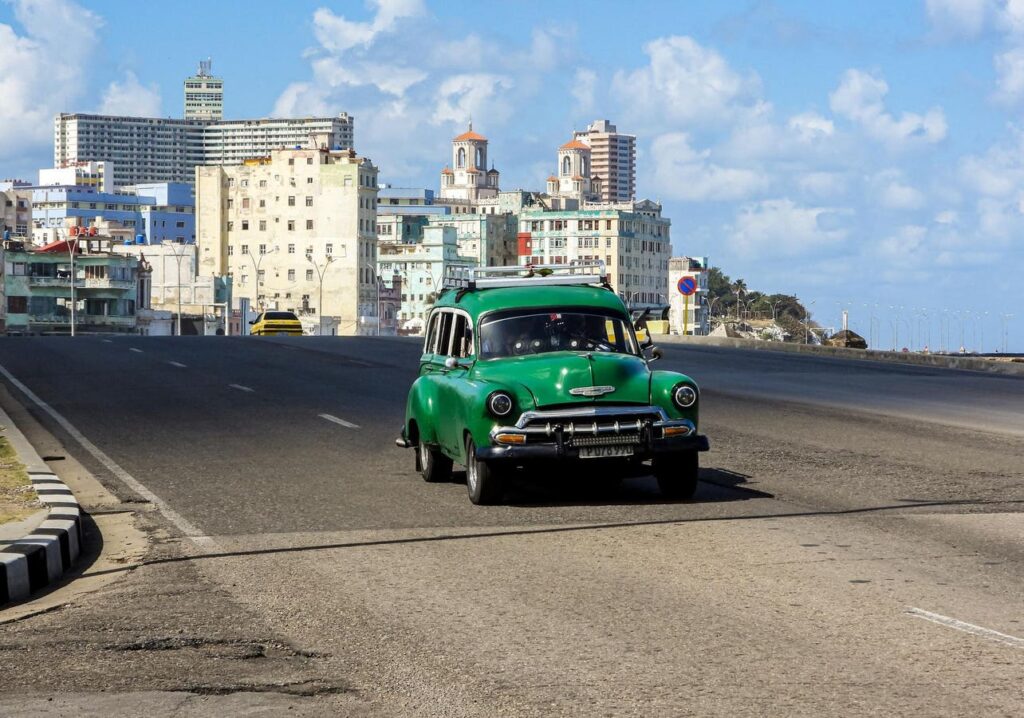
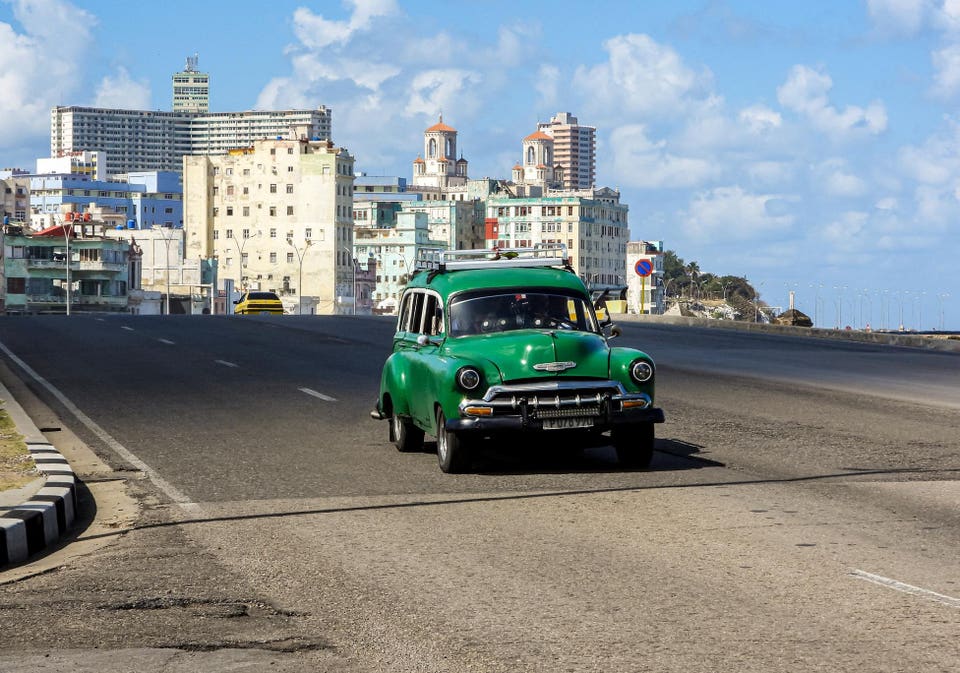
An old American car drives along a quiet avenue in Havana on February 8, 2026. The Cuban government on February 6 announced emergency measures to address a crippling energy crisis worsened by US sanctions, including the adoption of a four-day work week for state-owned companies and fuel sale restrictions. (Photo by ADALBERTO ROQUE / AFP via Getty Images)
AFP via Getty Images
The buses are stalling in Havana. Hospitals in Santiago are rationing electricity. In Camagüey, schools are cutting hours to conserve fuel. What looks like an internal Cuban crisis is increasingly becoming a stress test for the Caribbean and U.S. hemispheric strategy.
An executive order signed by President Donald Trump in late January has tightened an already severe energy squeeze by exerting pressure on countries supplying 60 percent of the oil that Cuba uses.
Former Caribbean heads of state and government have described the move as “economic warfare.”
“The consequences of this horrific fuel blockade are catastrophic and constitute cruel punishment … by the strangulation of Cuba’s vital requirements for energy, food, medication, education and basic livelihood,” the leaders stated in an unprecedented joint appeal. “We call upon the international community to provide Cuba with desperately needed humanitarian assistance… We stand with the people of Cuba. We stand as the Zone of Peace. We stand for a shared Caribbean future.”
This appeal, signed by the following former heads of state: Donald Ramotar (Guyana); Freundel Stuart (Barbados); Edison James (Dominica); Tillman Thomas (Grenada); Bruce Golding and P.J. Patterson (Jamaica); Kenny Anthony (Saint Lucia) and Keith Rowley (Trinidad & Tobago), makes clear that Cuba’s situation is unsustainable.
It also underscores the reality that actions taken against the communist government could have profound strategic and human consequences for the entire Caribbean region.
US Secretary of State Marco Rubio participates in a family photo with Caribbean Community (CARICOM) heads of government in Basseterre, Saint Kitts and Nevis, February 25, 2026. Rubio is meeting with Caribbean leaders seeking a common line on Venezuela and pressure on Cuba. He’s also addressing President Donald Trump’s priorities, including combating illegal immigration, drug trafficking and regional security. (Photo by Jonathan Ernst / POOL / AFP via Getty Images)
POOL/AFP via Getty Images
Washington’s assumption is familiar — economic pressure generates political leverage. But in tightly connected regions, pressure rarely stays contained. If Cuba’s fuel shortages deepen into prolonged paralysis, the consequences will not end at its shoreline. They will move through migration routes, health systems, energy markets and diplomatic alignments across the Caribbean.
As pressure mounts on Cuba, which is not a member of the Caribbean Community, better known as CARICOM, its decades-long relationships with many of the organization’s member states paint a complex and uncertain picture of the road ahead.
That uncertainty looms as regional heads of government gather in St. Kitts and Nevis for their annual meeting. At the forefront of their discussions is the question of how much shock their economies and institutions might have to absorb if Cuba’s energy crisis continues to spiral — a scenario Washington policymakers may not be fully prepared to confront or help manage.
CARICOM and its interconnectedness with Cuba, as seen in their commonality as small states with a broader global reach, makes it hard to view the U.S. foreign towards the island in a vacuum.
With the State Department, now led by former Florida U.S. senator and Cuban-American Marco Rubio, keeping its foreign policy goal of weakening the Cuban government — and potentially forcing long-delayed economic reforms — at front of mind, the central question is whether this new round of sustained economic pressure will increase political leverage and remain contained in a tightly interconnected region.
Rubio has long criticized previous administrations’ efforts to normalize relations with Havana, arguing that engagement failed to produce meaningful political change.
Since returning to office in January 2025, the Trump administration has been laser-focused on “shutting down” America’s southern border and curbing — or halting altogether — immigration pathways that had once provided relief for Cubans fleeing the island.
From 2021 to 2024, more than half-a-million Cubans made their way to the United States, marking one of the largest migration waves in the island’s modern history. That surge was fueled by deepening economic collapse at home and expanded humanitarian parole pathways under President Biden.
In 2025, President Trump moved to close those pathways, revoking parole protections and shifting U.S. policy from managed entry to aggressive restriction and deportation. Roughly 100 Cubans per month are now entering the United States under humanitarian parole, compared with more than 8,000 per month during the Biden administration.
William M. LeoGrande, a Latin American politics expert and associate vice provost at American University, says the policy shift will create a domino effect domestically.
Cuban and Haitian migrants en route to the United States leave the Migrant Care Center after receiving their laissez-passer to cross Honduran territory in Danli, 100 kms east of Tegucigalpa, on March 21, 2025. Cubans were privileged migrants in the United States after the 1959 revolution, but their benefits have been gradually limited in recent years. Now they are treated with no consideration by US President Donald Trump, who has put on hold the benefits of humanitarian programs created by his predecessor, Joe Biden, for migrants from Cuba, Venezuela, Nicaragua, and Haiti. (Photo by Orlando SIERRA / AFP) (Photo by ORLANDO SIERRA/AFP via Getty Images)
AFP via Getty Images
“They canceled the Cuba refugee program, they canceled the family unification program. They’re just not letting people in,” LeoGrande said. “If unrest on the island becomes enormous, the pressure in the Cuban American community will also be enormous.”
But the pressure may not remain confined to the United States. If Cuba’s energy crisis deepens and economic conditions further deteriorate, more residents could feel compelled to flee not only toward the southern United States, but nearby Caribbean nations such as Jamaica, the Turks and Caicos Islands, the Dominican Republic, or Belize.
During the 2021–2023 surge, more than half a million Cubans left the island — a figure larger than the entire population of several CARICOM member states. For small states with limited asylum infrastructure and fragile labor markets, even a modest uptick in arrivals this time around could strain public services and test regional cooperation mechanisms.
The Caribbean lives in a constant duality: benefiting from proximity to the U.S. economy while often bearing the unintended consequences of short-sighted U.S. foreign policy decisions made without a full accounting of their regional impact. That’s why, with economies that are reliant on American export markets, imports, tourism flows, and remittance payments, a sudden influx of Cuban migrants could strain fragile regional systems.
Recent history offers a clear lesson. The Russia-Ukraine War did not remain contained within Ukraine’s borders. Military strikes and economic collapse pushed millions of Ukrainians into Poland, Slovakia, Hungary, and beyond, reshaping labor markets, public services, and political dynamics across Europe. Prolonged destabilization in Cuba could produce similar ripple effects across the Caribbean — a region whose strategic importance is frequently underestimated in global conversations but whose vulnerability to economic shock is far more immediate.
Likely serving as the first transit stop or the first responders to human displacement resulting from America’s policy shift, the Caribbean could bear a weight that could weaken it and its neighbor to the north, the United States.
A picture shows a Cuba embroidery on the white coat of a member of a delegation of Cuban doctors after their arrival at the Martinique-Aime-Cesaire airport in Le Lamentin, near Fort-de-France, on the French Caribbean island of Martinique on June 26, 2020, as part of a medical assistance programme amid the COVID-19 pandemic, caused by the novel coronavirus. – A group of 15 Cuban doctors arrived for a three-month mission in Martinique to aid the island’s health workers strained by the coronavirus pandemic with a variety of medical work. (Photo by Lionel CHAMOISEAU / AFP) (Photo by LIONEL CHAMOISEAU/AFP via Getty Images)
AFP via Getty Images
Beyond migration, the Cuban energy crisis could take a toll on the Caribbean health care system. Since the 1960s, Cuba has been a major exporter of medical personnel. As part of its foreign medical mission, the small island nation has provided care in more than 160 countries and with more than 600,000 Cuban medical professionals serving abroad.
According to recent estimates, Cuba has roughly 24,000 doctors working in more than 50 countries, including those across the Caribbean. Jamaica alone hosts more than 400 Cuban doctors, nurses, biomedical engineers, and technicians embedded within its healthcare system. In Barbados, Dominica, Grenada, St. Kitts and Nevis, St. Lucia, St. Vincent and the Grenadines, and Antigua and Barbuda, Cuban medical teams work alongside local professionals to keep hospitals and clinics operational.
In many smaller island states, Cuban physicians provide specialist services that local systems struggle to staff independently.
But this medical diplomacy does not operate in a vacuum. The current shift in American foreign policy toward Cuba accelerated after the toppling of Nicolás Maduro in Venezuela, which effectively ended Caracas’s role as Havana’s chief energy lifeline. For years, Cuba sustained its overseas medical missions through the now-famous “oil-for-doctors” arrangement, in which Venezuela supplied heavily discounted crude oil in exchange for tens of thousands of Cuban medical and technical personnel.
A man pushes his cart past an empty gas station in Havana on February 19, 2026. Faced with a severe energy crisis exacerbated by US sanctions, private companies in Cuba are attempting to import fuel after the island’s government agreed to end its monopoly on the sector. (Photo by YAMIL LAGE / AFP via Getty Images)
AFP via Getty Images
At its height, Venezuela met more than 60 percent of Cuba’s fuel needs — a subsidy that helped stabilize the island’s energy supply and underwrite the international medical program that generates critical foreign revenue for Havana.
With Venezuelan support sharply reduced and new U.S. sanctions and visa restrictions targeting Cuba’s overseas medical apparatus, the financial and logistical burden of sustaining these deployments is growing. As Cuba’s energy crisis deepens, funding medical missions abroad — including the transportation and support of personnel stationed throughout the Caribbean — becomes increasingly difficult.
The ripple effect would not stop in Havana; it would be felt in the small island states whose healthcare systems have quietly come to depend on Cuban expertise.
For a brief period, Mexico attempted to fill part of the gap, providing limited energy support to help stabilize Cuba’s supply. But that effort quickly ran into geopolitical headwinds, as tariff threats and broader trade pressure from the United States discouraged sustained involvement, narrowing yet another lifeline just as Cuba’s energy crisis deepened.
“Cuba is very popular in CARICOM countries,” said LeoGrande, an international affairs fellow with the Council on Foreign Relations. “Mexico has a good relationship with Cuba and Brazil has one too. Nobody in Latin America really sees Cuba as any kind of threat. They don’t see it as a model either.”
LeoGrande, an international security expert, explained how pressure from the United States could change Caribbean and Latin America’s engagement with Cuba.
“The biggest impact,’ LeoGrande said, “whether it’s the Caribbean or broader Latin America, of U.S. policy toward Cuba is to basically demolish the funding founding principles of the OAS [Organization of American States], which was non-intervention.”
WASHINGTON D.C., UNITED STATES – APRIL 2: The Organization of American States building is seen in Washington DC, United States on April 2, 2023. (Photo by Celal Gunes/Anadolu Agency via Getty Images)
Anadolu Agency
Established in 1948, the Organization of American States is the regional forum intended to promote cooperation, peace and justice among countries in the Western Hemisphere. Its charter makes clear that no state or group of states has the right to intervene, directly or indirectly, in the internal or external affairs of any other state, a principle that extends not only to military action but to political, economic or coercive interference.
As for CARICOM, understanding and asserting sovereignty is more than rhetoric; it’s a lived experience shaped by a bitter colonial and enslaved history and post-independence diplomacy. While the United States remains the region’s largest economic and security partner, leaders and former leaders alike increasingly bristle when Washington’s policies are perceived to overstep what many Caribbean diplomats view as the boundaries of legitimate influence.
Flexing this muscle — even without overt confrontation — can generate quiet resistance and active counterbalancing that ultimately harms long-term cooperation.
“The foundation of the Caribbean Community rests on the right of each sovereign state to promote regional solidarity and advance comprehensive cooperation between all Caribbean states,” the group of former Caribbean leaders said in their joint statement. “The CARICOM tradition of solidarity and the exercise of the right to enter and pursue beneficial programmes within our regional geographic space have proven invaluable and worthy of perpetuation.”
With “dominance” in the Western Hemisphere articulated as a priority in the Trump administration’s National Security Strategy, some Caribbean analysts read this new policy shift toward Cuba as a bad-neighbor approach. They said it could slow or sour partnerships the United States has historically benefited from, particularly on shared challenges.
“It is likely that many Caribbean countries will scowl and comply, but the United States is not making good friends in the region,” LeoGrande said. “There are a lot of issues on which having partners advances the interest of the United States, leading among them is narcotic trafficking.”
Approximately 80 kilos of marijuana sits in a cart at San Ysidro, CA at the US-Mexican border near Tijuana on August 31, 2006. The dope is bagged and tagged, weighed, boxed and stored in a secret secure location. Some is kept as evidence for trial while the rest is burned. (Photo by Ken Cedeno/Corbis via Getty Images)
Corbis via Getty Images
One reason the U.S.–Mexico border has become a major entry route for drugs bound for the United States is the long-term cooperation between Cuba, Jamaica and other CARICOM members in disrupting trafficking through the Caribbean.
“We were able to pretty well close down a lot of the trafficking that went through the Caribbean,” Williams said. “These boats coming out of Venezuela were not headed for the United States — they were actually going to Europe.”
Beyond souring cooperation, advancing a policy that falls outside the norms of partnership could create opportunities for China or Russia to deepen their relations in the region, narrowing the diplomatic space available to the United States at a time when both powers are actively expanding their engagement across Latin America and the Caribbean.
“We will never accept the doctrine that might makes right,” the former heads of state said in their statement. ”Economic warfare waged on differences of ideology and political systems is no less odious in our single universe than military invasion anywhere for territorial aggrandizement.”
Complicating the picture further, the Supreme Court recently narrowed the president’s authority to impose sweeping tariffs under emergency powers, undercutting one of the legal tools used to pressure countries shipping oil to Cuba.
While the ruling does not automatically restore fuel flows or resolve the island’s shortages, it weakens the coercive architecture that helped deter third-party suppliers. It also reinforces a larger point: U.S.-Cuba policy is not only shaped by geopolitics, but by domestic legal constraints that can shift the leverage calculus mid-crisis.
Even so, Cuba’s energy paralysis is rooted in deeper structural vulnerabilities that no court ruling alone can reverse.
Complicating matters further are bipartisan blind spots that have contributed to an uneven and often shifting U.S. foreign policy toward its neighbors to the south. President Trump and Secretary Rubio are doubling down on longstanding Republican patterns in the region — an approach that not only leans heavily on coercive tools, but assumes pressure will remain contained and that displays of strength naturally translate into stronger alliances.
Democrats, however, are not without fault. While the party has become home to many Caribbean-American voters, its regional posture has often been episodic — marked by engagement rhetoric but lacking a durable, long-term strategy around energy security, economic resilience and institutional partnership.
Too often, policy has been short-term and Washington-centered, rather than grounded in the lived realities of the governments and citizens across the negotiating table. The result is a hemisphere that experiences American attention in cycles — pressure one administration, partial engagement the next — but rarely a sustained, bipartisan framework built for stability.
Taken together, this produces American foreign policy that often begins with a clear objective toward partnership but is marked by policy swings, strategic neglect, and regional governments left to navigate uncertainty.
In St. Kitts and Nevis, where heads of government are gathered for the Conference of CARICOM, Cuba remains high on the agenda. Rubio is expected to attend.
Jamaican Prime Minister Andrew Holness 3rd L delivers a speech during the closing ceremony of the 49th Regular Meeting of the Conference of Heads of Government of the Caribbean Community CARICOM in Montego Bay, Jamaica, July 8, 2025. The three-day meeting concluded on July 8 in Montego Bay, a port city in northern Jamaica. (Photo by Li Mengxin/Xinhua via Getty Images)
Xinhua News Agency via Getty Images
The objective of U.S. economic pressure may be political change in Havana. But if the strategy produces prolonged paralysis rather than reform, the Caribbean will live with the consequences. The question for Washington is not whether economic leverage creates pain. It is whether the second- and third-order effects have been fully modeled — and whether the hemisphere is prepared for what comes next.
Opening the meeting, Andrew Holness, Jamaican prime minister and current CARICOM chair, called for “constructive dialogue” between the United States and Cuba “aimed at de-escalation, reform and stability.”
“We believe there is space — perhaps more space now than in years past,” Holness said, “for pragmatic engagement that protects the Cuban people from any further deterioration in their circumstances and instead promotes national and regional prosperity.”