
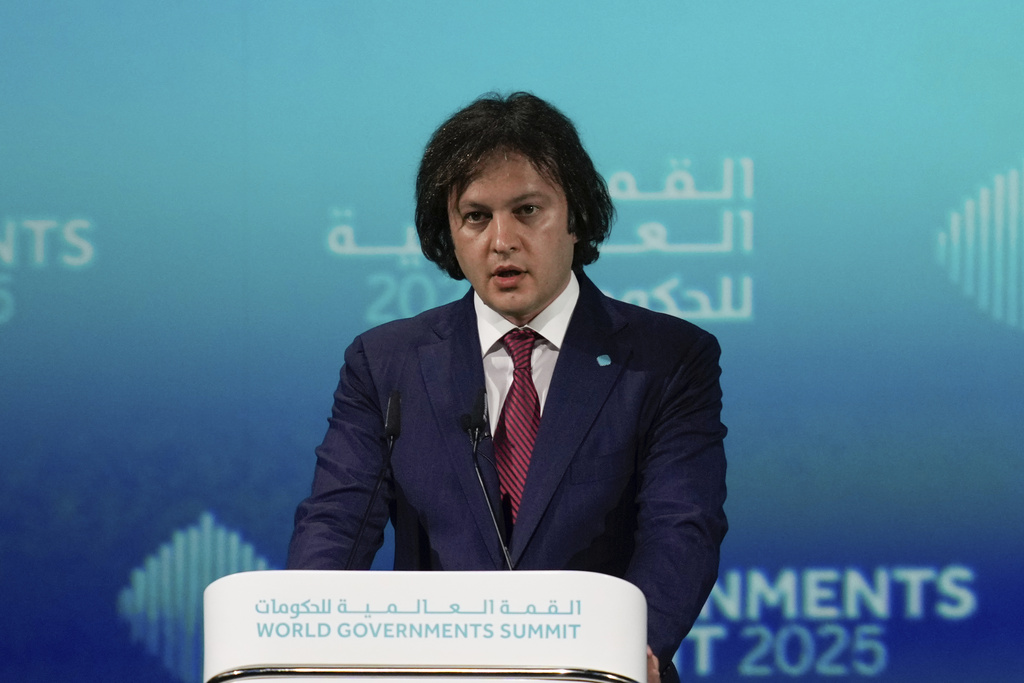
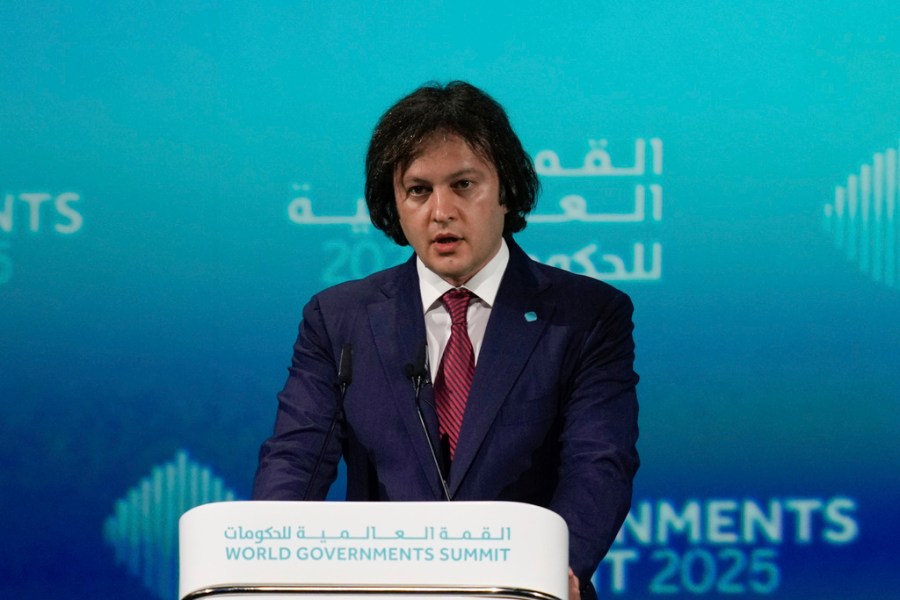
Georgian Prime Minister Irakli Kobakhidze speaks at the World Governments Summit in Dubai, United Arab Emirates, Tuesday, Feb. 11, 2025. (AP Photo/Altaf Qadri)
Tbilisi’s TV Tower lit up in the colors of the Islamic Republic on Feb. 11 to mark the anniversary of the 1979 revolution that brought Iran’s theocratic rulers to power. The streets in Tbilisi tell a different story: Ordinary Georgians have rallied behind the Iranian people in their struggle against the clerical regime.
These Georgians fear their own increasingly authoritarian ruling party, Georgian Dream, is becoming more like Tehran’s dictatorship. But that has not stopped Georgian Dream from pursuing closer ties with Iran, handing Tehran an avenue to circumvent U.S. sanctions.
A new report by the Georgian NGO Civic IDEA provides a clear snapshot of this burgeoning relationship. It finds that 72 companies registered in Georgia imported Iranian oil and petroleum products from 2022 to 2025. These importers include companies linked to Georgian Dream donors, state tenders, and public officials, including a former Georgian Dream member of Parliament.
Iran’s strategic objective is to ensure access to foreign markets despite American sanctions. Iranian officials describe Georgia as a favorable route for exporting Iranian goods to the European Union. In late 2021, Iran, Azerbaijan and Georgia agreed to cultivate a transit corridor linking Iran’s Persian Gulf ports to Georgia’s Black Sea ports of Batumi and Poti. In addition to moving licit goods, this corridor can facilitate sanctions-busting by obscuring the Iranian origin of illicit cargoes.
After Georgian Dream assumed power in 2012, the country’s annual trade with Iran nearly tripled to $322 million by 2024. The vast majority, $285 million, consisted of imports from Iran. Meanwhile, the number of Iranian companies registered in Georgia has exploded, reaching nearly 13,000 as of 2025.
Many of those Iranian firms are tied to a small number of addresses, often indicative of illicit activity. For example, some 700 Iranian companies were registered at one address in Tbilisi, while another 800 were registered in Dunta, a small rural village in western Georgia, roughly 105 miles from the capital. Iranian consultancies openly coach clients to register companies near Georgian ports and rebrand goods as “Made in Georgia.”
In one sanctions-busting scheme revealed by the U.S. Treasury Department in 2014, several Iranian individuals established multiple companies in Georgia and surreptitiously acquired a 70 percent stake in Georgia’s InvestBank. They used that bank for transactions totaling roughly $8 million with Iranian banks that were under U.S. sanctions.
At the time, the U.S. Treasury praised the Georgian government for working “closely” with Washington to counter illicit Iranian activity. But as U.S.-Georgian relations have frayed amid democratic backsliding by Georgian Dream, that cooperation is under greater strain.
Meanwhile, Tbilisi has pursued closer political ties with Iran. In May 2024, Georgian Prime Minister Irakli Kobakhidze attended the funeral of Iran’s former president, Ebrahim Raisi, alongside officials from Hamas, Hezbollah, the Taliban, and Russia. Kobakhidze returned the following July for the inauguration of Iran’s new president, Masoud Pezeshkian.
The next year, Georgian Deputy Prime Minister Aleksandre Khvtisiashvili attended an event at the Iranian embassy commemorating what Tehran described as “martyrs” killed in the 12-Day War between Iran and Israel. According to the embassy, Khvtisiashvili “made entries in the condolence book at the Embassy” and “expressed condolences and solidarity to Iran,” drawing a protest from Israel.
Researchers have also documented Iran-linked media activity targeting minority communities in Georgia with anti-Western messaging and narratives sympathetic to Tehran and Moscow. These influence operations matter because they reduce friction: The more Tehran can shape perceptions and polarize communities, the easier it is to operate commercially and politically.
The United States is investing political capital in the South Caucasus by brokering deals, financing infrastructure, and trying to build transit and energy corridors that bypass Russia and Iran. But Georgia, once America’s closest friend in the region, is undermining that strategy by creating a permissive hub for adversary influence and sanctions evasion.
Washington should make clear that Tbilisi will face consequences. The Treasury Department should aggressively penalize Georgia-based individuals and entities involved in sanctions-evasion, especially where those networks overlap with persons connected to Georgia Dream.
In concert, the U.S. should pair sanctions enforcement with renewed pressure on Tbilisi over its democratic backsliding. These are not separate problems. The environment that enables Georgian Dream to crush watchdogs, intimidate media, and concentrate power is the same environment that makes sanctions evasion easier to operationalize and harder to investigate.
To add teeth to U.S. diplomatic warnings, Washington should expand and strictly enforce targeted sanctions against Georgia Dream officials, propagandists, and financiers involved in corruption, electoral manipulation, and human rights abuses. For starters, Treasury should build on its 2024 designation of Bidzina Ivanishvili, the billionaire who rules Georgia behind the scenes, by tracking and targeting his assets, which he likely has attempted to shield.
The tower lighting was a message. The U.S. needs to send Georgia a strong message back — not just with words, but with action.
Keti Korkiya is a research analyst in the Russia Program at the Foundation for Defense of Democracies.