
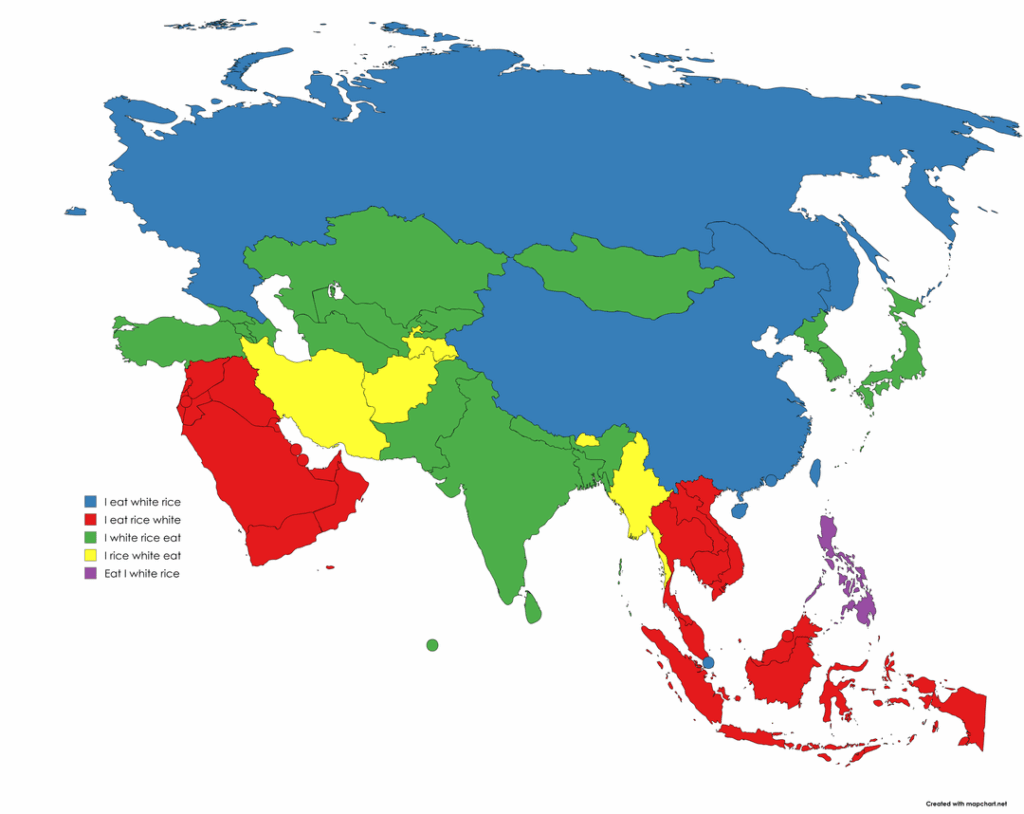
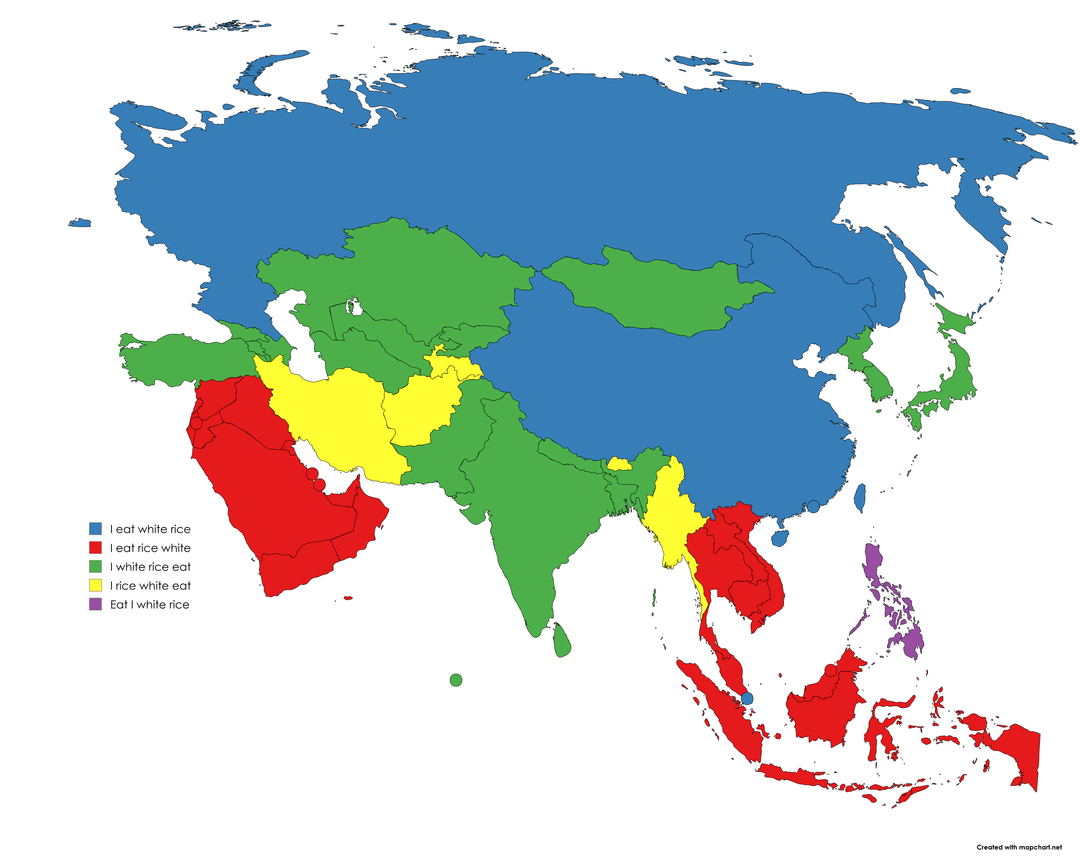
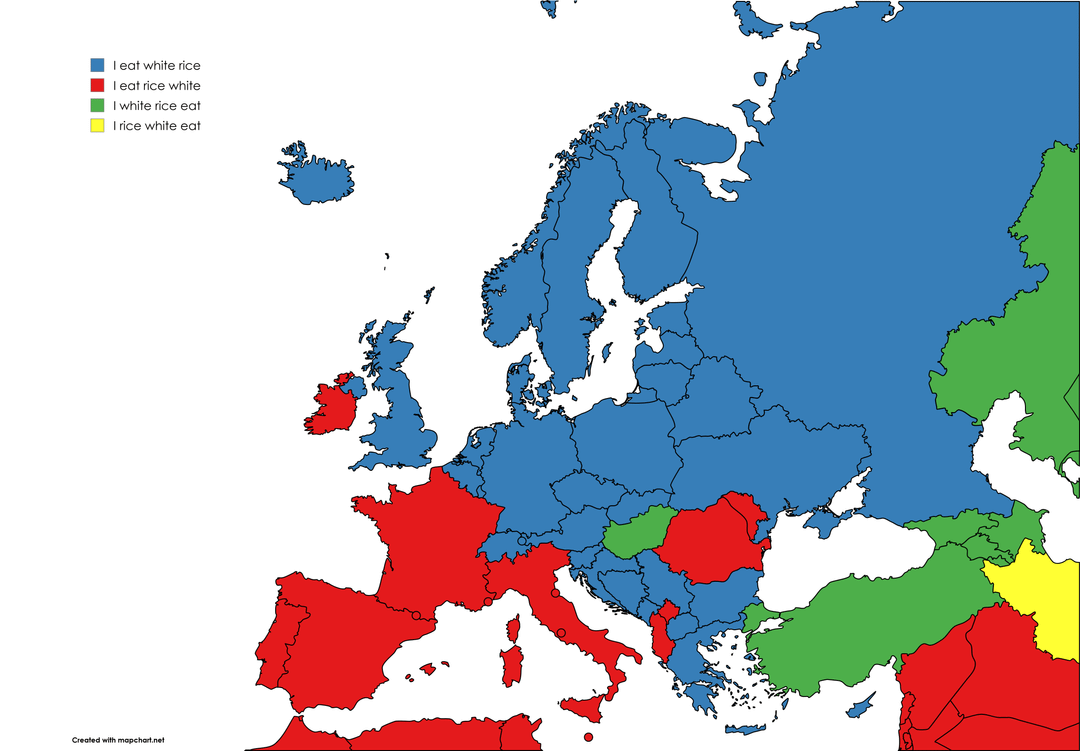
For languages with flexible word order, the default order is shown. Many languages drop the subject (“I”), but this map shows the word order when the subject is included. Particles and other grammatical markers are ignored.
edit: wrong color for Ireland or Irish/Gaelic should be "Eat I rice white"
Posted by Hirdanr
46 Comments
Ireland should be either blue ~~or purple~~, for English or Irish respectively.
Edit: Wait, no, purple is “Eat I white rice” but Irish would be “Eat I rice white”, its own category.
In Punjabi you could technically use all these forms depending on what you what to emphasise, like emphasis on of the rice is white, or emphasis on what you are eting.
Fun fact, in Georgian it doesn’t really matter at what place any of those 4 words will be, every possible 24 ways (4x3x2x1) fit perfectly and have the same meaning, maybe some of them are not grammatically correct but every one out of 24 will sound perfectly fine for a native speaker
Philippines: Kumain Ako ng Puti na Kanin, Kumain – Eat, Ako – I, ng, Puti – White, na, Kanin – Rice.
I suppose for Philippines, it would be *kumain* (eat) *ako* (I) *ng puting* (white) *kanin* (rice)
Less common but also technically valid arrangements would be
* Ako’y kumain ng puting kanin
* Kumain ako ng puting kanin
* Kumain ako ng kanin na puti
* Ako’y kumain ng kanin na puti
* Kumain ako ng kaning puti
* Ako’y kumain ng kaning puti
Can confirm
*I white rice eat*
In Romanian you can, as in many other languages, write that sentence with every word order variation, regardless of the prescriptive topic.
Eu mănânc orez alb.
Eu mănânc alb orez.
Eu alb orez mănânc.
Eu orez alb mănânc.
Mănânc eu alb orez.
Alb orez mănânc eu.
Orez alb eu mănânc.
Mănânc alb orez eu.
In fact, in Romanian it’s vastly common to drop the pronoun altogether and to just say:
Mănânc orez alb.
The sole seemingly static rule would be that the noun and the adjective *alb* and the noun *orez* but even thic can actually be circumvented in a perfectly correct sentence as follows:
Alb mănânc eu orezul.
The effect being an emphasis that falls on the regular whiteness of the rice.
Pretty hard to generalize the Language like that for a Country, some of these have hundreds of Languages.
No Yoda?
Missing “white rice, I eat” in Dagobah
Great idea and maps, OP!
In Arabic we can use all of them and we commonly drop the “I”.
In Azerbaijani we say:
Mən(I) ağ(white) düyü(rice) yeyirəm(eat)
Also we can say without “I”:
Ağ(white) düyü(rice) yeyirəm(eat)
Iirc Russian has no canonical word order, that’s what declension is for
Arabic is just ‘eat white rice’ The I is implied in the verb form used.
It’s an interesting map
White rice, eat I.

In Italy the word order is ‘I eat pasta’
The hell is up with SE Asia? Myanmar/Burma has one form of grammar and it is bordered only by countries with 3 different forms of grammar from its own. How does this happen lol.
Edit: corrected Thailand to Myanmar/Burma
If you club white rice as a single entity, then the order doesn’t matter, all 6(3*2*1) combos of the three words work in Indian languages like Marathi.
Dutch is weird because here it’s indeed classified correctly but often we put the verbs at the end. The most important (or only one) comes after the subject and any other verb at the end of the sentence
some languages work well despite changing order of words who uses complex structures like even more than the tenses or form of verb and are very detailed so this ‘word order’ doesn’t apply to multiple languages the similar concept about name of numbers was cool
If you were to add Madagascar, you’d have another: “Eat rice white I”*. Although, “Eat I rice white”** would work if the main subject is the rice, instead of the “I”.
*Mihinana vary fotsy aho
**Haniko vary fotsy
This is a case where nation-state borders really mess things up. For example, the Tibetan areas in China should be in yellow. Many Chinese-speaking areas in the northwest should be in green, as that’s the daily life word order. But to the east of the country, in Shandong Province, people also do this (and this fact has become a popular meme on Mandarin Internet), so it should be green, too. In the end, the map would look very different from how it is now.
r/notPORTUGALCYKABLYAT
In Irish it’s ‘eat me rice white’
I Spanish you can take the “I” out, as the verb will be already conjugated in first singular person. “Como arroz blanco”
Hmmmmm, in China we don’t say “white rice”, at least in my province and the nearby regions we say “We eat big rice”hahahaa
In Russian the default would be
Я ем белый рис
I eat white rice
Then you can shuffle the words almost as you like.
After noticing that the syntax contains the order “白吃”, “white eat”in some languages…
This is a pejorative term in colloquial Chinese usage. Someone who is a 白吃 is an idiot or fool.
The phrase and even usage of the character “eat” has evolved a bit over time, but most definitely it’s used as an insult, either self-deprecating or directed toward someone else.
In Vietnamese: Tôi ăn cơm trắng
In Basque, we’d say: “Rice white eat I”
In all Germanic languages (except English) the word order would be “eat I white rice” if you add some other sentence element to the beginning of the sentence, for example an adverb of time: “Today eat I white rice”.
Also, in my native language Norwegian, and I believe this also goes for many other Germanic languages, you can say “white rice eat I”. This is not something you’d do in a regular declarative sentence, but if you really wanted to emphasize the white rice part you could structure it this way.
Yellow knows what’s up. SOV gang represent
Green
Hungarian: Feher rizst eszem. White rice eat (I).
Hungarian is pro-drop language the above is a hidden/null subject represented by “em” at the end of oroginal word enni-> eszem
For me as a native English speaker and someone who likes languages, this was very interesting. OP are there any languages that go White rice I eat or White rice eat I?
Blue- normal
Red- mildly odd, but logical (I eat rice white vs I eat rice brown, rice is more important than color) I immediately associated it with Spanish.
Purple- I had no idea languages even put the verb first. So it’s odd but logical (Verb is the most important, followed by subject followed by object. Like writing year, month, day for a date) I think ASL is also a purple language.
Green- Weird, but my brain can understand it, talk like Yoda I do vibes
Yellow- Mind blowing. If someone said I rice white eat to me, I would be so confused.
turkey and hungary
🗿
Well, if you ignore particles and other grammatical markers, anything is possible, isn’t it? 😉
Turkey green, Japan green. Coincidence?
Philippine languages be like: Verb first!
Blue is the official and most used one in Finnish, but all of them are actually used in songs and poems.
Wtf is this map?!?!
Blue and white are the only logical structure of speaking, the other two is yoda
Unless you have applied some other criteria, India should be Green and Blue. Because India has two official languages (Hindi and English) and no single national language.
In many Indian languages, even if you change the order of the words, the meaning remains the same, the sentence still makes sense, and it is grammatically correct. The difference is what gets implied.
I eat white rice.
I eat rice white.
I white rice eat.
I white eat rice.
I rice eat white.
I rice white eat.
Rice eat white I.
Rice eat I white.
Rice I eat white.
Rice I white eat.
Rice white I eat.
Rice white eat I.
White rice eat I.
White rice I eat.
White I eat rice.
White I rice eat.
White eat I rice.
White eat rice I.
Eat rice white I.
Eat rice I white.
Eat I rice white.
Eat I white rice.
Eat white I rice.
Eat white rice I.
All are correct, have same meaning, and are grammatically correct.
No, we eat potatoes.