
Ukraine has just commemorated the four-year anniversary of Russia’s full-scale invasion, which began on Feb. 24, 2022. But as all Ukrainians know, Russia first invaded 12 years ago, on Feb. 27, 2014.
In February 2014, after nearly three months of street protests in freezing temperatures, the Revolution of Dignity turned extremely violent. Then-President Viktor Yanukovych tried to crush the protests on Feb. 18 that year and remove the tent city that had formed on Kyiv’s huge Maidan Nezalezhnosti (Independence Square). The protesters resisted and managed to retain control of more than half the square. Then, on Feb. 20, the infamous massacre occurred, in which Ministry of Interior troops could be seen shooting scores of unarmed protesters walking up a hill to confront them.
Follow our coverage of the war on the @Kyivpost_official.
By the end of the next day Yanukovych was on a helicopter en route to what would become his permanent abode: Russia.
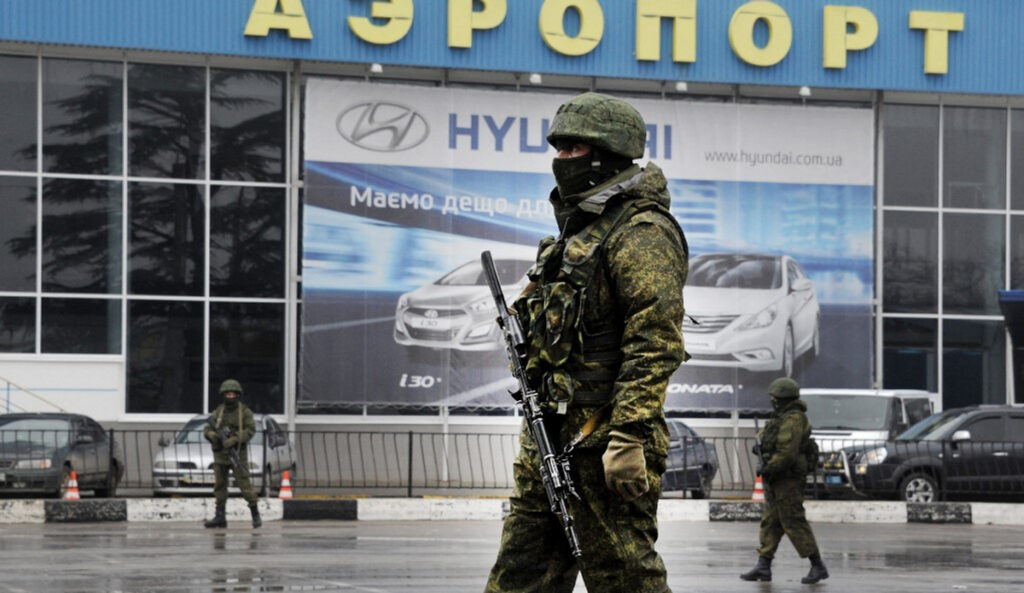
In less than a week, “masked men with guns” as the New York Times described them, seized government buildings in Crimea. Ukrainians knew exactly who those gunmen were. There was CCTV video available to the public almost immediately afterward. Without a doubt these were Russian spetsnaz – elite special operations units.
But the rest of the world hesitated.
In hindsight, we know that the Ukrainians were right. Russian spetsnaz troops had initiated the invasion of Ukraine. What astonished so many Ukrainians and Ukraine-watchers was the willful incredulity and reluctance of so much international media when it came to reporting the obvious.
Other Topics of Interest
Russia Vows Retaliation Against EU for Cuts to Diplomatic Staff
Russian Foreign Ministry spokeswoman Maria Zakharova said the EU decision to limit the size of the Russian mission to 40 people was “discriminatory” and would not go unanswered.
In the pre-dawn hours of Feb. 27, 2014, several entryways to the Crimean Supreme Council building in Simferopol were blasted open by at least a dozen well-equipped soldiers.
Any person with even a cursory understanding of military procedures can examine the video, see how the entryways were breached with explosives, and easily conclude that these were not run-of-the-mill protesters, such as those on the Maidan in Kyiv. These were well-trained soldiers with a plan to carry out.
At minute 5:31 in the video, what appears to be a Ukrainian Crimean policeman is seen walking into an office and gesturing to a woman who is working there. Remain calm, he appears to be saying, as if assuring her everything was under control. Shortly thereafter, two armed and armored men walk in, then another policeman. They wait for the woman to gather her belongings and they all leave together. The CCTV’s time indicator says 4:32 a.m.
Clearly, some people in the building had been expecting the armed soldiers – or at least were not cowering in fear.
On the following day, the “little green men” – soldiers without insignias – appeared throughout Crimea, taking control of airports and military bases.
During a March 4 press conference, Russian President Vladimir Putin denied any involvement, claiming the “green men” were “local self-defense units” who had bought their uniforms at a store.
On March 18, after a bogus referendum held at gunpoint, Russia annexed Crimea.
Then, on April 17, Putin finally admitted publicly for the first time that Russian special forces had been involved in the February and March events in Crimea.
Longstanding plans
With the benefit of hindsight, we now know that Putin had been planning a takeover of Crimea since at least the 2003 Tuzla Island Crisis between Russia and Ukraine, if not earlier.
And even before the Maidan protests culminated, in early February 2014 while Moscow was ostensibly supporting Yanukovych in his negotiations with protesters, the Kremlin had received a strategy paper outlining plans for the annexation of Crimea. It was reportedly part-written by Konstantin Malofeev – a Russian oligarch, political operative and staunch Putin supporter, who had just been to Crimea on a “religious” tour – and published a year later by the Russian newspaper Novaya Gazeta.
The documents deemed Yanukovych and his government to be “totally bankrupt” and assessed that it would not last. The report proposed that Russia should foster separatism in Crimea and other eastern regions, and should begin work on taking control of them. The documents outlined plans for fomenting pro-Russian protests and a propaganda campaign to justify a Russian takeover.
Logistically, there was no need to bring soldiers from Russia into Crimea, as they were already there. Even before 2014, the Russian military was permitted by treaty to station up to 25,000 troops in Crimea, mainly affiliated with the Black Sea Fleet in Sevastopol.
Not satisfied with Crimea, Putin tried to apply a similar approach to the Donbas: spark anti-Maidan protests, then insert Russian operatives into the cities in the guise of native Ukrainians, who would in turn recruit as many locals as they could. Once the violence started, under the pretext of containing a “civil war,” they would send in Russian “peacekeepers” via a humanitarian convoy – as happened in mid-August 2014.
Igor “Strelkov” Girkin, the notorious Russian nationalist and one of the masterminds behind the Crimea and Donbas invasions, has explained the operations in detail on numerous occasions to the press. He fell afoul of Putin’s good graces for his criticism of the 2022 “special military operation” (too half-hearted, he said) and is now languishing in a Russian prison.
Willful blindness
Twelve years later, despite most observers recognizing how Russia initiated the invasion of a sovereign country and obfuscated public opinion with outright lies, many political leaders and analysts are still willing to feed on the chum of disinformation the Kremlin scatters to distract any focused opposition to their stated goal: the destruction of Ukraine as a sovereign state.
Barack Obama, US president at that time, had told Ukraine to stand down. He was concerned that Ukraine did not have the means to fight back – means which he also consistently refused to provide – and was even more concerned about maintaining Russian support for his ongoing nuclear deal with Iran.
The combined use of plausible deniability and not-so-subtle saber-rattling is a tried-and-true tactic that has allowed Russia, which is clearly weaker than NATO forces combined, to incrementally push back on what Moscow claims is “NATO encroachment” and regain “lost territory”
One of the few politicians to see through Moscow’s subterfuge was the late US Senator John McCain.
“The Russians took Crimea, the first time in the post-World War II period where a country has just taken another country in Europe, and continued to move into eastern Ukraine,” he said after the invasion of Crimea and the Donbas. “The freely elected Ukrainian government begged us to provide them with defensive weapons. We refused to do so.”
He characterized the refusal as “shameful” and “cowardly.”
Today, the 12-year anniversary of Russia’s stealth invasion has been eclipsed by the more spectacular invasion that came eight years later. But at what price does one forget the methods used?