
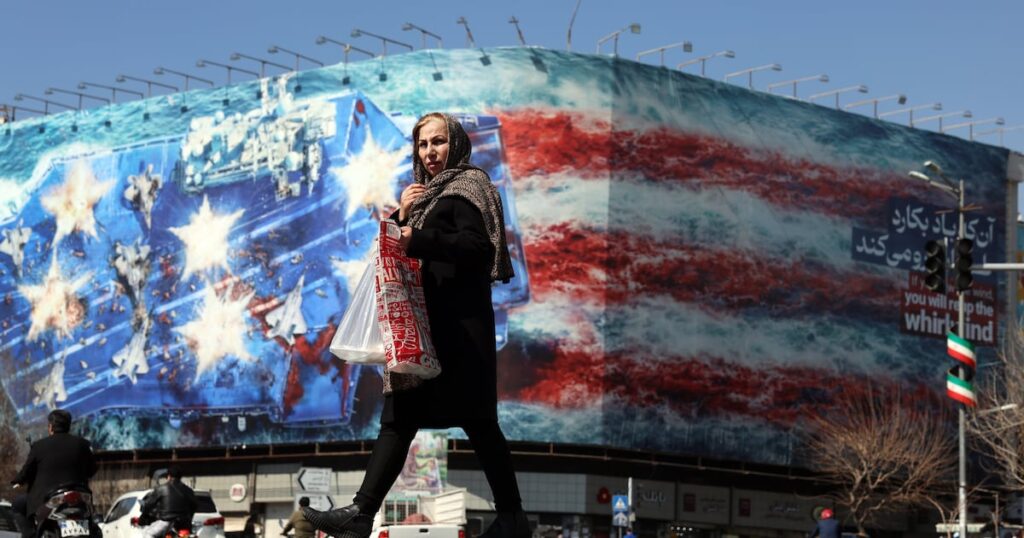
Iranians feel that war is inevitable after their government and the US failed to reach a nuclear agreement in marathon talks yesterday.
“There will be a big war. Many thousands of our people will die,” one resident of Tehran told The National. “I wish I could have left the country, for the safety of my family.”
President Donald Trump said on Friday that he had not made a final decision over whether to use military power against Iran, amid the largest US military build-up in the Middle East since the 2003 invasion of Iraq.
For many in Iran who have been closely watching US warships arrive in the region, conflict seems unavoidable.
I wish I could have left the country, for the safety of my family.
Resident of Tehran
“It seems war is inevitable,” another resident of Tehran told The National over a secure messaging app. Both people requested anonymity for security reasons.
The withdrawal of foreign diplomats from Iran – the UK on Friday confirmed it had pulled staff from its embassy in Tehran – was an indicator that conflict was on its way, the person said.
“I just hope that it doesn’t turn into a long-term war and that it doesn’t lead to bad results for the people of Iran,” he said.
If war happens, phone lines and internet connections would likely be cut by the Iranian authorities, he added. The country witnessed its longest ever communications blackout last month during a brutal crackdown on anti-government protests in which at least 7,000 people were killed, according to human rights observers outside the country. Activists are working to confirm an additional 11,000 reported deaths.
Iranians are already dealing with the trauma of last month’s crackdown, the bloodiest in the country’s modern history, as well as the war with Israel last summer. More than 1,000 people were killed in that 12-day conflict, in which the US also struck key Iranian nuclear sites.
Some Iranians have been sharing social media posts offering practical advice on what to do in the event of conflict.
“What to do when you hear the sound of an explosion or attack warning?” one post shared nearly 2,000 times on Instagram read.
Some Iranians support the idea of foreign military intervention in an attempt to topple the current leadership. The regime, which has ruled since the revolution of 1979, imposes strict curbs on social and political freedoms and has overseen a nosedive in economic conditions, worsening the living standards of millions of normal Iranians.
“I hate this government” one man in the central city of Isfahan told The National as an explanation for supporting the idea of US strikes.
Others are more cautious, either because they support the current government or because they fear the unknown consequences of what would follow US military strikes.
Iran has promised that it would retaliate against any US or Israeli military attack.
“Any reckless action will ignite a widespread blaze in the region, and you will receive a response the likes of which you have never experienced in your history,” senior Iranian army official Abolfazl Shakarchi told the Tasnim news agency on Friday. Iran is not looking for war but would “vigorously defend” its interests, and warned that “all US resources and interests in the region” would be within the Iranian military’s reach, he added.
But in the event of internal breakdown and attempts at regime change precipitated by US strikes, one person told The National that fewer Iranians are willing to fight for the current government because of their horror over the widespread killing of protesters last month.
Although it is impossible to calculate the scale of that change in sentiment, the person said that even people who support the regime have become disenchanted because of the killing.
“Due to the recent mass killings, the Islamic Republic has been delegitimised, and there is little chance, if not no chance, for a national mobilisation [against US military action],” the person said. He added that the regime has a “its own loyal forces and a special social class”, which is assumed to be between five and 10 million people.
Iranian state media on Friday claimed that a trip by Oman’s Foreign Minister Badr Albusaidi to the US was a last-ditch attempt to convince Washington not to strike.
“Albusaidi will try to explain to US officials that the war with Iran will not be limited, regime change in Iran will not be possible, and devastating blows to Iran cannot achieve the goals emphasised by the US President, as they did not in the June attacks,” Irna news agency reported, referring to last year’s war.