
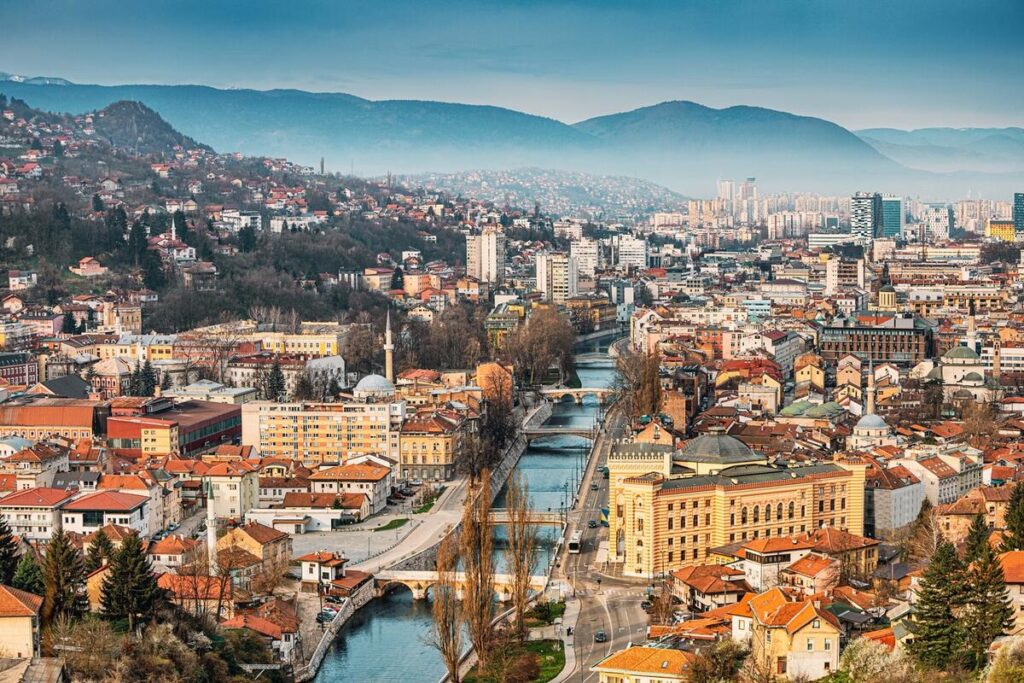
Sarajevo (Illustration), Photo: Shutterstock
The mayor of the Sarajevo Municipality of Stari Grad, Irfan Čengić (SDP BiH), announced today that the monument to the Austro-Hungarian Crown Prince Franz Ferdinand and his wife Sofia will not be re-erected in that municipality. Let us recall that on June 28, 1914, Gavrilo Princip, a member of “Young Bosnia”, assassinated the couple, which was the trigger for the start of World War I.
The monument to Ferdinand and Sophia was removed from the Latin Bridge site and destroyed in 1919, after the end of World War I and the formation of the Kingdom of Serbs, Croats and Slovenes.
The Sarajevo City Council last week accepted the proposal to reinstall the monument, but Čengić said that “a monument to Franz and Sofia Ferdinand will not be erected in the Old Town. Even if there were full consent, the necessary permits are almost impossible to obtain in practice,” Sarajevo media reported.
He added that some councilors in the City Council are proposing initiatives for which they are not competent, and that the council is adopting conclusions beyond its authority.
“I call on the City Council to deal with its responsibilities and make a decision on bridges of importance to the City of Sarajevo as soon as possible, which is an obligation prescribed by the Constitution of the Sarajevo Canton,” Čengić emphasized.
The initiative to erect a monument to Ferdinand and his wife was launched by the Party for Bosnia and Herzegovina (SBiH).
“It is unacceptable that in Sarajevo there are monuments and symbolism dedicated to the assassin Gavrilo Princip, that his footprints have been returned, and at the same time there is no authentic monument for those who were killed and no dignified memorial for their victims,” the SBiH stated.
“We cannot change the past, but we can show who we are today – whether we celebrate the murder or pay tribute to the victims,” they added.
The Sarajevo Museum, which was the initiator and implementer of the comprehensive conceptual project for the revitalization of the monumental culture of the Sarajevo assassination, also spoke out today.
The Museum’s statement emphasizes that the City Council’s claims about the existence of monuments dedicated to the assassin, but the lack of a dignified monument for the victims, are extremely inappropriate and unfounded.
“Such a formulation indirectly labels the Museum of Sarajevo as an institution that ‘promotes crime or criminals’, which is incorrect, offensive and deeply unfair to museum historians, curators and authors of the permanent exhibition of the Museum of Sarajevo 1878–1918,” the statement said.
The museum recalled that the project was implemented in several phases, in accordance with the standards of historical science and the museological profession. It included marking the route taken by Ferdinand’s open car, the sites of both assassinations, the restoration of the assassin’s footprints made according to a cast by artist Vojo Dimitrijević, as well as marking the place where the car carrying Ferdinand and his wife stopped.
“The exhibition does not glorify the assassin or de-victimize the victim, but interprets the entire event in accordance with professional standards and ethical principles of museum activity,” the statement said.
Thanks to the efforts of the Museum, today the site of the Sarajevo assassination is clearly and dignifiedly marked, and is visited daily by numerous tourists from all over the world.
Politicians from Republika Srpska also spoke out about the decision of the Sarajevo City Council, stating that the initiative to return the monument to Ferdinand and his wife “represents a unique example in the world of erecting a monument to an occupier.”

News