
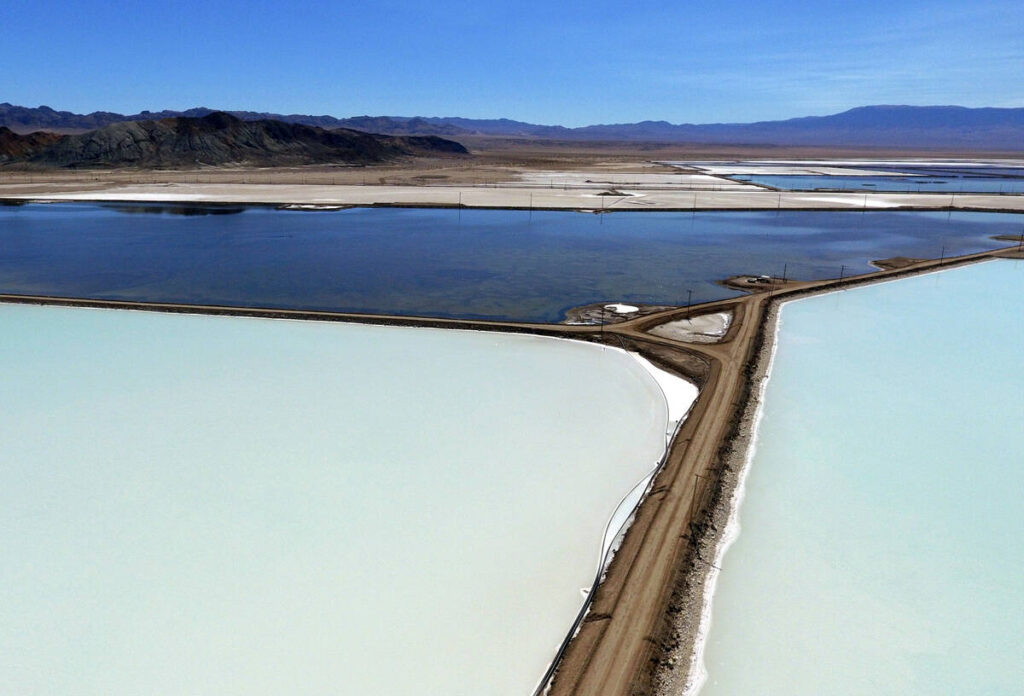
The nation’s only operational lithium mine received the federal government’s approval to expand, allowing it to use new technology to increase its yield up to 100 percent, according to a Friday news release.
Silver Peak, owned and operated by North Carolina-based chemicals company Albemarle, is located in Esmeralda County, Nevada’s most sparsely populated county with a U.S. Census tally of just over 1,000 residents.
Now, the mine’s footprint will be 8,058 total acres, with 1,601 acres of public land. The company can proceed with building two pump stations, two brine ponds and other pipelines, the Bureau of Land Management said.
The agency “retroactively approved existing facilities built without prior authorization,” but did not specify what those were.
“Silver Peak remains an essential asset for America’s domestic lithium supply chain,” Albemarle spokesman Ryan Dean said in a statement. “Federal approval of this project supports Albemarle’s efforts to expand the facility’s production capacity and enhance efficiency.”
The expansion is among the first projects to come to fruition under the FAST-41 program, meant to speed up permitting timelines, the BLM said.
More lithium to come
Across multiple administrations, lithium mining and battery production in Nevada have secured billions in federal and state investments and tax incentives. The Silver Peak operation has mined lithium since 1965.
Lithium, best known for its use in EV batteries, is important for electronics and grid storage. The market has largely been cornered by China and Australia.
Today, two more lithium mines stand to be built after obtaining federal permits. The Thacker Pass lithium mine near the Oregon border is set to begin its first production phase in 2027, and another Esmeralda County mine, called Rhyolite Ridge, cleared permitting hurdles but has been challenged with a lawsuit.
And Albemarle’s operation in Esmeralda County, which is about equidistant between Las Vegas and Reno on the western state border, hasn’t been without controversy and course correction.
A dispute over whether Albemarle could hold onto water rights without using them to their full capacity, brought on by another company called Pure Energy, reached the Nevada Supreme Court last September and is pending a ruling.
Two years ago, the Nevada Department of Environmental Protection found that Albemarle had been sending more particulate matter into the air than the mine’s air pollution permits allowed, though the company quickly fixed the issue.
Contact Alan Halaly at ahalaly@reviewjournal.com. Follow @AlanHalaly on X.