
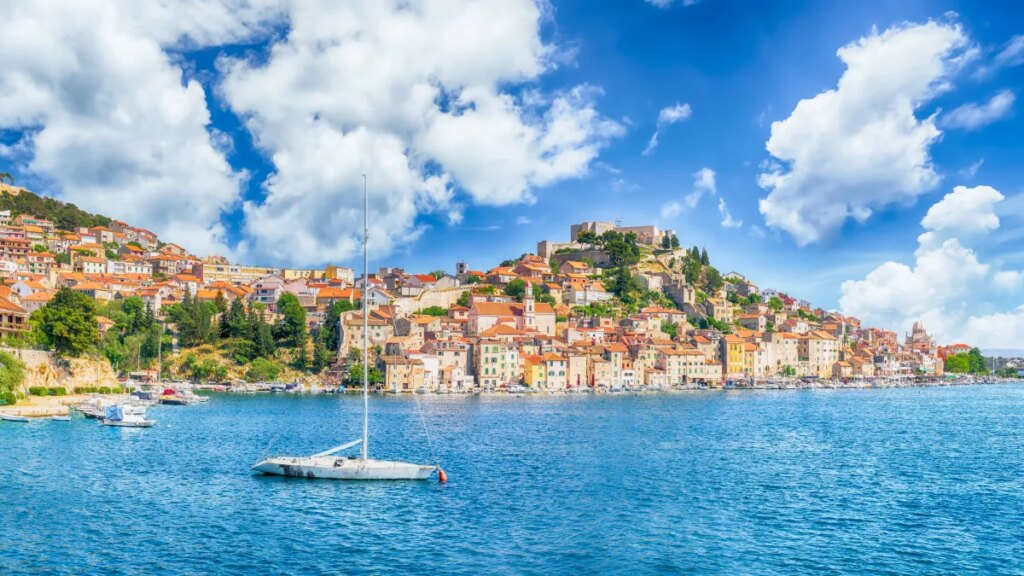
I am admiring the 15th-century Cathedral of St James in Sibenik with my guide, Ante Caric, when a wedding party bursts out. Waving Croatian flags they form a boisterous circle as they begin to sing and dance. After an entertaining hour already spent with Caric, I am not surprised at his comment: “In Croatia we start drinking before the wedding, not after.”
With the singing still echoing in the plaza around us, Caric points out that the Unesco-listed cathedral is a mix of gothic and Renaissance styles. “It’s built of interlocking stone blocks, with no mortar or bricks, like a giant Lego set,” he says. “The 71 sculpted heads you see outside are all of ordinary townspeople — most unusual for the time.”
From the cathedral we walk through the red-tiled old town of Sibenik. It is full of handsome public structures built on the wealth of the region’s salt trade. High above is the imposing St Michael’s Fortress and I spot a museum dedicated to the dalmatian dog breed.
Passing a Benedictine nunnery, Caric questions the nuns’ Christian compassion at having once kept “bunnies” for food, then reels off their recipe for rabbit stewed in red wine. And so we repair to the Gradska Vijecnica restaurant for my first taste of local cuisine. A Croatian friend has already told me: “On the coast it’s like Italian cuisine but not as good. Inland it’s like Austrian cuisine but not as good.” After sampling a classic black risotto I quickly realise that quip is also self-effacing Croatian humour. Here on the Dalmatian coast there’s plenty of fresh seafood and this is a delightful showcase for it. Subtle, with a mild saltiness, the risotto has tiny mussels with a perfect bite. It is beautifully balanced (mains from £19; sibenik.hr).
I’m in Sibenik as part of a week-long cruise aboard the elegant wooden gulet Allure, with classic lines, tall rigging and accommodation for 14 in 7 en-suite cabins. Of the thousand or so islands off Croatia, 89 are scattered here in the Kornati archipelago. The coast and islands are formed of gritty karst, shaped into low hills with a covering of fragrant shrubs and small pine trees.
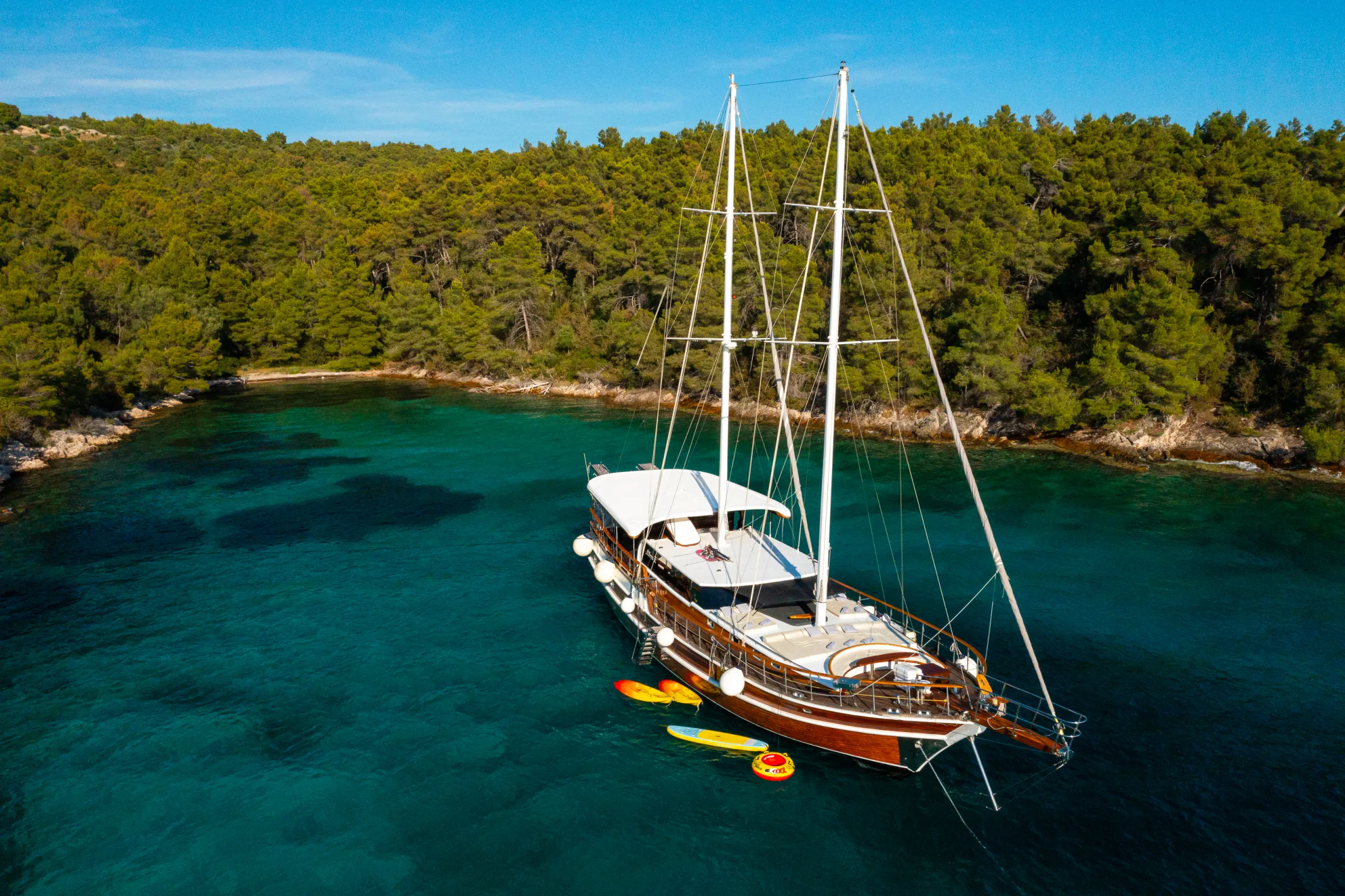 Allure is a classic wooden gulet with seven en suite cabins
These sheltered waters are a paradise for boating. In 1936 King Edward VIII came sailing here with the American divorcee Wallace Simpson. The ensuing scandal led directly to his abdication, but also helped to put Croatia on the tourism map.
What you need to know
- How to get there Fly to Split, from where it’s a scenic one-hour drive north along the Croatian coast to Sibenik
- What to pack There are no shoes allowed aboard the gulet; dress is casual and storage is limited, so pack light and leave the hard suitcase at home
- Insider tip If you love a classic wooden boat, the Betina Museum of Wooden Shipbuilding on Murter Island, part of Allure’s itinerary, has two-century-old boats in the nearby harbour that are as photogenic as they are historic (mbdb.hr)
The most important crew member is the chef
My regular daily life soon seems as distant as that golden interwar era. I’m ensconced every night in the boat’s gleaming teak interior. The four-person crew — the most important member of which is the chef, Tomislav Zaja — look after their passengers with great care. From a tiny galley Zaja produces meals that would flatter a fancy restaurant.
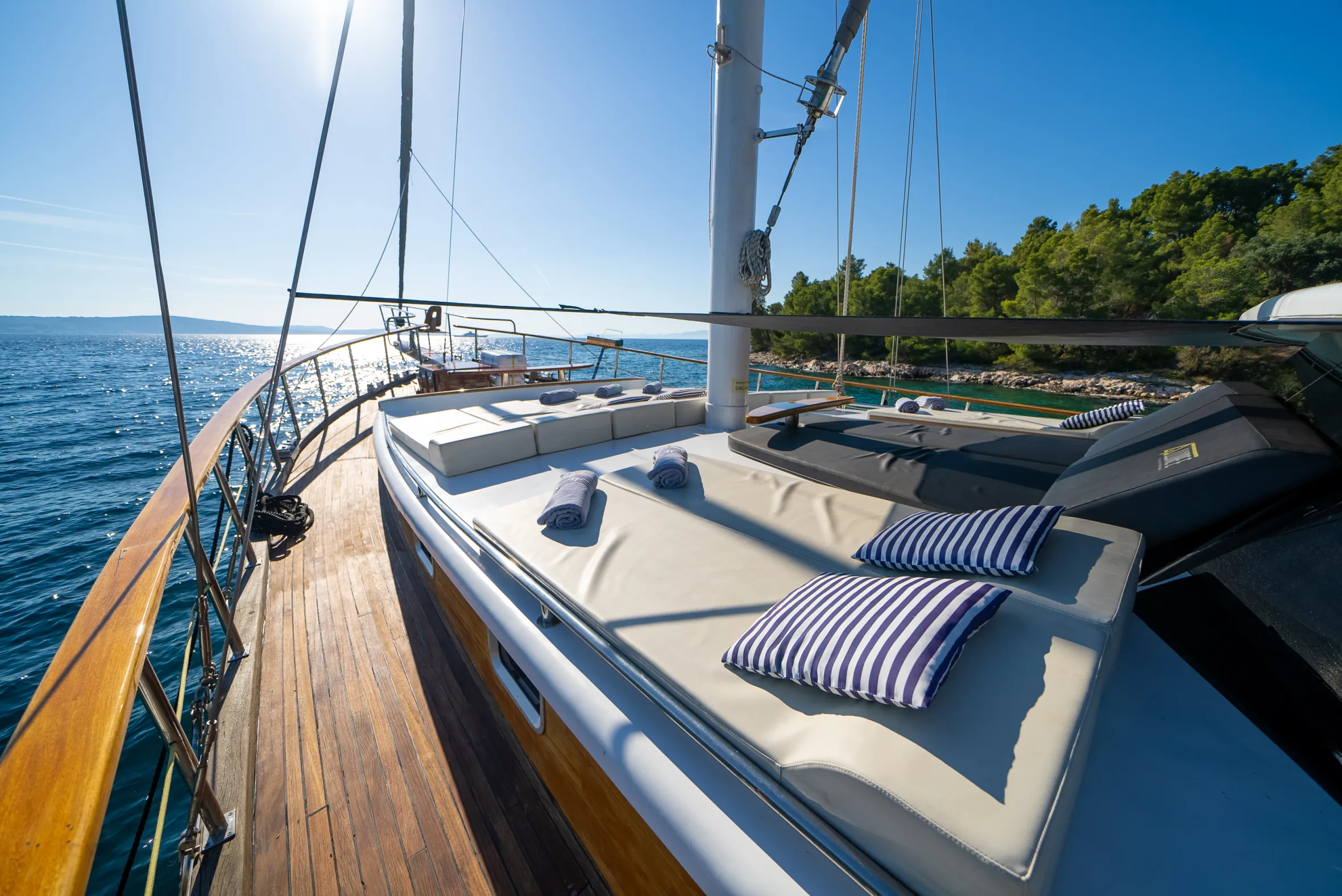 Guests can sunbathe on the boat’s deck
Over the next few days of island-hopping I enjoy plenty of seafood and Dalmatian specialities, such as the tagine-like peka and pasticada (slow-cooked veal) with gnocchi. A constant on the table is the bread — rustic, often sourdough, it’s great for soaking up rich, aromatic sauces.
Zaja is a treasure trove of information about the cuisine. “Salted and smoked fish are used a lot here, especially grouper and octopus,” he says. “For a fish stew you need only this dried fish, plus onions, potatoes, garlic, parsley, olive oil, salt and pepper. Here in the Adriatic we call it gregada.”
Even after a week of good food on land (we venture ashore for some meals) and sea, I don’t expect the delights at Festa, a superb restaurant a short walk from the pretty harbour on the island of Zut. I eat on a spacious terrace where rough stone walls and open-air window spaces suggest nature enclosed but not tamed.
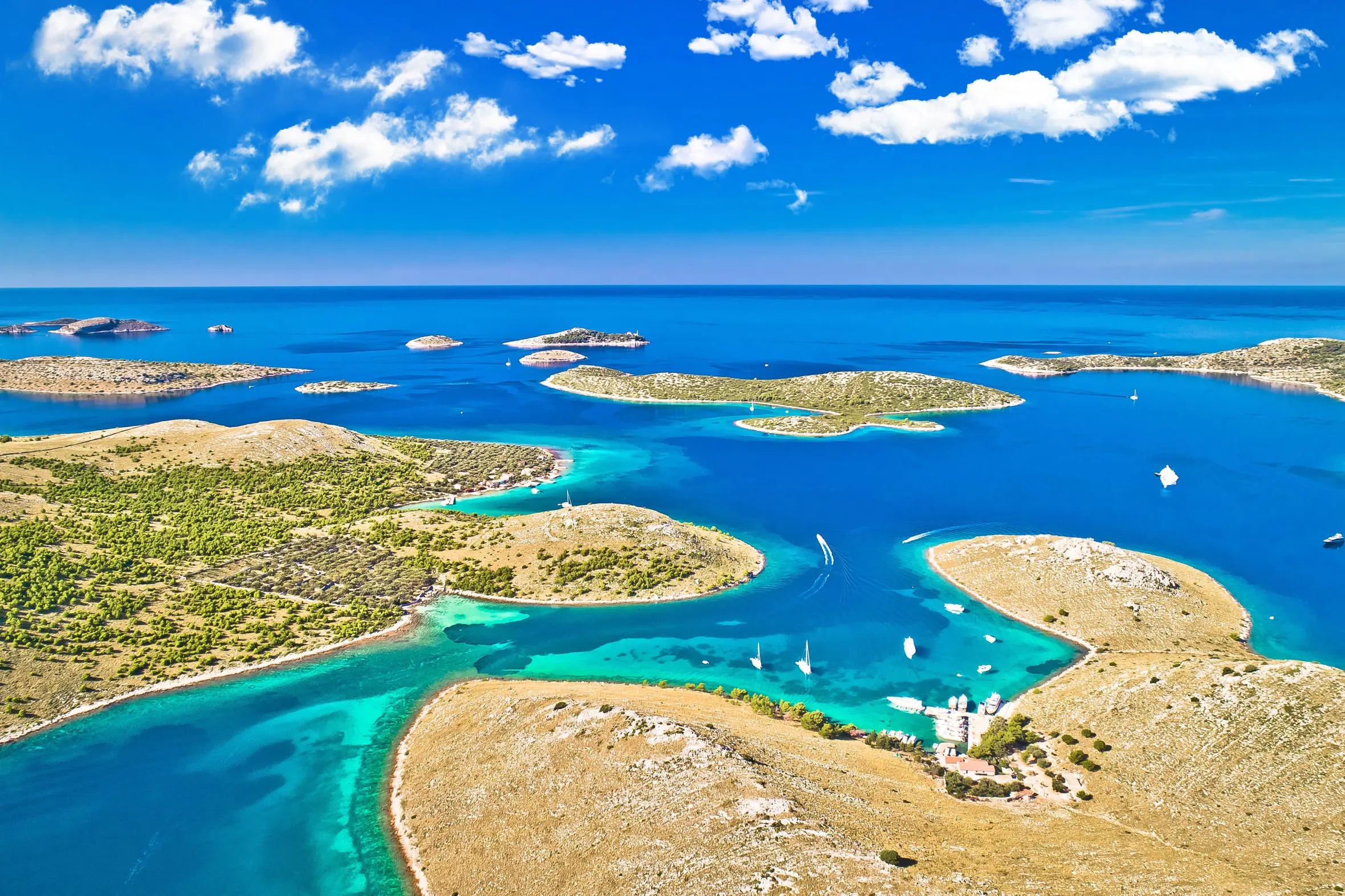 The Kornati archipelago is made up of 89 islands covering 320 sq kmAlamy
That seems to be the philosophy with the food too. I start with a shared medley of octopus and tuna carpaccio, cubes of local cheese, various dips including hummus and some of the best olives I have eaten. After an outstanding cooked seafood platter, there is another black risotto, which is even better than the one I enjoyed in Sibenik. There is some serious, understated magic in the kitchen. Over a dessert of fig mascarpone the owner, Kresimir Mudronja, tells me that his family has been here since the 1880s, when they planted the olive trees that still supply the restaurant (mains from £26; zut.hr).
Talking about Croatian cuisine, Mudronja notes the historical influence of the Venetians, the Habsburgs and the Ottomans. He adds that “Mediterranean cuisine” describes a lot of what I have just eaten but keeps coming back to the ingredients. “On this Dalmatian coast we have the perfect balance of salt in the sea,” he says. “The Adriatic gives our fish and seafood a unique taste. We just have to do as little as possible to spoil that. That is the skill.”
At the Baraka winery I sample some excellent local wines. “Most of the wineries here are very small, maybe 20,000 bottles per year,” says the owner, Philip Baraka. “That explains the difficulty of exporting.” The first wine I taste is a debit, an ancient grape variety grown by the Romans. It’s fresh and citrussy with a pleasant finish. The standout red is babic, a fruity wine with enough acidity to pair with fish and seafood (tastings from £17; baraka.co).
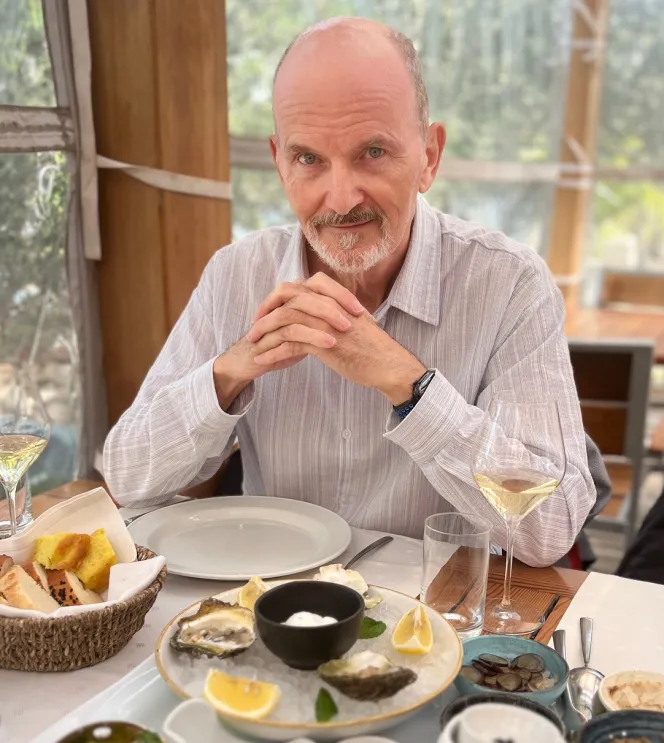 Kieran enjoying some local cuisine on dry land
At the end of my week I head ashore to the pretty town of Primosten. Just outside the gates is a curving beach that seems designed to catch the sun. The light in Dalmatia is bright but never harsh — perhaps that’s why the film director Orson Welles chose to holiday here.
I climb a hill to the sturdy Church of St George. Its graveyard must have one of the best views of any in the world, with pine-clad hills behind and that Adriatic beach out front. From here, among family tombs that hold many generations in their embrace, I can see sunbathers far below and, on the horizon, Allure.
Something I read in the Croatian Coral Centre on the island of Zlarin (£6; hckz.hr) comes to mind: “There are three kinds of men: the living, the dead and those who sail the sea.” With my week-long escape in this coastal paradise behind me, I set my course for home.
Kieran Meeke was a guest of the Croatian Tourist Board (croatia.hr) and Master Charter, which has seven nights’ gulet charter for 14 from £19,298, with full board an additional £732pp, departing from Split or Sibenik in April, May, September or October (mastercharter.com). Fly to Split
More great sailing holidays
By Siobhan Grogan
Sicily for two
Get away for the ultimate romantic break by chartering a yacht for two around the Italian Aeolian Islands. Sailing from Portorosa in Sicily, you’ll take in waterfront villages, volcanoes and black sand beaches, visiting Vulcano, Filicudi, Salina, Stromboli and Lipari. The compact yacht has two enclosed cabins, a shower and a well-stocked galley.
Details Seven nights’ yacht only for two from £1,512 (sunsail.com). Fly to Catania
Antigua with a gang
Sit back and do nothing on this week-long jaunt round Antigua and Barbuda where you’ll spend days snorkelling, swimming and lounging on sandy beaches. The purpose-built, fully-staffed vessel Rhea sleeps 26 in swish en suite cabins with teak details and full-size showers and is fully stocked with stand-up paddleboards and snorkelling equipment.
Details Seven nights’ full board from £2,817pp (venturesailholidays.com). Fly to Antigua
Greece for families
Island-hop on a modern yacht sleeping up to eight around the Ionian islands of Kastos, Atokos, Ithaca and Cephalonia. You’ll have a skipper to handle the sailing but the kids can chip in and learn some techniques if they fancy. Along the way you’ll swim in secluded bays, dine in waterfront tavernas and visit local museums.
Details Six nights’ yacht only from £580pp (responsibletravel.com). Fly to Lefkada