

Published on
February 28, 2026

Image generated with Ai
Outbound tourism has become a key driver of Brazil’s economy, significantly contributing to the country’s GDP through expenditures on international travel, including flights, accommodation, and activities. In 2019, Brazilian travellers spent approximately USD 12 billion abroad, enhancing Brazil’s service exports. While not the largest contributor to GDP, outbound tourism has a ripple effect, benefiting industries such as airlines, travel agencies, and local businesses. With the rise of Brazil’s middle class and increased disposable income, demand for international travel continues to grow, fostering employment and economic development. Despite challenges like economic instability and visa regulations, Brazil’s outbound tourism sector is poised for growth in the post-pandemic era. As airlines expand routes and visa-free travel agreements increase, outbound tourism is set to remain a vital contributor to Brazil’s economic prosperity.
Key Destinations
Brazilian travelers traditionally head to destinations within South America, particularly neighboring countries like Argentina, Paraguay, Uruguay, and Chile. However, North America (especially the United States) and Europe (particularly Portugal, Spain, and Italy) are also highly favored due to cultural, economic, and historical ties. Additionally, Asia and Oceania have seen increasing traffic, with popular destinations being Japan, China, Australia, and New Zealand.
Europe & Eurasia
Europe is a major destination for Brazilian travelers, with many countries offering visa-free access. Nations like Albania, Andorra, Armenia, Austria, and Belgium allow Brazilian citizens to enter without a visa. Other countries, including Germany, France, Italy, Greece, and Spain, also provide visa-free access. However, Russia and Ukraine still require a visa. Countries such as San Marino, Slovenia, and Monaco have similar visa exemptions. Additionally, Switzerland, Sweden, and Finland offer visa-free entry for short stays.
Americas
Brazilian citizens enjoy significant travel freedom within the Americas. Argentina, Colombia, Costa Rica, and Panama offer easy access without a visa. Popular Caribbean destinations like Antigua and Barbuda, Bahamas, and Barbados also extend visa-free entry. However, for certain destinations like Venezuela, a visa is required due to political restrictions. Other destinations, including Trinidad and Tobago, Ecuador, and Paraguay, allow Brazilians to travel visa-free.
Asia & Middle East
Brazil has visa-free access to several prominent Asian countries. China, Hong Kong, Indonesia, and Japan are part of this group, with China’s visa-free access extending until the end of 2026. Other destinations like Israel, Qatar, and Singapore also grant visa-free access. However, some countries such as India require an eVisa. Turkey and the United Arab Emirates are also visa-free for Brazilian citizens for short stays. For Sri Lanka, Jordan, and Bahrain, visas on arrival or eVisas are available.
Africa
In Africa, Angola, Morocco, Senegal, and South Africa offer visa-free access to Brazilian citizens. Other countries like Botswana and Eswatini are also visa-exempt. Cabo Verde and Seychelles permit visa-free entry for short stays, while countries such as Zimbabwe and Ethiopia offer Visa on Arrival and eVisa options for Brazilians.
Advertisement
Advertisement

Image generated with Ai
Oceania
Brazilian travelers have visa-free access to some idyllic island destinations in Oceania, such as Fiji, Micronesia, Niue, and the Cook Islands. These destinations are popular for their tropical allure and provide easy travel access for Brazilian citizens.
Visa On Arrival / eVisa
Countries like Comoros, Sierra Leone, and Egypt offer Visa on Arrival, while Ethiopia and Madagascar provide the option of obtaining a Visa on Arrival or eVisa. Sri Lanka and Jordan also offer visa-on-arrival facilities or eVisa applications for Brazilian citizens, making travel easier for those seeking spontaneous travel options. Additionally, Bahrain and Laos allow travelers to apply for a visa on arrival or through an eVisa process.
Americas / Pacific (Visa On Arrival)
Some remote Pacific islands, including Samoa, Palau, and Tuvalu, offer Visa on Arrival options for Brazilian citizens. This makes travel to these locations more accessible, offering an easy entry process for tourists.
Europe (Visa On Arrival / eTA)
Brazilian travelers visiting Saint Kitts and Nevis, South Korea, United Kingdom, and New Zealand will need to apply for an Electronic Travel Authorization (eTA) before arrival. These requirements streamline the visa process but are a form of pre-entry authorization.
South Asia / Other (eVisa)
For countries such as India, Cuba, Guinea, and Pakistan, Brazilian citizens need to apply for an eVisa before departure. The eVisa system simplifies the visa application process and allows for easier access to countries that might otherwise require consular visits.
Partially Recognised / Disputed Territories
Regions like Kosovo, Northern Cyprus, Palestine, and Transnistria allow Brazilian citizens to enter without a visa. These territories have varying international recognition, but Brazilians can still travel there visa-free.
Dependent & Autonomous Territories
Several territories, such as Faroe Islands, Greenland, and Gibraltar, extend visa-free access to Brazilian passport holders. Overseas territories like French Polynesia, Aruba, and Curaçao also offer visa-free entry, making them popular choices for Brazilian tourists.
Mercosur (Freedom of Movement Agreements)
Thanks to the Mercosur Agreement, Argentina, Bolivia, Chile, Colombia, Ecuador, Paraguay, Peru, and Uruguay allow Brazilians to travel using only their national ID, without the need for a visa or passport.
This overview highlights the travel flexibility of Brazilian citizens, offering numerous destinations with minimal entry requirements across continents. However, travelers should always verify specific entry conditions before planning their trips to avoid disruptions.
Here is a simplified table showing the visa status for each country for Brazilian passport holders:
Here is the information presented in a simplified one-liner table format:
This table summarizes all regions, countries, and visa statuses in one line per entry. Let me know if you need further clarifications!
This table includes only the visa-required countries for Brazilian citizens, listed in alphabetical order. Let me know if you need any other details!
TTW’s Editor-in-Chief, Mr. Anup Kumar Keshan, says: “Brazil’s new visa-free travel access to 168 countries as of early 2026 is a game-changer for global tourism. As nations like Switzerland, France, Germany, Japan, Singapore, Panama, and New Zealand welcome Brazilian tourists with open arms, we can expect an influx of travellers eager to explore new destinations. This move not only boosts tourism but also strengthens Brazil’s position as a key player in the global travel market. With access to iconic landmarks, rich cultural experiences, and natural wonders, Brazilian travellers are now in a prime position to embark on new adventures across the world, all while contributing to the growing cultural exchange and international tourism boom.”
Top Airports in Brazil
Brazil has several prominent airports that serve as major hubs for both domestic and international travel. Here are some of the top airports in Brazil based on passenger traffic, infrastructure, and connectivity:
1. São Paulo/Guarulhos–Governador André Franco Montoro International Airport (GRU)
Located in São Paulo, GRU is the busiest airport in Brazil and one of the busiest in Latin America. It handles the largest number of international and domestic flights and is a major hub for airlines such as LATAM Airlines and Gol Linhas Aéreas. With modern facilities and multiple terminals, GRU offers excellent connectivity to destinations around the world.
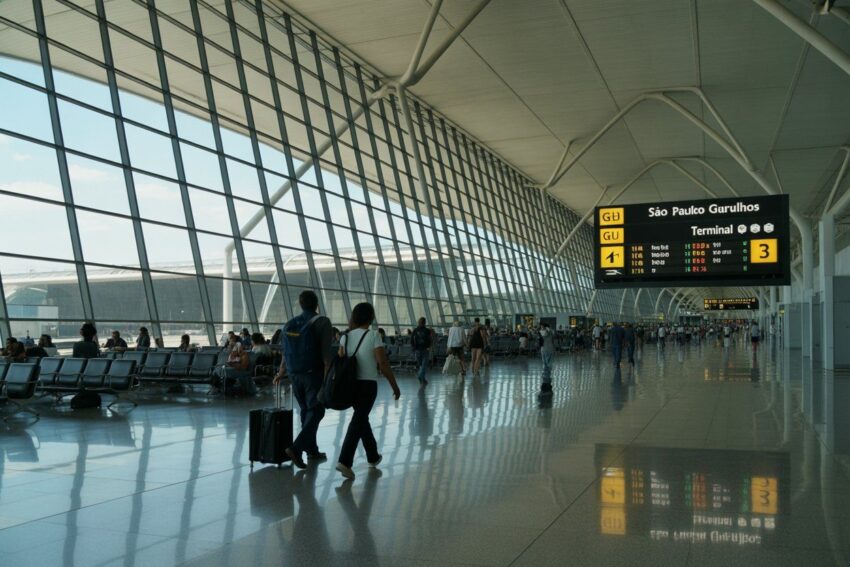
Image generated with Ai
2. Rio de Janeiro/Galeão–Antonio Carlos Jobim International Airport (GIG)
Galeão Airport, located in Rio de Janeiro, is another key international gateway in Brazil. Serving as a hub for Avianca Brazil and Gol Linhas Aéreas, it offers direct flights to a variety of international destinations, especially to Europe and North America. The airport also boasts a range of passenger amenities and is a popular departure point for travelers visiting Rio’s world-famous attractions.
3. Brasília International Airport (BSB)
Located in the capital, Brasília, BSB serves as a vital hub for domestic flights and is particularly important for governmental and business-related travel. It connects many cities within Brazil and offers some international flights. The airport’s central location makes it a strategic stop for flights traveling across the country.
4. São Paulo/Congonhas Airport (CGH)
Congonhas is a key domestic airport located closer to downtown São Paulo. Known for handling the majority of short-haul domestic flights, especially to major cities like Rio de Janeiro, Belo Horizonte, and Brasília, CGH is one of the busiest airports in the country in terms of passenger traffic.
5. Salvador Deputado Luís Eduardo Magalhães International Airport (SSA)
Serving the state of Bahia, Salvador Airport is one of the busiest in Brazil. It connects the country’s northeast region with both domestic and international flights, especially to European destinations. The airport has undergone significant modernization and is known for its efficient services and good connectivity to local tourist destinations.
6. Fortaleza Pinto Martins International Airport (FOR)
As the main airport in Ceará, Fortaleza handles both domestic and international flights, connecting Brazil to Europe, the United States, and neighboring Latin American countries. The airport is an important entry point for tourists visiting Brazil’s northeast region, particularly the popular beaches along the coastline.
7. Recife/Guararapes–Gilberto Freyre International Airport (REC)
Located in Recife, the capital of Pernambuco, REC serves as a key airport for both regional and international travel, especially to destinations in Europe. The airport has seen significant growth in passenger numbers, bolstered by increased tourist arrivals to Brazil’s northeast coast.
8. Curitiba Afonso Pena International Airport (CWB)
Serving Curitiba, the capital of Paraná, CWB is another prominent regional hub. It connects the southern region of Brazil to major domestic destinations and is also expanding its international flight offerings.
9. Florianópolis Hercílio Luz International Airport (FLN)
Florianópolis Airport, serving Santa Catarina, is crucial for tourism, especially during Brazil’s high travel season. It provides access to one of the country’s most popular tourist destinations, known for its beautiful beaches and vibrant culture. The airport connects to several Brazilian cities and international locations.
10. Porto Alegre Salgado Filho International Airport (POA)
Located in Porto Alegre, the airport serves the Rio Grande do Sul region. With an increasing number of domestic flights, POA also provides connections to international destinations, mainly within South America.
Image generated with Ai
Top Airlines in Brazil
Brazil has several prominent airlines that dominate both domestic and international air travel. Below are the top airlines in Brazil, based on fleet size, passenger traffic, and overall industry influence:
1. LATAM Airlines Brasil
- LATAM Airlines Brasil is the largest airline in Brazil and a subsidiary of the LATAM Airlines Group, which is the largest airline group in Latin America. It operates an extensive network of domestic and international flights, connecting major cities in Brazil with destinations around the world, especially to North America, Europe, and other parts of Latin America.
- Fleet: LATAM Brasil operates a diverse fleet of over 150 aircraft, including Airbus A320s, Boeing 787 Dreamliners, and A350s.
2. Gol Linhas Aéreas
- Gol Linhas Aéreas is Brazil’s largest low-cost carrier and is well-known for its extensive domestic network and budget-friendly international flights. Gol has revolutionized air travel in Brazil by making flying more affordable for the middle class. It also operates flights to destinations across South America, North America, and the Caribbean.
- Fleet: Gol operates a fleet of around 130 aircraft, primarily consisting of Boeing 737s.
3. Azul Brazilian Airlines
- Azul Airlines is a significant player in the Brazilian aviation market, particularly known for its service to smaller, regional airports across Brazil. Azul provides both domestic flights and select international routes to destinations in the United States, Europe, and the Caribbean. The airline has earned a reputation for its high-quality customer service.
- Fleet: Azul operates a fleet of over 160 aircraft, including Embraer E195s, Airbus A320s, and Airbus A330s.
4. Avianca Brasil (formerly OceanAir)
- Avianca Brasil, a subsidiary of the Avianca Group, was once a major airline in Brazil, offering domestic flights primarily within Brazil and some international connections. However, the airline suspended operations in 2019 due to financial difficulties. Avianca’s brand is still recognized in the aviation industry, though its operations have been limited in recent years.
- Fleet: At its peak, Avianca Brasil operated a fleet of over 30 aircraft, including Airbus A320s.
5. Passaredo Linhas Aéreas
- Passaredo is a regional airline in Brazil that primarily serves smaller cities and remote destinations in the country. It focuses on providing air travel to cities in São Paulo, Minas Gerais, and the Northeast region of Brazil.
- Fleet: Passaredo operates a smaller fleet, including ATR 72 aircraft and regional Embraer jets.
6. MAP Linhas Aéreas
- MAP Linhas Aéreas is another regional airline in Brazil, known for connecting remote cities in the North and Northeast regions of the country. It operates primarily in partnership with larger airlines like Azul.
- Fleet: MAP operates a fleet of ATR 42 and ATR 72 aircraft.
7. Sideral Linhas Aéreas
- Sideral Linhas Aéreas is a small regional carrier that primarily operates flights to and from Northern Brazil. The airline is focused on providing air travel to underserved areas and has a very limited number of routes.
- Fleet: Sideral operates smaller aircraft, including Embraer 110 and Let L-410.
These airlines represent the core of Brazil’s aviation sector, ranging from full-service international carriers like LATAM to low-cost carriers like Gol and regional players such as Azul. Despite challenges in the aviation industry, these airlines continue to play a critical role in connecting Brazil to the rest of the world.
Brazil’s Visa-Free Policy: A Gateway to Global Connectivity
Brazil’s visa-free policy marks a significant milestone in its global integration, offering Brazilian passport holders the opportunity to travel to 168 countries without the hassle of obtaining a visa. This move not only enhances Brazil’s diplomatic relations but also strengthens its position as a key player in the global tourism and trade markets. The policy has already led to a surge in Brazilian outbound tourism, enabling easier access to popular international destinations across Europe, Asia, Africa, and the Americas.
The inference from this policy shift is clear: Brazil is becoming a more globally connected nation, facilitating smoother travel for its citizens and encouraging cultural exchange, economic ties, and tourism growth. Countries such as Switzerland, France, Japan, and the United States welcoming Brazilian travelers with fewer barriers symbolize the growing trust in Brazil’s passport strength.
In conclusion, Brazil’s strategic decision to extend visa-free access to such a large number of countries is a forward-thinking approach that will boost tourism, enhance global mobility, and contribute to Brazil’s socio-economic development. This move paves the way for increased international collaboration and positions Brazil as a key player in shaping global tourism and trade trends.
