
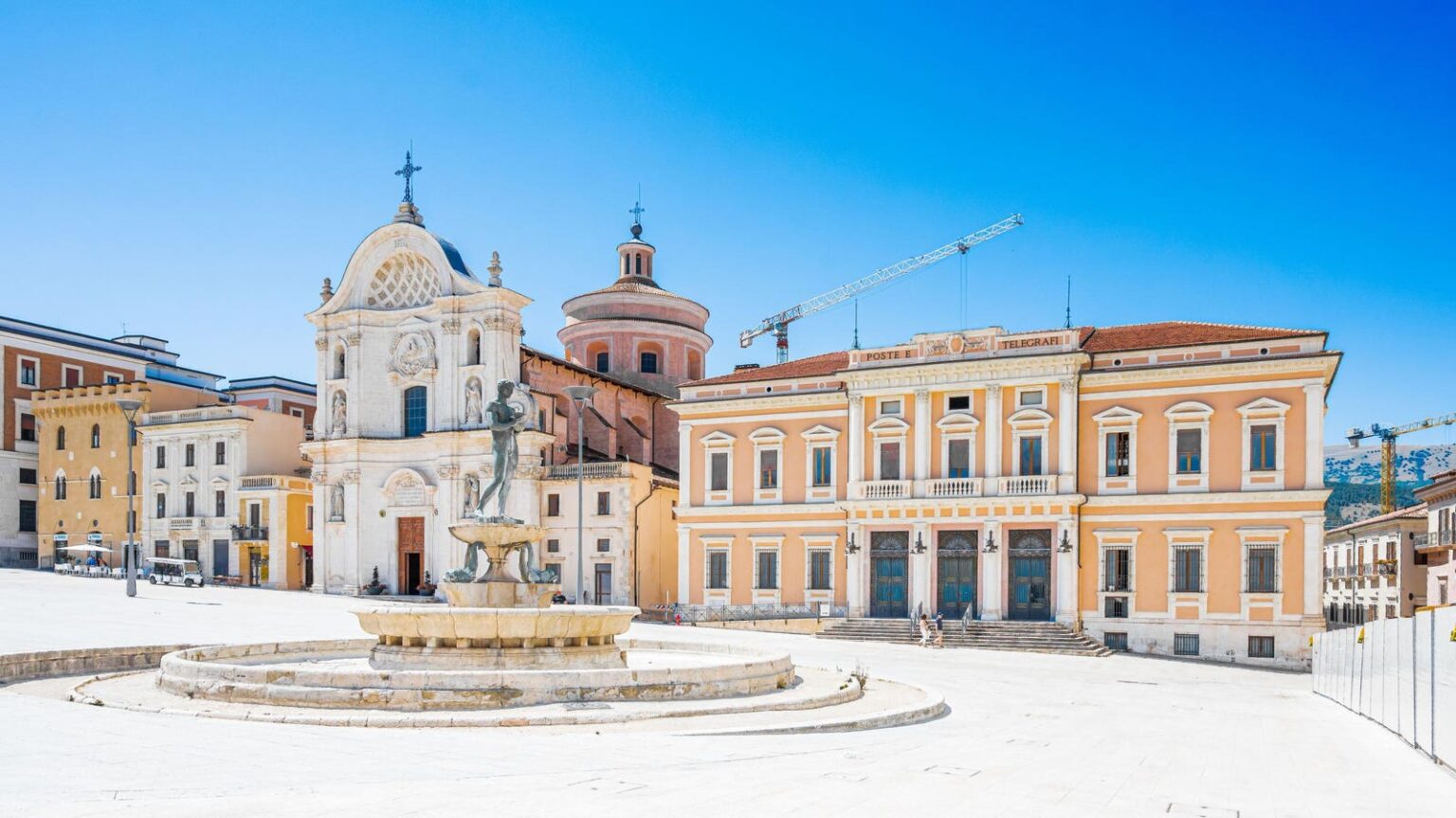
L’Aquila is the capital of Abruzzo, a central region in Italy.
getty
Italy has many art cities, from the obvious (Rome, Florence, Venice) to the lesser-known (e.g., Udine—home to Tiepolo) with most urban centers having a noteworthy cultural heritage even if they aren’t defined as a città d’arte (where tourism centers on the local art and architecture).
L’Aquila, the capital of Abruzzo, a central region in Italy, certainly has a rich artistic past, although many of its landmarks were destroyed in the 2009 earthquake, one of the most devastating natural disasters in Italian history (with hundreds of deaths and 100,000 buildings damaged in the area).
Former President Barack Obama and the late, former Italian Prime Minister Silvio Berlusconi in front of a damaged building destroyed by the April 2009 earthquake. (Photo: JOE KLAMAR/AFP via Getty Images)
AFP via Getty Images
The road back has been long and painstaking, but the city has made art a catalyst for its revival. Not only has L’Aquila worked to restore its historic monuments and museums (parts of the centro storico were off-limits for years due to the collapse risk), it has also used the recovery to fashion a new relationship to contemporary art. With the proposal, “L’Aquila Multiverse City,” submitted as part of the winning competition to become Italy’s Capital of Culture for 2026, the city outlined a fresh way forward with new cultural hubs and broad programming involving contemporary art and performances, as well as heritage programs.
L’Aquila’s calendar for 2026 will see over 300 days of events at 100 locations, among them a new opera by an Oscar-winning composer, the debut of a major Renaissance masterpiece, contemporary shows with top artists, and a glorious revival of the city’s many palazzi and churches.
Here are some of the highlights to make a trip to L’Aquila memorable this year.
Ai Weiwei and Maurizio Cattelan come to town.
Artist Ai Weiwei attends the preview of one of his exhibitions in Bolpgna. (Photo: Roberto Serra – Iguana Press/Getty Images)
Getty Images
Palazzo Ardinghelli, one of L’Aquila’s most noted Baroque buildings, was among the first structures in the city to be restored after the 2009 quake. Home to MAXXI L’Aquila, a satellite of the MAXXI Museum in Rome (National Museum of 21st Century Arts) that was designed by Zaha Hadid Architects, this venue will host two important shows in 2026. The much anticipated Aftershock will look at the five-decade career of the noted multi-media artist, Ai Weiwei. Curated by British art historian Tim Marlow, it will run April 29—September 6, 2026.
In September 2026, the museum will stage another major show dedicated to Fabio Mauri, an avant-garde multi-platform artist, curated by Maurizio Cattelan, famous for his provocative installations, and curator Marta Papini.
Expanded arts festival
The Fontana Vecchia in L’Aquila’s Piazza Duomo in the centro storico.
getty
Cantieri dell’Immaginario, a major performing arts festival, was created after the 2009 earthquake to help revitalize the historic center city. The annual program, spanning contemporary and classical music, theater and dance, typically includes about 40 events, a number which should increase this year because of the Culture Capital celebrations. More international companies are expected to participate and newly refurbished historic sites will be used as open-air stages. Programs are developed by the city’s major performing-arts institutions, like the Teatro Stabile d’Abruzzo and Teatro Zeta.
A rare, Renaissance masterwork
Ecce Homo by Antonello da Messina at Sotheby’s during Old Masters Week.
Anadolu via Getty Images
Ecce Homo by Antonello da Messina, a pivotal Sicilian artist during the early Renaissance who brought Northern European-style painting to Italy, was recently purchased from Sotheby’s by the Italian government. To mark L’Aquila’s designation as Culture Capital, the work, previously in a private collection, will be shown at the city’s National Museum of Abruzzo located in Forte Spagnolo, in 2026. It will then be exhibited in various cities throughout Italy.
New opera
Oscar-winning composer Nicola Piovani. (Photo: Alessandro Levati/Getty Images)
Getty Images
A new opera by Oscar-winning composer (Life Is Beautiful) Nicola Piovani will mark the 2026 celebrations and a milestone anniversary for one of L’Aquila’s oldest and most influential cultural institutions, the Barattelli Society, known for its outstanding music programs. The opera’s title and premiere date to be announced.
Reopening of major cultural centers
The town’s historic Teatro Comunale.
getty
The Teatro Comunale, the city’s historic opera house that also hosts symphonic concerts and ballets, and the Teatro San Filippo, (originally a church), a space used for contemporary theatre, dance and literary productions, will reopen for the 2026 festivities. (The National Museum of Abruzzo in the Castello Cinquecentesco opened to the public in December of last year,)
Private palaces on view
Exterior of an historic palace in L’Aquila.
getty
L’Aquila is home to fine examples of the major architectural styles of the past 1000 years. The “Open Palaces” program will provide access one day a month to some of the city’s most notable private structures, which have been impacted by earthquakes and rebuilt repeatedly over the years. Among the properties to see are the Palazzo Alfieri, with roots in the 1400s, whose reconstruction after the 2009 quake brought new period frescoes to light. Another Renaissance palace is the Palazzo Carli Benedetti; its architect, Silvestro dell’Aquila, is considered the greatest sculptor of the Abruzzo Renaissance. The neo-classical Palazzo Cipolloni Cannella, a large imposing structure in the center of town, and the Baroque Oratory of Sant’Antonio dei Cavalieri de Nardis, known for its lavish frescoes, are other places to visit with the “Open Palaces” program.
Dining
Making pasta alla chitarra.
getty
Vineyards growing grapes for Montepulciano d’Abruzzo wine.
getty
L’Aquila’s culinary heritage was shaped by its mountain locale, although dishes are different from what you’ll come across in Italy’s northen Alpine regions. Thanks to the area’s long sheep-herding traditions, expect to find many lamb dishes and lamb ragus. Wild mountain herbs flavor many soups made with orapi, farro, and high-altitude lentils.
The local pasta to try is spaghetti alla chitarra, a pasta whose square shape is produced on a device with guitar-like wires (hence the name; chitarra means guitar in Itaian) served with a variety of seasonal sauces. Perhaps L’Aquila’s best-known product is saffron, another high-altitude crop, used in everything from pasta sauces to pollo alla cacciatore. Don’t miss the sweet cake, pan dell’orso, made with almonds, honey and covered with chocolate. The local wine to drink is Montepulciano d’Abruzzo, a red made from the Montepulciano grape. (It is different from Tuscany’s Vino Nobile di Montepulciano which comes from the Sangiovese grape.)
Lodging
The Sextantio Albergo Diffuso in the medieval hilltop village of Santo Stefano di Sessanio is about a 45-minute drive from L’Aquila. As an albergo diffuso, or “scattered” hotel, it has 27 rooms and suites with a rustic and authentic country chic decor.
Sports
Alpine skiers at a summit in the Gran Sasso mountain range.
getty
Nestled in the Apennines more than 700 feet above sea level, L’Aquila also has plenty of sports offerings. For skiers, there are several nearby resorts, like Campo Felice (20 kilometers away) and Campo Imperatore (40 kilomenters), the Gran Sasso ski center. In warmer weather nearby mountain areas offer numerous hiking and trekking opportunities.
Getting to L’Aquila
The best bet is by car from Rome, about a two-hour drive away. You can travel by rail, but there are no direct trains and the trip can take twice as long.