
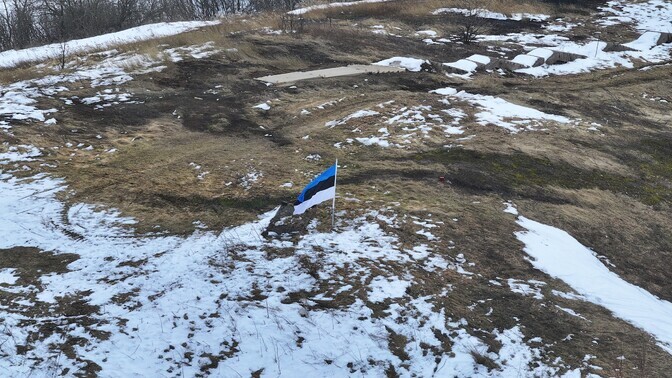
A small hill in northeastern Estonia is the focal point of ongoing discussions on how to illuminate the blue-black-white Estonian flag, which flies on the summit.
Ultimately, the location atop Kukruse mägi, not a natural hill but made up of tailings from the nearby oil shale mines, will likely have to be connected to the national power grid.
Together with the purchase of new floodlights, this will cost approximately €14,000.
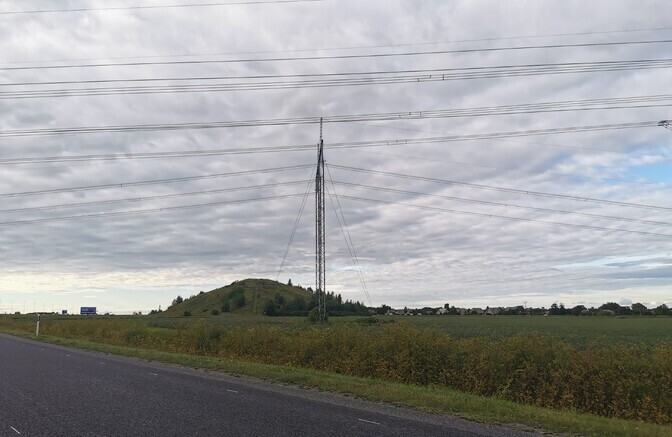 The Kukruse hill is the result of mine tailings being heaped up (photo taken May 2025). Source: Jenny Va / ERR
The small wind-powered and solar-powered solutions in situ have proven inadequate to the task, and the lighting bulbs have burned out too, but at the same time, the law requires that the Estonian flag, when flown at official state, public, and local government locations, must be lit up at all times during the hours of darkness.
This means that instead of being lit up, the flag is raised at dawn and lowered at dusk, but the location can make this challenging during winter too.
An additional factor has been a change in municipality boundaries, which has handed the hill and its flat to Jõhvi municipality and away from the municipality of Toila.
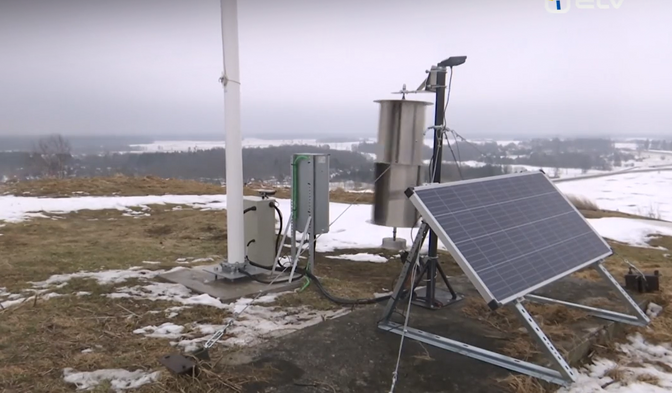 The current electricity generation facilities, a wind generator and a solar panel, have proven to be not up to the task of keeping the Estonian flag lit up. Source: ERR
Other potential solutions have been found but may be temporary and may not be reliable.
Aivo Tamm, economic specialist at the Jõhvi municipal government, said there is a solar panel, a wind generator, and a high-capacity battery all located on the hill. These naturally require the right conditions, though. “And if there are more than four days of calm and gloomy weather, a problem may arise where there is not enough energy,” Tamm noted.
While the lighting issue will be fully resolved once a permanent electricity connection is installed, Jõhvi Mayor Vallo Reimaa conceded this was a case of 20-20 hindsight.
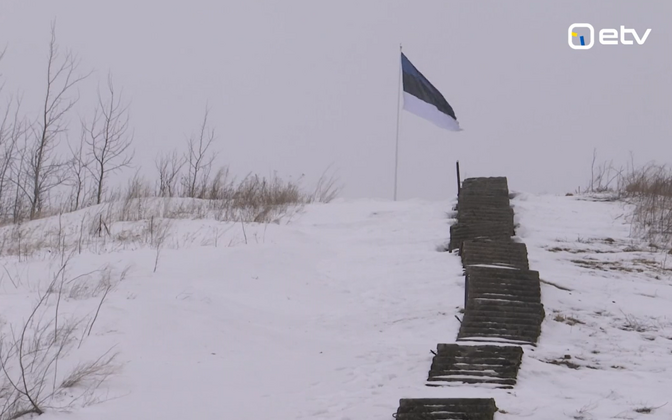 The flagpole can be reached up this flight of steps. Source: ERR
“Political will may be a powerful force that moves the world, but the harsh reality has become clear that it cannot overcome physics. A proper engineer should have been involved to account for a sustainable technical solution,” Reimaa said.
The large Estonian flag was first hoisted to the top of Kukruse hill last October, following lengthy preparations.
—
Source:
‘Aktuaalne kaamera.’ reporter Jüri Nikolajev.