
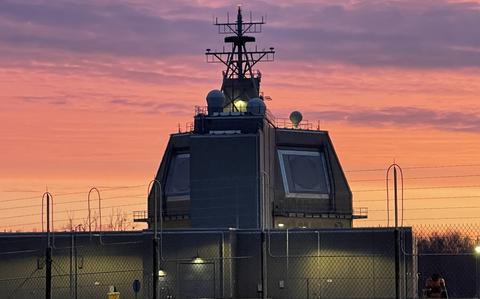

The Aegis Ashore Missile Defense System Poland at Naval Support Facility at Redzikowo, seen in early 2024. NATO’s missile defense system is on alert as Iranian attacks took aim at an unprecedented number of U.S. military sites and other locations across the Middle East. (Ashleigh Whitney/U.S. Navy)
NATO’s missile defense system is on alert as Iranian attacks aimed at an unprecedented number of U.S. military sites and other locations across the Middle East put American and partner air defenses in the region to the test.
It’s still unknown whether Iran will attempt to attack targets farther afield. The U.S. has numerous military bases along the Mediterranean Sea and across Europe that enable the military to project power into the Middle East.
A senior NATO military official said Saturday that the alliance has a round-the-clock vigilance to ensure the security of its 32 member nations.
The approach “covers land, air, sea, cyber and space domains,” the official said. “This constant high state of alertness is designed to deter adversaries, monitor for threats and provide rapid, coordinated responses to any crisis.”
NATO’s missile defense system, which involves a U.S. Aegis Ashore site in Romania and U.S Navy destroyers out of Rota, Spain, was initiated over 15 years ago and developed in phases over time with a ballistic missile threat from Iran in mind.
The NATO system includes a missile defense suite in Poland and an early-warning mountaintop radar in Kurecik, Turkey.
Colin P. Clarke, a terrorism expert at the Soufan Center think tank, said Saturday that the United States and its allies should prepare for a range of countermeasures from Tehran that stretch beyond the Middle East.
“For Iran, this war is existential,” Clarke said in a statement. “And because it is, I would fully expect Tehran to activate any sleeper cell capacity it has in the West to make this painful for the U.S. and Israel. Hezbollah and other assets could very well seek to conduct attacks in Europe, North America, etc.”
While Iran’s retaliatory strikes thus far have covered a wide range of territory in the Middle East, analysts say they could be holding large numbers of missiles in reserve.
“We have not yet seen saturation attacks intended to overwhelm layered air defenses,” said Alex Plitsas, an expert on Iran at the Atlantic Council think tank. “It is unclear if that is due to U.S. and Israeli strikes on missile stocks, Iran holding missiles in reserve, Iran testing defenses, or a combination thereof.”
Besides Bahrain, Iran’s strikes also have been directed mostly at U.S. military targets in places such as Iraq, Kuwait, Qatar and the United Arab Emirates.
“Iran’s response thus far has been measured and rational,” Plitsas said.