
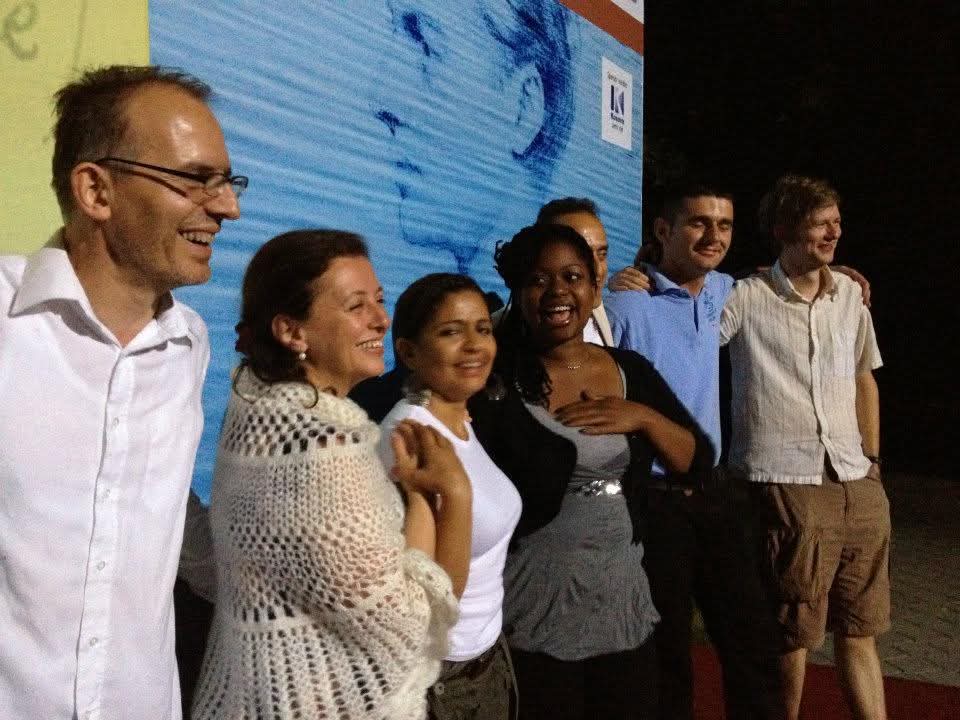
A group of former journalists from Kosovo explain how they organized a literature festival to bring people back to a small village. From Balkan Insight.
By the time NATO bombs began falling on Yugoslavia in March 1999, Faik Luta, his brother Ragip Luta, and Ragip’s wife Valbona were already far from their homes in Kosovo. Based in London, Faik and Ragip were working for the BBC World Service’s Albanian-language radio channel, reporting on a war that was consuming their families and reshaping their country from a distance.
“We were telling the world what was happening in Kosovo, but we didn’t know where our own sisters and broader family were,” Ragip recalled. “That was the hardest part – being journalists and refugees at the same time.”
From studios in Bush House in central London, the BBC World Service’s former headquarters, they broadcasted daily updates while trying to track the fate of relatives scattered across Albania and North Macedonia.
“You sit in front of a microphone and speak calmly,” Valbona said, “but inside you are thinking: what if this is the last time I hear from them?”
More than a decade later, their lives had settled into a different rhythm in Britain. Yet Kosovo remained part of everything they did.
“You never really leave,” Faik said. “You build another life, but your country stays with you.”
Then came an unexpected idea.
Instead of returning only as visitors or retired journalists, the three decided to return with culture. In a village that few outsiders could even find on a map, on the shores of the Batlava Lake, northeast of the capital Pristina, they imagined a gathering of poets, musicians, and writers from Kosovo and the world. And the three witnessed that it takes a village to raise a baby – or a festival in their case.
“We thought: if war scattered us across Europe, maybe literature can bring people back,” Valbona said.
What began as a personal act of return soon became something larger: the Festival of Literature Orllan, turning a quiet rural village into an international meeting point for artists from London, Pristina, Sarajevo, and beyond.
“It sounds impossible now,” Ragip said. “But we really believed a village could become a stage for the world.”
Reporting a War from Far Away
Brothers Faik and Ragip Luta, born in 1961 and 1964, were already journalists before leaving Kosovo. Faik had worked for Rilindja, the leading Albanian-language daily newspaper in Kosovo, while Ragip and Valbona had studied languages and literature. Valbona began her career in the 1980s with a student newspaper in Pristina.
In 1993, when the BBC World Service relaunched its Albanian Service, the two brothers applied. Faik was already in London, improving his English, while Ragip applied from Pristina. When Faik and Ragip were accepted, the move felt both inevitable and frightening. Later on, Valbona found a job as a London correspondent with the Albanian section of Radio France International.
“The situation in Kosovo was getting worse and worse,” Ragip recalled. “But even if it had been peaceful, we would not have refused the chance to work for the BBC.”
By 1999, when war broke out, Faik and Ragip were broadcasting daily from Bush House in London. Their reports relied on a fragile network of stringers and correspondents still inside Kosovo.
 Faik Luta (left) in the BBC World Service radio studio at Bush House. Photo courtesy of Faik Luta.
“Almost no foreign journalists were there at the time,” Ragip said. “Even local journalists were disappearing. We were trying to piece together what was happening from phone calls and short reports.”
They also became informal sources of information for other BBC departments and foreign-language services, helping to explain the political and humanitarian catastrophe unfolding in Kosovo.
But while trying to inform the world about what was happening back home, they feared silently for their loved ones.
Their families were scattered across the region. One sister fled to Albania, another to North Macedonia. For days, they had no information about relatives living near Pristina airport, which was under the control of Yugoslav troops before the NATO bombing started.
“It was traumatic,” Valbona said. “You are telling the world what is happening, but you don’t know where your own people are.”
As BBC journalists, they were bound by rules of impartiality. Yet the war forced them into moral and personal dilemmas.
In 1999, when a number of British writers associated with the English PEN club published a letter in The Times criticizing NATO’s intervention, Ragip felt compelled to respond with a letter defending the need for action to stop atrocities in Kosovo.
It was published. Soon after, he began receiving death threats.
“They were believed to come from a Serbian extremist group called the White Wolves,” Ragip said. The UK Police offered protection. Years later, the case was reopened after new links emerged between the threats and organized extremist networks.
“It was a moment when journalism and personal life collided completely,” he said.
Living in London shaped their experience of exile. Unlike Albanians in smaller towns or rural areas, they found the city largely tolerant and cosmopolitan.
“I was never insulted because of where I came from,” Faik said. “When people asked, I said I was from Kosovo. That made a difference.”
Still, stereotypes followed Albanians from Albania, especially as organized crime stories began dominating tabloids in the 2000s and 2010s.
Working later as court interpreters, Faik and Ragip saw the scale of the problem firsthand. “In some courts, two or three rooms out of seven would have Albanians on trial,” Faik said.
The stigma was difficult to escape, even for those with long professional careers in British media.
Valbona described isolation as another struggle. “I didn’t speak English at first. I felt very alone,” she said. “You never fully feel at home again.”
Putting Orllan on the Map
The first return after the war left a deep emotional mark.
Faik remembers arriving in Kosovo after midnight and being greeted politely by a police officer. “For the first time in my life, a policeman said: ‘Good evening’ to me,” he said. “I thought: This must be freedom.”
The idea of a literature festival emerged years later, after the BBC closed its Albanian Service in 2011.
Valbona had become involved with Exiled Writers Ink, a London-based organization supporting writers in exile. During the war, she had helped to organize a solidarity event called Sharing the Pain for Kosovo.
“Why don’t we do something similar in Kosovo?” she suggested.
Faik and Ragip agreed. They had experience organizing BBC cultural events and roadshows. They also had a location – Orllan, Faik’s birthplace, a village overlooking Batlava Lake.
“It was a perfect setting,” Faik said. “Beautiful, but forgotten.”
They envisioned a festival combining poetry, literature, and music, inspired by the many village literary festivals they had seen across England.
Between 2011 and 2016, they organized six editions.
They invited leading Albanian poets from Kosovo, Albania, and North Macedonia, alongside international writers from Syria, Japan, Bosnia, the U.S., and Britain. One edition was dedicated to Beat poetry, featuring legendary British poet Michael Horovitz, who had once shared a stage with Allen Ginsberg at the Royal Albert Hall in London in 1965.
 Kosovar poet and writer Lulzim Haziri reading from his book at the 2016 FLO festival. Photo courtesy of the Luta family.
They established a literary prize named after beloved Kosovar writer Ramiz Kelmendi, awarding it to Bosnian writer Faruk Sehic at one of the editions, among others.
Music was equally central. They hosted top Kosovar bands and British acts, such as Public Service Broadcasting, who later performed at Glastonbury.
A local villager even helped set up live streaming when national TV stations said there was no internet connection strong enough to broadcast.
“People brought us a piano from Pristina for one concert,” Valbona recalled. “They helped without expecting anything in return.”
Despite only modest funding from Kosovo’s Ministry of Culture, the EU office in Pristina, and several embassies, the festival gained international attention.
The prestigious U.S. magazine World Literature Today published two features about it, one presenting the festival as a symbol of Kosovo’s emerging literary scene.
For the organizers, this recognition was proof that a small village could speak to the world.
“We wanted to make Orllan visible,” Ragip said. “And to show that Kosovo was more than war and politics.”
But financial strains eventually forced them to pause.
“We were terrible with money,” Valbona admitted. “We paid for flights, food, and accommodation. In the end, we added our own money.”
Organizing the festival from London while working full-time became exhausting.
Yet the idea has never fully disappeared.
With Faik now planning retirement and spending summers in Orllan, they are now considering new formats, such as podcasts, online literary events, and even a “senior literary festival,” as Faik jokingly calls it.
“Technology makes it easier now,” Valbona said. “We don’t have to be in the same place all the time.”
More than two decades after leaving Kosovo, the Luta family still lives between countries, identities, and languages.
They remain part of the diaspora, but not detached from home. Their festival was not only about literature. It was about repairing connections broken by war.
“When we started, Orllan wasn’t on the map,” Valbona said. “Now Batlava is a destination.”
As Ragip reflected: “We thought the war might be the end of Kosovo. Instead, years later, we found ourselves bringing writers from all over the world to a village where Faik was born. That is something I will always be proud of.”
Azem Kurtic is a reporter for Balkan Insight, where this article was originally published. He is a multimedia journalist and producer with 10 years of experience working for local, national, and international media. Republished with permission.