
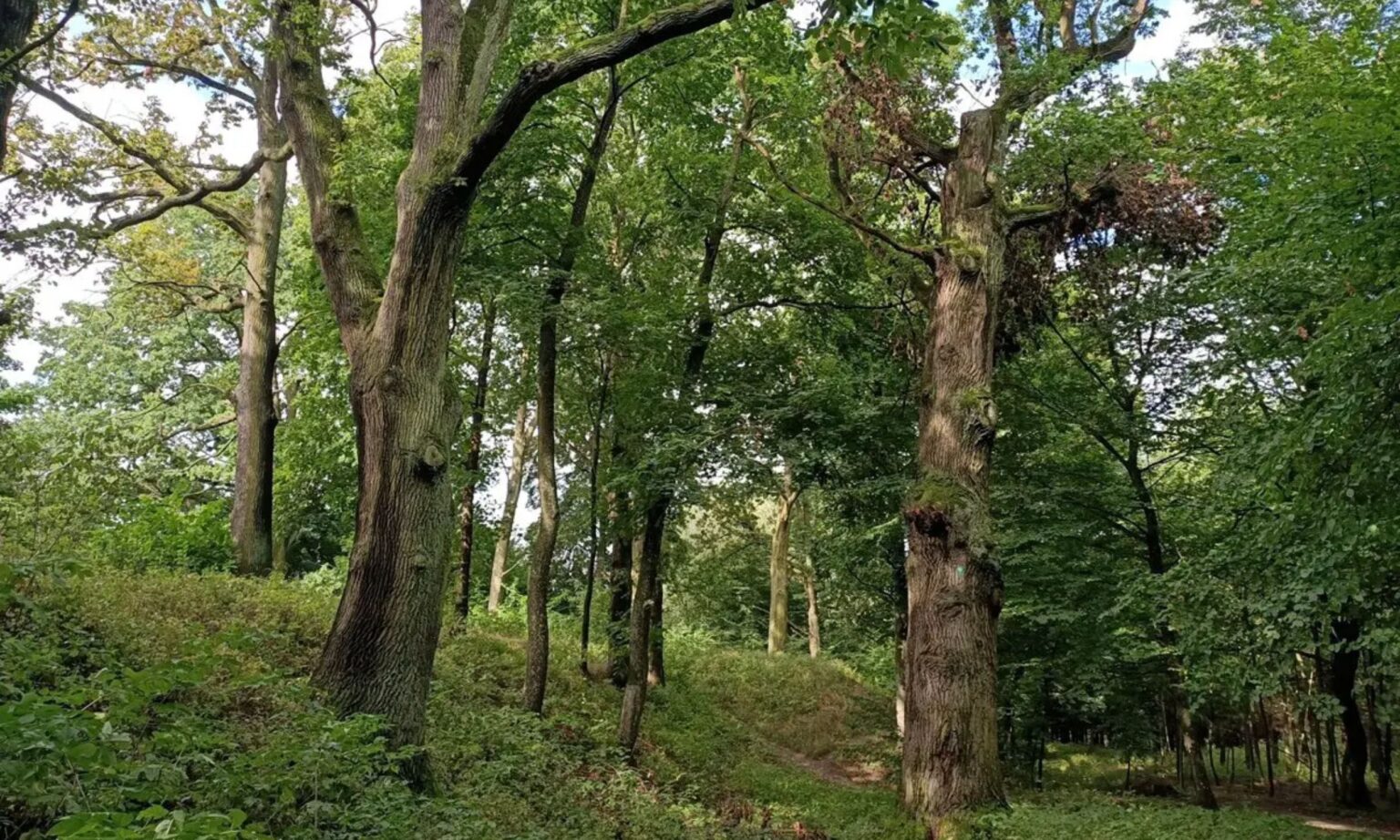
A low earthen rise in eastern Poland has been confirmed as the remains of a fortress built with projecting corner defenses designed for gunpowder warfare.
That reclassification redraws the defensive map of the Bug River frontier, where shifting power and repeated invasions once shaped local survival.
Rediscovering a lost fort

Inside a manor park in Chełm County near Poland’s border with Ukraine, faint ridges and ditches outline the buried footprint of that long-misread stronghold.
By comparing the terrain with archival records, archaeologists at the Lublin Voivodeship Conservator of Monuments documented a bastioned plan that earlier files had never confirmed.
Earlier interpretations had treated the shape as part of a simple horseshoe feature, but the corrected outline reveals a deliberate defensive design.
Although only fragments of the earthworks remain, the clarified footprint establishes the fort’s original form and sets up the question of how such a structure functioned along this contested frontier.
Laser mapping the frontier
From an aircraft, LiDAR, a laser method that maps ground height, sends pulses that measure the surface point by point.
Software filters away trees and buildings, leaving a bare-earth surface where faint ditches show up as sharp shadows.
Because the method records thousands of points across each acre (0.4 hectares), it catches shapes that a walkover can miss.
Even so, the laser map cannot date soil on its own, so other clues must carry the timeline.
Bastions replace horseshoes
At the surviving corner, the earthwork juts outward in a way that fits gunpowder-era defense planning.
A bastion, an outward corner built for crossfire, let defenders cover the walls with overlapping lines of fire.
In Polish sources, scholars sometimes call such a place a fortalicium, a small fortified manor or strongpoint.
That geometry makes the earlier horseshoe idea hard to defend, yet it still leaves the fort’s builders unnamed.
Measuring the enclosure
Only the northwest section survives, but traces of banks point to a rectangle with four corner projections.
In one regional report, the remaining ridge rose about 6.5 feet (2 meters) and covered roughly 1 acre (0.4 hectares).
Estimates put the original enclosure near 4 acres (1.6 hectares), with sides about 400 by 460 feet (122 by 140 meters) when the whole circuit stood.
Those numbers hint at a serious investment, but surface traces cannot show where buildings stood or how long troops stayed.
Maps that remember
On an Austrian military map, cartographers marked the fort as a ruin between 1801 and 1804.
That label implies the site stopped serving a protective role by the late 1700s, before modern surveying began.
Later 19th-century maps showed the earthworks fading, as farming and landscape reshaping flattened the southern half.
Church construction on the former perimeter may have erased what remained, so today’s outline survives only in fragments.
Paper trails nearby
Beyond maps, older records mention earth moving near the Bug River, which fits the idea of a defensive trench.
A 1694 note described a trench near the river, and an 18th-century entry named nearby fields for a shaft.
Such wording can outlast buildings because farmers repeat place names, even after walls collapse and ditches fill.
Still, documents rarely explain who dug the earthworks, so archaeology must test whether the paper trail matches soil.
War on the frontier
During the 17th and 18th centuries, the Bug River marked a tense edge of the Polish-Lithuanian Commonwealth.
Raids and armies moved through this corridor during Cossack incursions, the Swedish Deluge, and Polish-Russian conflicts.
Researchers dated the fort only tentatively to that era, since no excavation has yet produced artifacts or timbers.
“The finding provides a new perspective on the regional defensive actions taken up along the Bug River frontier, at one of the most tumultuous episodes in the Polish-Lithuanian Commonwealth’s history,” said archaeologists from the Lublin Voivodeship Conservator of Monuments.
Vauban’s long shadow
Across Europe, fort designers reshaped walls for cannons, trading tall stone for lower angles and thicker banks.
A French military engineer named Vauban popularized star-shaped fort designs that used angled corners to cover approaching attackers from multiple directions.
By matching the corner traces to that French approach, the team linked the Polish earthworks to permanent or semi-permanent bastion plans.
Design echoes alone cannot pin down a builder, but they do explain why the fort looks squared-off instead of round.
Excavation still needed
The site still needs careful excavation to confirm what lies beneath the surviving earthworks.
Test trenches and soil cores could confirm dates, reveal building remains, and show whether the fort held timber, brick, or both.
Clear boundaries on maps and in law could prevent accidental damage, especially when roads, drainage, or new buildings arrive.
Until spades reach the ground, the fort stays a powerful outline, offering clues without delivering a complete story.
Protecting the frontier fort
The LiDAR-defined shape, old maps, and paper records now point to a private fortress guarding a borderland landscape.
Future digging can tighten the date and purpose, while protection efforts keep the remaining earthworks from disappearing under fields.
—–
Like what you read? Subscribe to our newsletter for engaging articles, exclusive content, and the latest updates.
Check us out on EarthSnap, a free app brought to you by Eric Ralls and Earth.com.
—–