
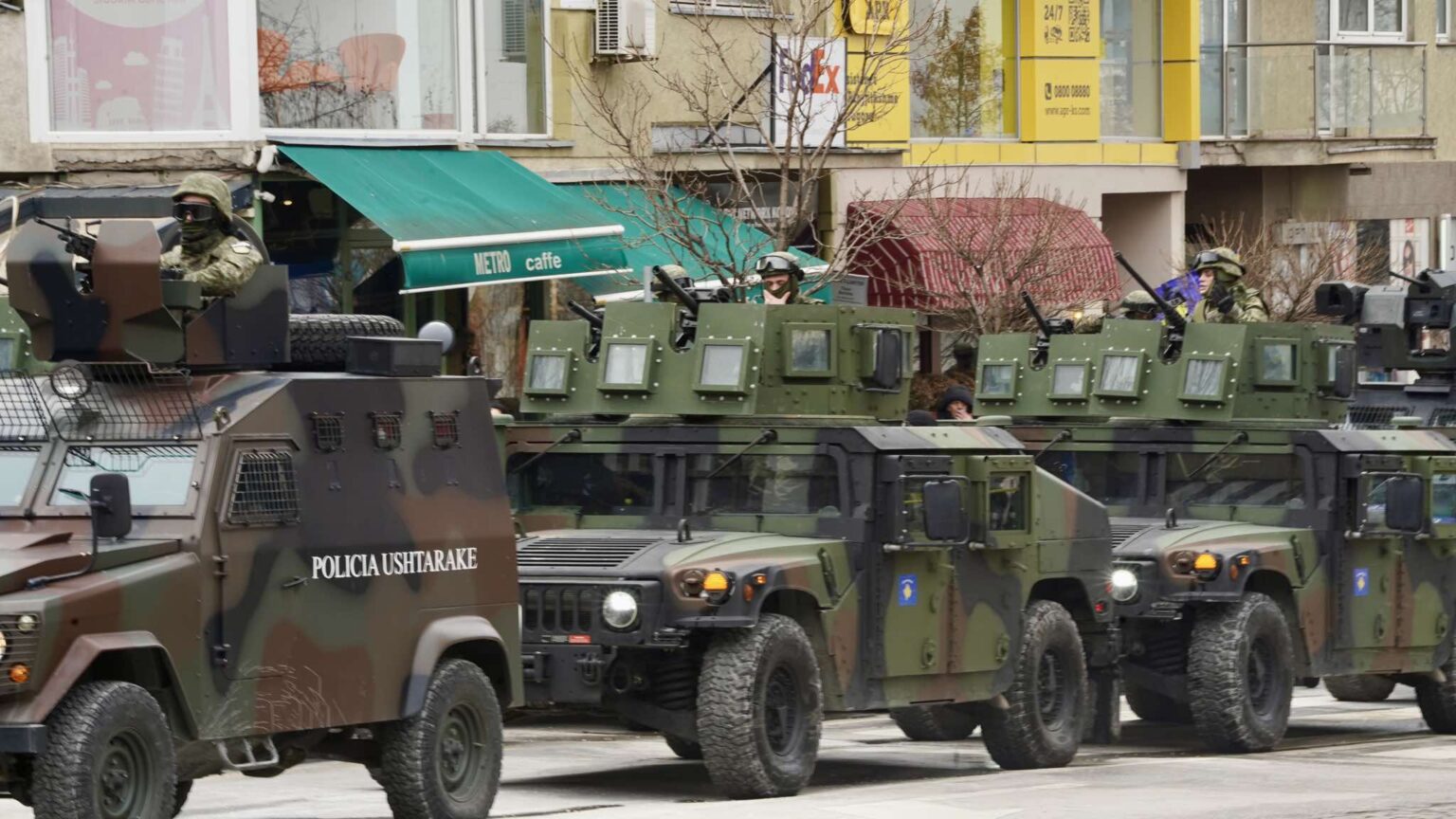
Kosovo’s engagement in Gaza, strategic step to strengthen relations with the USA
The Kosovo Security Force (KSF) engagement in the International Stabilization Force is being seen as an important step in further strengthening relations between Kosovo and the United States, as well as enhancing the country’s international role in the field of security.
According to security experts, the KSF’s participation in international missions, such as the one in Gaza, demonstrates its institutional maturity and professional capabilities, positioning Kosovo not only as a beneficiary but also as a contributor to global security.
However, how can it be explained that the KSF is taking part in peacekeeping in Gaza while KFOR troops are still maintaining peace in Kosovo?
The director of the Kosovo Center for Security Studies (QKSS), Mentor Vrajolli, told KosovaPress that participation in peacekeeping missions is essential for Kosovo.
Recommended
Osmani: 23 years ago, NATO intervened to stop the ongoing genocide against the people of Kosovo
Meanwhile, while Kosovo is still guarded by KFOR forces, Vrajolli emphasized that its participation is not a weakness of Kosovo’s security, but rather a strength.
According to him, Kosovo should return this international goodwill by taking part in peacekeeping missions.
“It is extremely important that Kosovo is not only a consumer of security but also a security exporter. We must keep in mind that the KFOR mission, besides being a military mission, is also a political mission. So, KFOR’s presence in Kosovo is absolutely not a weakness of Kosovo’s security, but a strength. Nevertheless, Kosovo must offer something in return. I think more than 25 years have passed since NATO’s mission has been present in Kosovo, and to reduce the financial burden on Western countries, Kosovo should be ready as soon as possible to return this goodwill through participation in peacekeeping missions,” Vrajolli said.
The director of the Octopus Institute, Arben Fetoshi, also described this engagement as a strategic message in the context of current geopolitical developments.
Since the conflict with Serbia remains unresolved, he said, it makes KFOR’s stabilizing role necessary, emphasizing that the KSF is built according to a program aligned with NATO standards as a defensive force.
Recommended
The MFAD trade unionists protest: Fear and blackmail have been installed in the ministry
“KSF’s involvement in the Gaza mission not only affirms its capacity to contribute, but it is also a very important strategic message for the Republic of Kosovo in the context of international relations and current geopolitical tensions worldwide. Cooperation, coordination, and Kosovo’s specific situation — it is not yet a NATO member, but operates under NATO’s umbrella. Of course, the specifics related to the unresolved conflict with Serbia make a stabilizing and reactive role of KFOR necessary only in extraordinary situations. NATO’s presence in Kosovo has been an important factor for peace, state development, and consolidation of the Republic of Kosovo, but not in terms of rivalry — especially since the Kosovo Security Force has been developed according to a NATO-standard program as a defensive force,” Fetoshi added.
Meanwhile, retired KSF Colonel Afrim Veseli described the operation as a vital step toward NATO membership.
Veseli also commented on border security being handled by KFOR rather than KSF, stating that Kosovo’s forces operate in the north of the country when needed.
“The deployment of our soldiers and our army in such a stabilization operation is vital for Kosovo’s decades-long path toward NATO membership. This operation and the deployment of these forces bring us closer to NATO’s door. God, the KLA, and the Americans have brought us this far and now allow us to pursue our dream of joining NATO… In Kosovo, it is a political issue; NATO has been here since 1999 under UN Resolution 1244. KSF operates in the north when needed. I am one of the officers who has repeatedly operated in the north with the American forces. The soldiers and officers of the Kosovo Army are ready for any operation,” Veseli said.
Defense Minister Ejup Maqedonci told KosovaPress that in recent years, the KSF has built its capacity to be able to export security abroad.
Maqedonci noted that in the coming years, a serious dialogue with NATO will take place regarding the competencies and responsibilities of Kosovo’s security institutions, including the KSF.
“I am not saying that it is unnecessary to have such a force in the Republic of Kosovo, but over the years, alongside consuming security, we have built our capacities to be able to export security abroad. I believe that in the coming years, we will have a more serious and deeper dialogue with NATO regarding the competencies and responsibilities of Kosovo’s security institutions, including the Kosovo Security Force,” Maqedonci said.
Kosovo and Albania are among the first five countries to send troops to provide security in Gaza under the Peace Board.
The first five countries to contribute troops to the International Stabilization Force are Indonesia, Morocco, Kazakhstan, Kosovo, and Albania. Meanwhile, Egypt and Jordan have undertaken police training.