
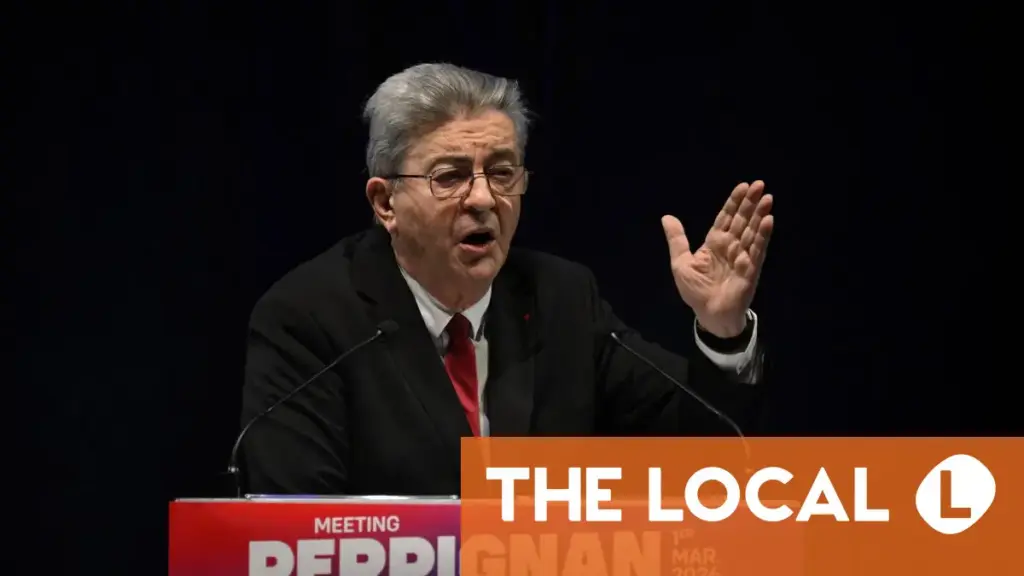
France’s hard left leader Jean-Luc Mélenchon has denied accusations of anti-Semitism over jokes about the name of Jeffrey Epstein – here’s what happened.
What happened?
On Thursday, speaking at a gathering in the southeastern city of Lyon, La France Insoumise (LFI) Mélenchon invoked the name of notorious US-based sex trafficker Jeffrey Epstein, after recent disclosures detailed the convicted sex offender’s extensive ties to the world’s rich and famous.
“I wanted to say ‘Epstein’, sorry, it sounds more Russian, ‘Epsteen’,” said Mélenchon.
“So now you’ll say Epsteen instead of Epstein, Franckensteen instead of Frankenstein,” he told a laughing audience.
The comments sparked outrage from across the political spectrum in France.
Mélenchon, 74, had said his comments were “ironic” and on Sunday, he rejected the accusations again.
“I am not antisemitic,” he told a crowd of some 2,000 people at a rally for an LFI candidate in the southern town of Perpignan.
“It wasn’t me who made the connection between Epstein and his religion,” he said. “That man had no religion, and there is no God who can claim such scum and filth as his own.”
However in the same speech in Perpignan he also mangled the name of the centre-left MEP Raphaël Glucksmann, referring to him as “Mr Glucksman, Glucksmann sorry, . . . I’ll be here for hours.”
In response, Glucksmann posted on social media: “OK Jean-Marie Le Pen.”
What’s all this about?
Mangling the names of Jewish people in an attempt to make them sound ‘foreign’ is an old anti-Semitic trope, with a long history in France and around the world.
It has been used over decades to push the idea that Jewish people are not ‘real’ citizens of their country.
Glucksmann’s response “OK Jean-Marie Le Pen” refers to the founder of the French far-right party Front National (now Rassemblement National and run by Le Pen’s daughter Marine).
Convicted multiple times for hate speech and Holocaust denial, Jean-Marie Le Pen in 1988 referred to the French minister Michel Durafour as “Monsieur Durafour-crématoire” punning on the Jewish minister’s name and the crematoria at Nazi death camps.
Macronist former minister Clément Beaune said: “Jean-Luc Mélenchon is having a new ‘Durafour moment’. It’s not a one-off, it’s a deliberate strategy that feeds anti-Semitism. He is provoking and will do it again.”
Context
Mélenchon’s party La France Insoumise have faced accusations of failing to properly condemn the October 7th, 2023 attacks by Palestinian militant group Hamas on Israel.
There have also been concerns raised about anti-Semitic rhetoric from a minority within the party.
Similar to the UK’s former Labour leader Jeremy Corbyn, most of the previous accusations against Mélenchon have not been that he personally is anti-Semitic, but that he has failed to take seriously anti-Semitic rhetoric from a small minority within his party, or to publicly condemn it.
Elections
While accusations of anti-Semitism would be serious at any time, super-charging this affair is the upcoming local elections, at which the parties of the left and the centre have to decide whether to enter into alliances to block the rise of the far right.
Relations between the hard left and the centre left were already strained, but reactions from leading figures on the centre-left, such as Glucksmann, and the centre, such as Beaune, make such alliances even more problematic.
READ ALSO: France’s divided left faces tough choices in local elections✎
Mélenchon, 74, is a three-time presidential candidate who is believed to be considering running again as the hard-left candidate in the 2027 elections.