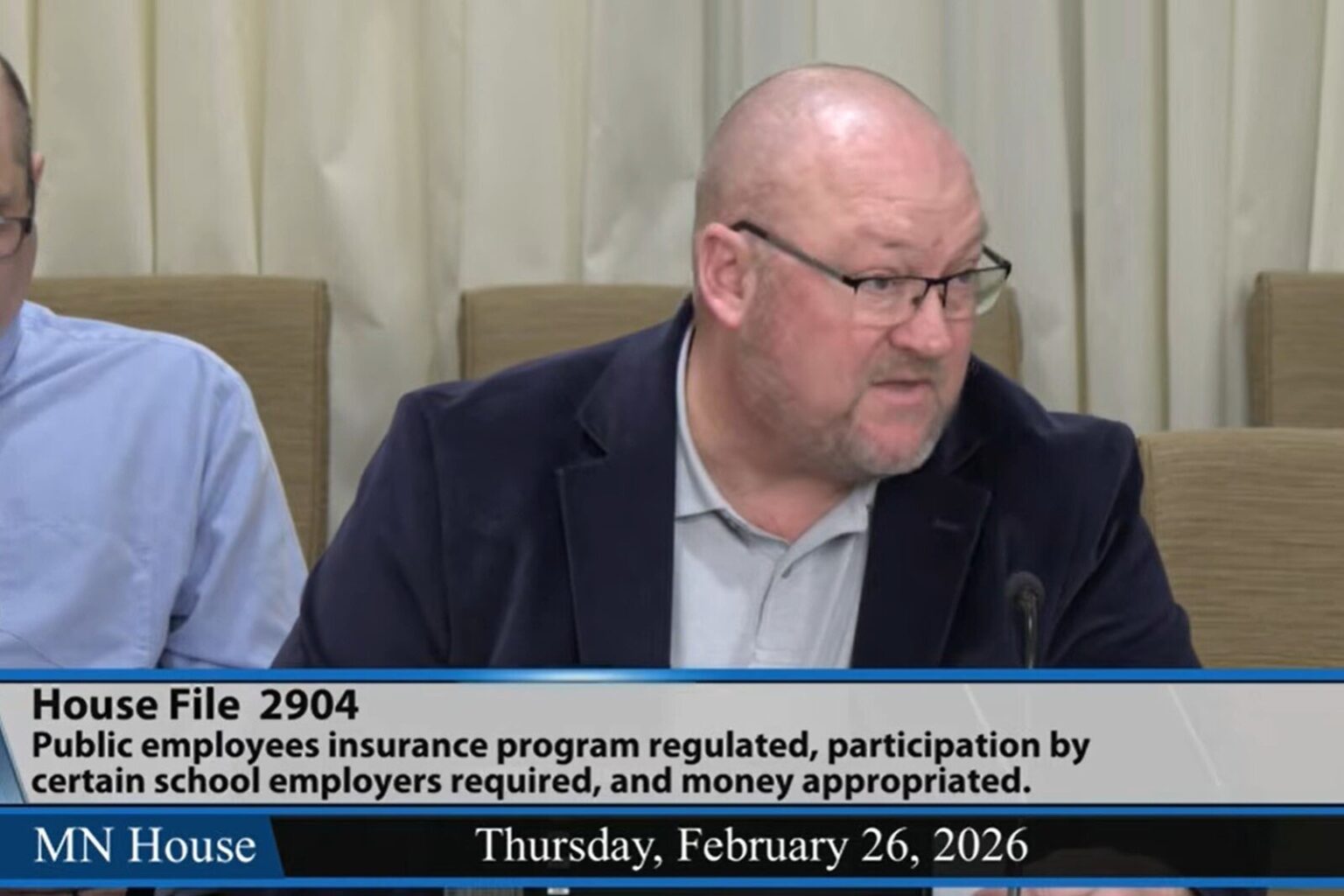
ST. PAUL — Kasson-Mantorville teacher Aaron Wilke recently testified before the Minnesota Legislature about the prohibitive cost of health insurance for educators while speaking in support of a bill that would aim to address the situation.
Wilke was testifying before the House State Government Finance and Policy Committee regarding House Bill 2904. The proposal would create a statewide health insurance program for school districts instead of having each district maintain its own plan.
“I have colleagues who have had to stop insuring their families as of Jan. 1,” Wilke said. “I have personally put off medical treatment for years to avoid the $7,500 deductible I simply cannot afford every single year. To the point, not only are premiums going up, but coverage is getting worse.”
During the same committee hearing, Rep. Liz Reyer described another teacher from Kingsland Public Schools in Spring Valley, saying the teacher has to make a choice between her paycheck and having insurance.
The issue is something districts across the board have been trying to grapple with for years. In November, Rochester Public Schools said the cost of the district’s health insurance was predicted to increase
.
“We need a single, large insurance pool,” Wilke said. “We need to share resources. We need power to negotiate for our health insurance as a single unit. This can’t wait.”
Despite the testimony of multiple educators emphasizing the seriousness of the situation, there were others who were skeptical the proposal would be effective.
Todd Mensink, the director of labor relations and benefits for Anoka-Hennepin Public Schools, which is the largest district in the state, spoke on behalf of multiple organizations, including the Minnesota Association of School Administrators. He said that districts wouldn’t actually realize much savings from the pooling of administrative costs through the proposal.
He said the proposal would have “winners and losers,” in the sense that districts with better-than-average coverage would see their premiums increase and that districts with worse-than-average coverage would see their premiums decrease.
“A big concern my colleagues have is that it takes away the opportunity at the local level to find point solutions that might work better for their individual employees,” Mensink said. “And it doesn’t really save a lot of cost or administrative burden.”
Kirk Schneidawind, executive director of the Minnesota Schools Boards Association, said that a similar effort was made more than a decade ago, which resulted in the program called the Public Employee Insurance Program (PEIP). Schneidawind described that program as “underwhelming for our school districts.”
Although PEIP was supposed to shield organizations from large swings in costs, multiple Rochester-area school districts left the co-op when the reverse turned out to be true.
In 2023, Blooming Prairie Public Schools Superintendent Chris Staloch said that the compounded increase over a three-year period was approximately 80%.
the school districts of Pine Island, Zumbrota-Mazeppa, and Plainview-Elgin-Millville, withdrew from PEIP as well.
Instead, Schneidawind said a possible alternative would be to allow school districts to join the already-established State Employees Group Insurance Program (SEGIP).
Like Mensink, Schneidawind said the proposal would take away local control from districts.
“With this bill, the authority seems to be shifting away from out school boards,” he said. “The bill removes local authority over one of the largest components of employee compensation while leaving schools boards responsible for budgets and outcomes. When decisions are made at the state level but the financial consequences remain local, accountability does break down.”
There were some questions during the committee hearing about whether it would be practical for school districts to join SEGIP since it is structured for a single employer, meaning the state.
Also, in response to the argument that the proposed bill would take away local control, Rep. Kristin Bahner suggested it may be a problem that is beyond local districts’ ability to handle.
“We know that the trajectory of health care insurance costs is like a runaway train at this point,” she said. “And, in all due respect to our school boards, the reality is I don’t know how they stop that train.”