
![[OC] Dairy vs. plant-based milk: what are the environmental impacts?](https://www.byteseu.com/wp-content/uploads/2026/03/647x8bl5nnmg1-1229x1536.png "[OC] Dairy vs. plant-based milk: what are the environmental impacts?")
A growing number of people are interested in switching from dairy to plant-based alternatives.
But are they better for the environment, and which is best?
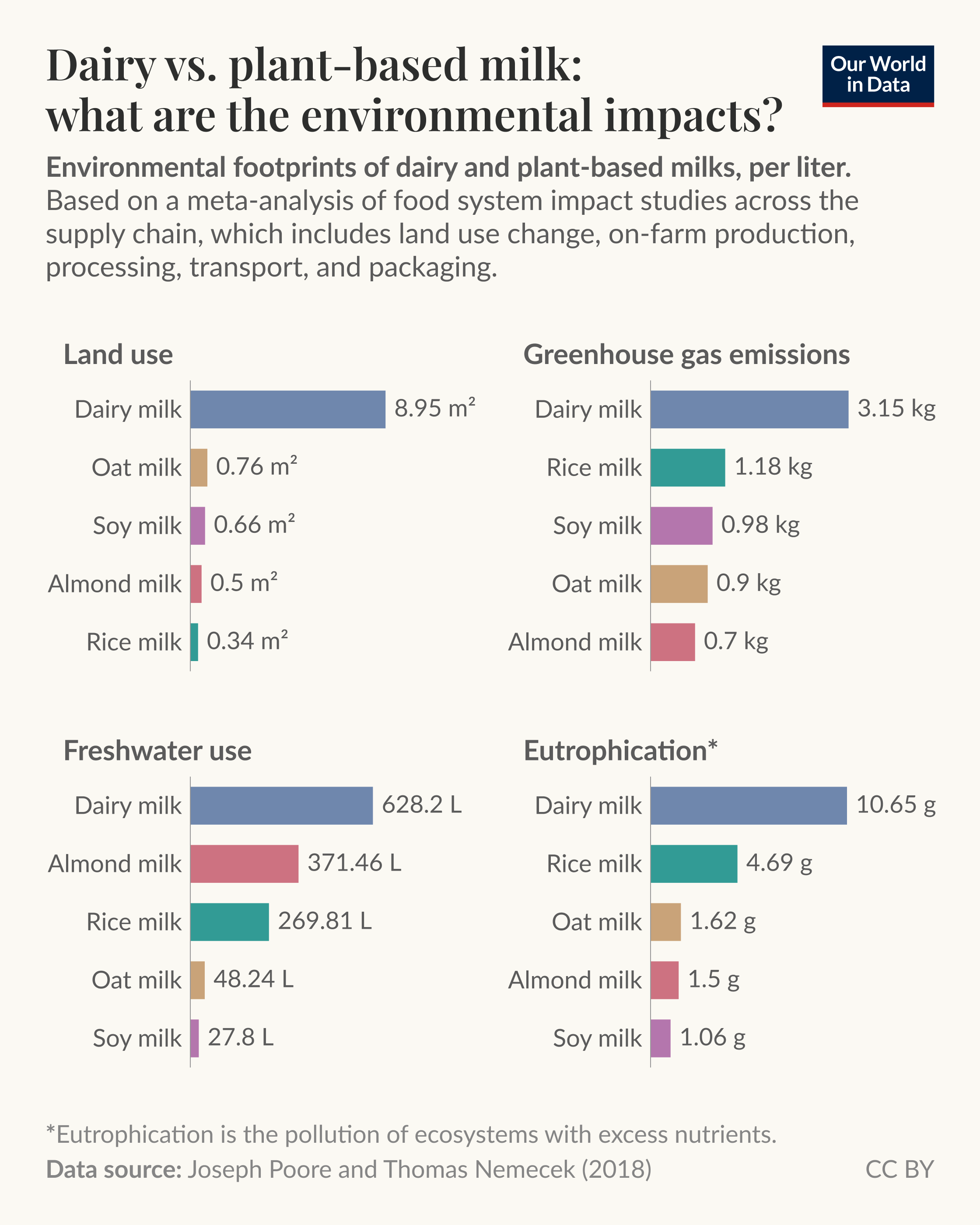
In the chart, we compare milks across a number of environmental metrics: land use, greenhouse gas emissions, water use, and eutrophication (the pollution of ecosystems with excess nutrients). These are compared per liter of milk.
Cow’s milk has significantly higher impacts than plant-based alternatives across all metrics. It causes around three times as much greenhouse gas emissions; uses around ten times as much land; two to twenty times as much freshwater; and creates much higher levels of eutrophication.
If you want to reduce the environmental footprint of your diet, switching to plant-based alternatives is a good option.
Which of the vegan milks is best?
It really depends on the impact we care most about. Almond milk has lower greenhouse gas emissions and uses less land than soy, for example, but requires more water and results in higher eutrophication.
All of the alternatives have a lower impact than dairy, but there is no clear winner across all metrics.
Posted by ourworldindata
32 Comments
Data source: [Joseph Poore and Thomas Nemecek (2018)](https://www.science.org/doi/10.1126/science.aaq0216). Reducing food’s environmental impacts through producers and consumers. Science.
Tools used: initial plotting with the [OWID-Grapher](https://github.com/owid/owid-grapher), finishing in Figma
Add goat milk as some data shows it has 80% lower land use.
I wish these data could be normalized to resource scarcity. E.g. water usage in Wisconsin is a lot less concerning than water usage in California.
nice! could the data have been grabbed from a more recent study?
One of the issues with doing these broad comparisons, is that they miss the the regional differences in resource availability. For instance, almond milk uses less fresh water than dairy milk, but almonds are also primiraly grown in a region where there are sever fresh water shortages.
oat milk drinkers rise up
Would have loved to see more milk types, like coconut milk
Now show the nutritional value comparison.
Soy > Almond > Oat = Rice > Dairy
If they didn’t add this unnecessarily high markup to the price, I’d be all in.
So heute in the Alps almonds grow only in greenhouses with artificial light. On the other hand we have plenty of meadows where you can’t till and an abundance of water.
Hopefully it won’t be too long before we can start buying dairy milk that’s produced via bioreactors. It’ll be identical to cow-sourced dairy milk but much more environmentally friendly.
Cows milk is also significantly more nutritious if that’s of any significance.
Me with my unsweetened soy milk lattes 😎
No breast milk, that’s disappointing…
I wonder whether resource use is sometimes double counted when comparing milk to almonds. Dairy cows produce both milk and meat, a cow must have calves to lactate, and while females often join the dairy herd, most of the males enter beef production. Because dairy systems generate multiple products, environmental impacts are typically allocated between milk and meat rather than attributed entirely to milk alone. Plus, cows typically graze on land thats unsuitable for other forms of crops, so its not like they’re taking away from almond production.
Edit: to the people saying they dont graze, they’re currently grazing in my pasture and the field across from mine. It’s land that is difficult to farm and only good for hay or a gravel pit.
It takes 1-3 gallons to produce a single almond. And yet, almond milk still uses a fraction of the milk that dairy uses. Wild.
I quit dairy after finding out how terrible the lives of dairy cows are. Watched the documentary called “dominion” and now I can’t unsee it.
I thought it would be hard to say bye to dairy, since I ate it every day in every way…. But it was super easy, barely an inconvenience.
Soy wins, especially considering how much more nutritious it is than any other plant based milk.
Almond milk is so damn good. It is hard to go back.
I wonder how rice milk has lower water usage than cows and almonds. Doesn’t rice literally grow in water?
Can you clarify the sources that relate to what farming practices are used re the cow milk?
I have no doubt that cow milk will still be worse on these metrics. However, cows fed on soy beans grown in the amazon are surely worse than cows grazing grass and hay in places with consistent rainfall like ireland, NZ, England?
How does eutrophication from run off from cow pats vs the fertiliser for the grain production compare?
Am i deluding myself and the difference is marginal? Part of me doesn’t want to know…
Now offset this to how much you’d need to drink to get the same amount of nutrition.
Is there a comparison on nutritional content available as part of this study/data?
I know that many people drink milk because it’s also a cheap way to get basic nutrients.
Then Price it like it! None of these data matters if you’re not bringing the price down. You can’t boast about it using less resources to make, costing less to make but then make it more expensive for consumers to buy.
If Soy Milk cost 30% of Dairy Milk, I’m sure a lot of people would consider making the switch.
My favorite is macadamia milk. I wonder where it fits on that list.
I used to enjoy many different types of Soy milk. Stopped drinking it for a bit, went back to the shops recently to pick some up and it’s all been taken over by useless almond milk
What’s going on with that? No protein, uses too much water – why are there so many brands of pointless almond milk?
This was one of the charts I saw that got me to commit to oat milk.
I wish I could enjoy soy milk, but most brands I’ve tried are just not it.
Interesting. Wonder why is Not Milk so expensive then. Is it because of increased willingness to pay rather than use of resources?
“milk”. White Oat/rice/almond/soy water
I like oat milk and the environment. However, these “milks” are not milk. Comparing them to each other makes sense, but nutritionally they are very different from milk. A comparison of milk vs beans, for example, would make sense but not this. Imo.
My immediate reaction was “this isn’t OC, you’ve just screenshotted from Our World In Data!”, but now I see that you ARE our world in data!