
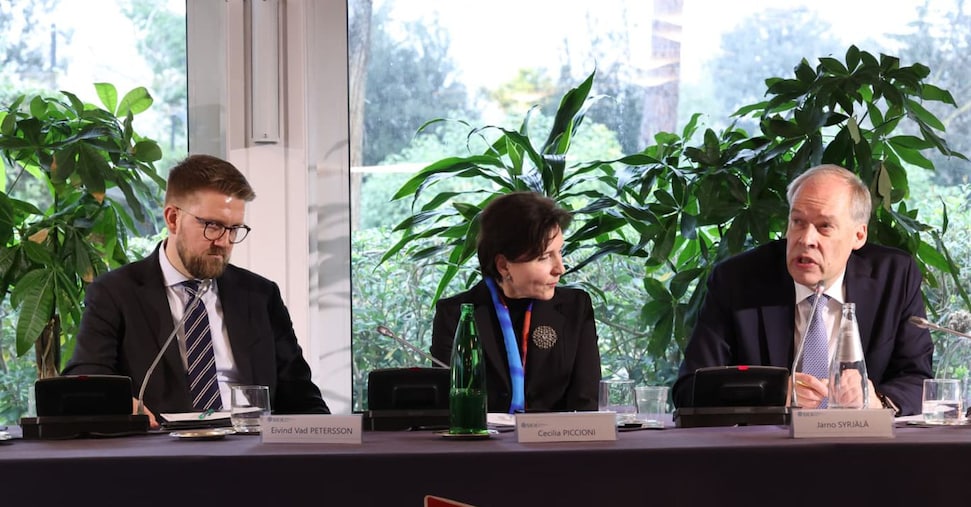
One area of cooperation could be in nuclear energy, and in particular small modular reactors. ‘Yes, this is one of the options on which we are developing some capabilities,’ explained the Undersecretary for Foreign Trade at the Ministry of Foreign Affairs of Finland. ‘But I mean, especially in renewable energy Finland has done extremely well in recent years. So, for example… not only has wind power reached the point where 24 per cent, 25 per cent of our electricity is generated by wind, but then we are also strong in nuclear, also in traditional technology issues and safety issues. So there are many opportunities there, but I think small modular reactors (smr) will be one of the growth areas. In general, when we talk about science and that kind of cooperation, Finland will still invest very heavily in Research and Development (R&D) in general. So our goal is that by the end of this decade, 4 per cent of our GDP will be spent on research and development. This is one of the highest values in the world,’ Syrjälä emphasised.
Norwegian Petersson: ‘New Italian Strategy Platform for Further Cooperation’
Undoubtedly, the issue of critical raw materials plays a major role in Italia’s view of the Arctic. In 2024, the Norwegian company Rare Earths Norway announced the discovery of the largest rare earth deposit in Europe, located in the Fen carbonate complex in Telemark County, with an estimated 8.8 million tonnes of total rare earth oxides. “First of all, Norway is in the fortunate position of having a number of critical minerals in some very promising areas,” recalled Norway’s Deputy Minister for Foreign Affairs, Eivind Vad Petersson. There is already work going on between our Ministry of Trade and Industry, and our Italian counterparts. I know that they have already met and there are future working tables. So absolutely, in the new context this also becomes a question of strategic autonomy for Europe, with access to these minerals. Therefore it is important that Norway, although not a member of the EU, but being part of the internal market, contributes to a certain extent to European sovereignty by providing access to these materials. Fortunately, on the Norwegian side, there are a number of promising projects, and I, on behalf of the government, warmly welcome Norwegian-Italian cooperation in this area as well’.
‘As far as Arctic research is concerned,’ Petersson continued, ‘there is a long-standing cooperation. There has been an Italian research presence in the Norwegian Svalbard archipelago for about three decades now. As far as I know it has mainly focused on climate research. And in this regard I want to say that we would absolutely continue on the Norwegian side to facilitate this kind of scientific cooperation. And we believe on the Norwegian side that we have some of the best infrastructure and logistical setups to conduct research in the Arctic. Fortunately, Italian researchers have been making use of this opportunity for several decades now’.
The High North also brings up the subject of energy sources. ‘Eni, for example, is already a major player in the Norwegian oil and gas sector, on the Norwegian continental shelf,’ he recalled. ‘It has been very active for a number of years, including some of the oil and gas activity that is taking place in the Norwegian Arctic, in the far north of Norway and offshore. So in this regard we have very close cooperation, also in partnership with Norwegian companies, and this is something we very much welcome and appreciate from the Norwegian government side. We hope that it can continue and grow.”
“Norwegian gas now covers almost 10% of Italy’s gas needs”
“Speaking in terms of oil and gas, just to explain, I mean, we have become an important supplier of natural gas to the rest of Europe. But this is mainly through the 8,800 kilometres of undersea pipelines. In the far north of Norway, where Eni is involved, there is also an LNG plant. And in terms of gas supply to Italia, I have seen that the numbers have increased: now Norwegian gas covers almost 10 per cent of Italy’s gas needs. And for the last few years we have been supplying almost 40 per cent of European needs. That is one thing. On the other hand, I want to say that we are a big player not only in oil and gas, but also in renewable energy. Take the Norwegian company Statkraft, I think it is the biggest producer of renewable energy in Europe. And in this respect there are a number of interesting projects in the pipeline, both in terms of energy production but also in terms of infrastructure,’ he says.