
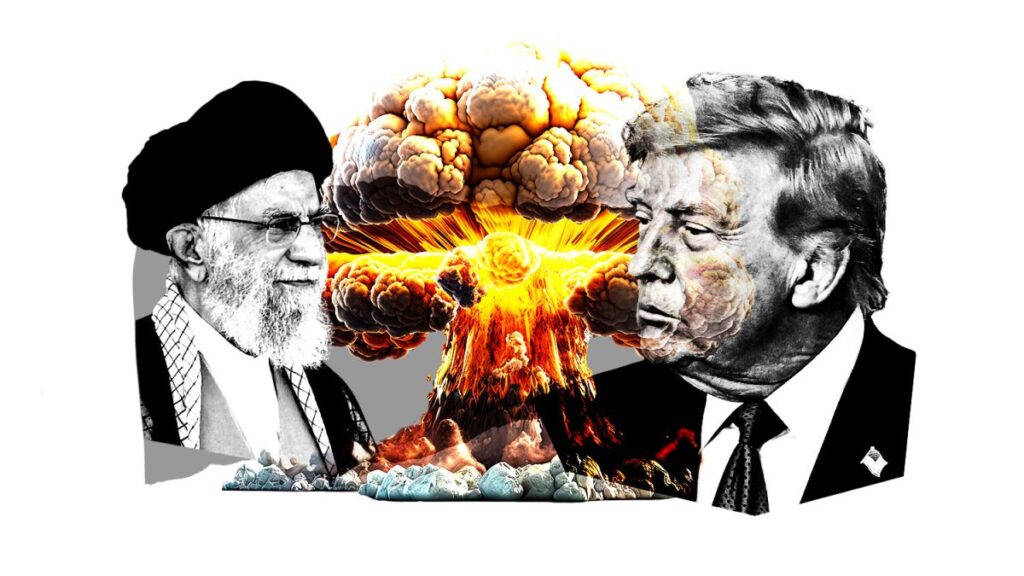
President Trump justified his attack by saying he could not allow Iran ever to develop a nuclear weapon.
But after America joined Israel in bombing the country in June last year, he claimed to have “obliterated” its nuclear weapons programme.
On Monday Iran said that targets of the latest attacks had included its Natanz nuclear facility, south of Tehran. There were also explosions heard from the vicinity of nuclear facilities in the city of Isfahan.
• Iran war live: follow the latest updates
That all suggests that Trump and Binyamin Netanyahu, the Israeli prime minister, agree with analysts that the June attacks damaged but did not destroy Iran’s capabilities. At that time, standard assessments were that, should it choose to, Iran could refine and weaponise its enriched uranium into a nuclear device within three to eight months.
Those analysts and Rafael Grossi, director-general of the International Atomic Energy Agency (IAEA), the United Nations monitoring body, agree that the June bombing has made it harder to assess what state the programme is in.
Since then, Iran has only co-operated in part with IAEA inspectors, not allowing them to visit either the main sites hit last June or to know the whereabouts of existing stocks of enriched uranium, the crucial bomb-making material.

Crowds in Revolution Square in Tehran in June last year protest against the US-Israeli attacks on nuclear facilities
FATEMEH BAHRAMI/ANADOLU/GETTY IMAGES
Iran then declared it possessed 440kg of 60 per cent enriched uranium: enough if further enriched to 90 per cent for ten nuclear warheads, but capable of being used in a weapon even at that level.
The stockpile is thought to have survived the American and Israeli onslaught, and to be stored in surviving underground tunnels at Natanz, Isfahan and the third main nuclear site, Fordow.
Analysts are fairly certain that the main enrichment plants themselves, with their racks of centrifuges which “spin” uranium hexafluoride gas to separate uranium isotopes, were seriously damaged in June.
What is uncertain is the progress of reconstituting those and other necessary facilities, or whether there were reserve stocks of centrifuges. A newly developed site, under “Pickaxe Mountain” near the existing Natanz site, was not struck in June.
There has been evidence of activity at some of the sites, though much of that is consistent with efforts to “clean up” and make them safe.
“The Pickaxe tunnel complex is not yet operational, but construction has been steady for several years and now appears to be nearing the end,” said a report for the Institute for Science and International Security, a Washington think tank, in November.
“Ongoing activities warrant close scrutiny. With the widescale destruction of Iran’s other centrifuge-related facilities, the Pickaxe Mountain complex is a potential candidate site for any Iranian reconstitution of its centrifuge programme, from centrifuge component production to centrifuge assembly to uranium enrichment.”

The Natanz nuclear facility in February last year. Enriched uranium is thought to stored in surviving tunnels at the site
MAXAR TECHNOLOGIES/AFP/GETTY IMAGES
What has remained unchanged for two decades is the assessment of most analysts in this area that while Iran has worked on necessary components of a nuclear weapons programme, there is no visible technical or political commitment to bringing them together.
There has clearly been no concerted effort even to bring the programme back to its pre-June levels, perhaps for fear of triggering further attacks. But that does not rule one out in future.

Binyamin Netanyahu, the Israeli prime minister, warning of Iran’s growing nuclear threat in 2018
JIM HOLLANDER/EPA
“Iran has not been actively seeking nuclear weapons for a couple of decades, but it has maintained the foundations for a weapons programme,” said Ian Stewart, a former Ministry of Defence specialist and now the executive director of the James Martin Centre for Non-proliferation Studies at the Middlebury Institute in the US.
If it did try to press ahead now, or even resume its previous activity, it would be hindered but not totally prevented by the fact that many of its top nuclear scientists were killed in the June airstrikes. Israeli intelligence is thought to have thoroughly penetrated the programme.
However, the baseline knowledge and capabilities are now present in Iran, so if the regime survives anything is possible, especially if an even more hardline figure takes over from Ayatollah Ali Khamenei. He always ruled it was un-Islamic to build a bomb but others in the regime disagreed.
“Iran now cannot quickly acquire nuclear weapons, but the risk is that an extremist could take charge and press ahead with the programme where Khamenei had held back,” Stewart said.