
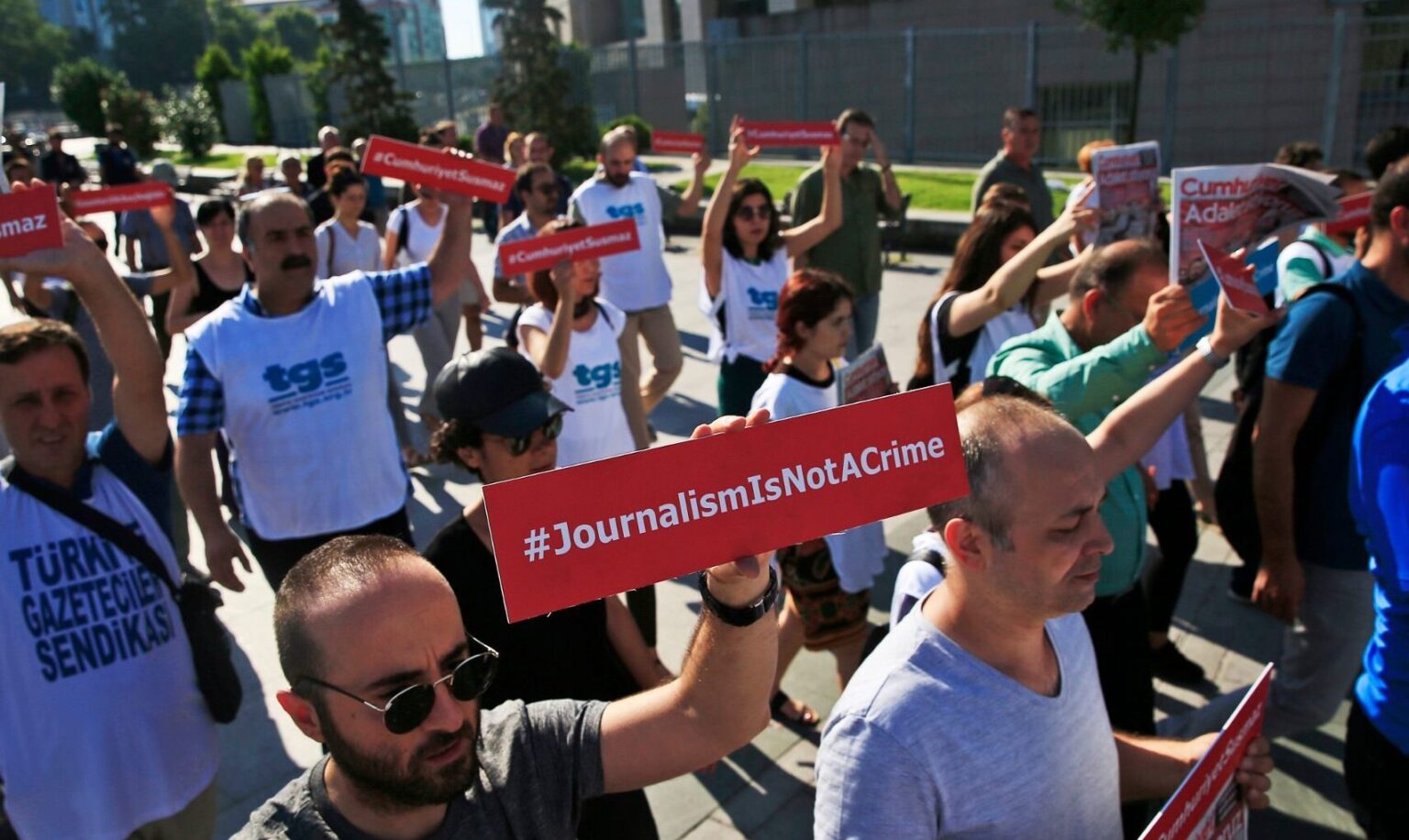
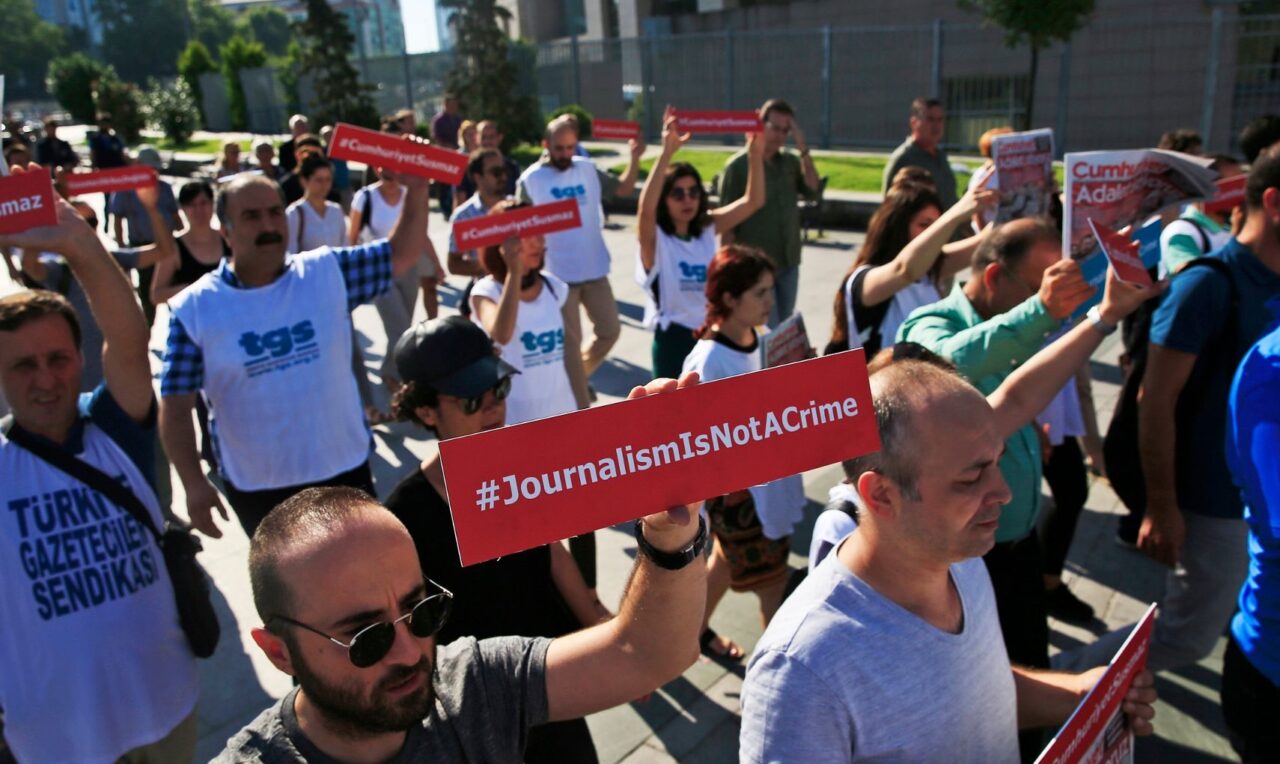
 Turkish journalists’ protest. Photo: Journalists’ Union of Turkey, TGS.
A new report published on Tuesday by the Council of Europe-backed Safety of Journalists Platform says that press freedoms worsened in Europe in 2025, especially in Turkey, Serbia and Bulgaria.
“Press freedom continued to be under sustained pressure in Europe in 2025, driven by legal threats, physical attacks and intimidation, attempts of media capture and transnational repression,” the Europe Press Freedom Report 2025 said.
According to the report, this decline was mitigated by initiatives in some states and at a European level, including the adoption of action plans to protect journalists and legislation in some countries to address issues such as abusive lawsuits, disinformation and source protection.
In 2025, the Safety of Journalists Platform’s partners registered 344 press freedom alerts, which was 29 per cent higher than 2024. The countries with the highest number of alerts were Russia (50), Turkey (49), Georgia (35), Serbia (35) and Ukraine (27).
The report described Turkey as “one of Europe’s most challenging environments for independent journalism, characterised by legal harassment, intimidation and censorship..
“In 2025, [Turkish] authorities’ actions further eroded press freedom and media pluralism. Political pressure shaped the press freedom landscape, with high-profile detentions signalling an escalation of repression,” the report said.
The report also noted the death of the Turkish freelance journalist Hakan Tosun after a brutal assault. It said there had been 90 cases of physical attacks on journalists in the country.
According to the report, Serbia emerged as a major flashpoint for attacks on press freedom in 2025. The situation in Serbia deteriorated “as the media environment [in Serbia] grew increasingly hostile for journalists, particularly in the aftermath of the fatal collapse of a railway canopy in Novi Sad on 1 November 2024, which triggered nationwide anti-corruption protests,” the report said.
The report also drew attention to the worrying level of media ownership concentration in Serbia amid “growing state-party control”.
Bulgaria showed a modest improvement in 2025 when it comes to press freedom, but still remained challenging for independent journalism.
“The media landscape [there] continues to be shaped by deep political polarisation, political and economic influence over editorial work and legal and governance dysfunctions,” the report said.
It also said that legal threats and punitive lawsuits, known as SLAPPs, remain a significant concern in Bulgaria. “Abusive lawsuits, often filed by major businesses, politicians or judges, continue to target investigative reporting [in Bulgaria],” it said.
In addition to political interference, restrictive legislation, insufficient funding, abusive SLAPPs and the systematic use of detention are also listed as common tools to silence the media in Europe.
“As of 31 December 2025, 148 journalists were held in detention across Europe, including 36 in Azerbaijan, 32 in Russia, 27 in Belarus, 26 held by Russia in the occupied territories of Ukraine, 24 in Turkey, two in Armenia and one in Georgia,” the report noted.
The Europe Press Freedom Report – On the Tipping Point: Press Freedom 2025 is the annual assessment compiled by partner organisations of the Safety of Journalists Platform of the Council of Europe.
The platform consist of 15 European media and rights organisations, including the European Federation of Journalists, Reporters Without Borders, the European Centre for Press and Media Freedom and the Committee to Protect Journalists.