
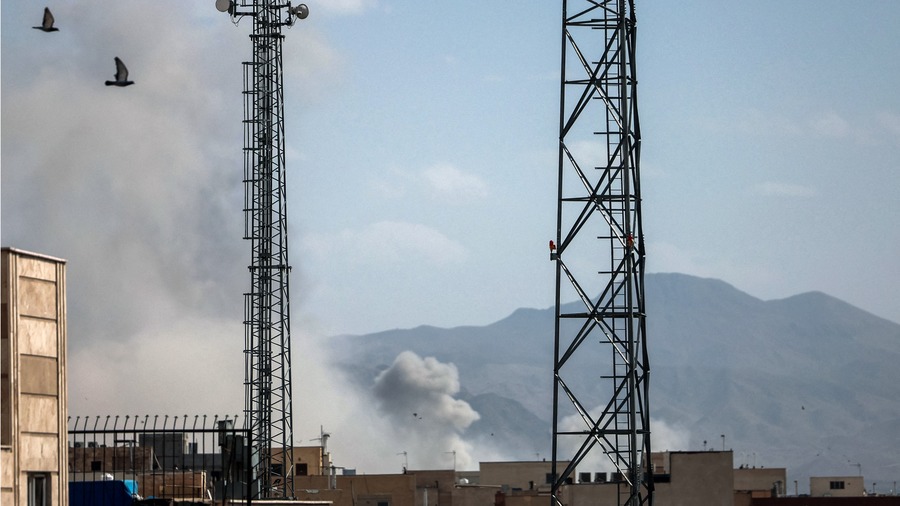
On Feb. 28, 2026, the United States and Israel launched an unprecedented joint air campaign against Iran. President Trump confirmed on Truth Social that Iran’s Supreme Leader, Ayatollah Ali Khamenei, was killed in the strikes. Trump declared this was the Iranian people’s greatest opportunity to reclaim their country, and called on the Revolutionary Guards to lay down their arms. Israeli Prime Minister Netanyahu confirmed his forces destroyed Khamenei’s residence and urged Iranians to take to the streets. Iran’s Red Crescent reported at least 200 dead and 700 wounded. The U.S. military reported no casualties.
The operation, codenamed “Operation Epic Fury” by the United States and “Operation Lion’s Roar” by Israel, represents the most direct military confrontation between Western powers and the Islamic Republic since the 1979 revolution. The strike’s implications extend far beyond Iran, threatening the Chinese Communist Party’s strategic position across the Middle East.
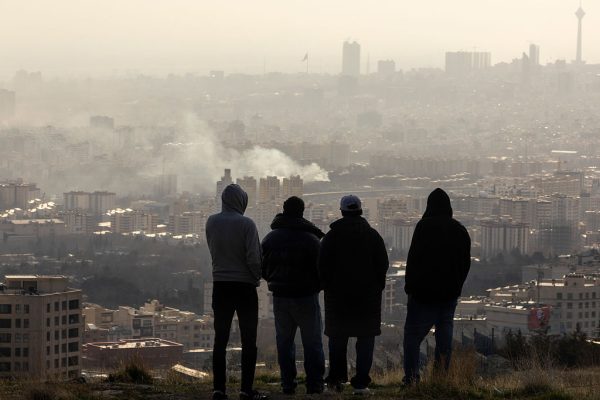 Men watch from a hillside as a plume of smoke rises after an explosion on March 2, 2026 in Tehran, Iran. The United States and Israel continued their joint attacks that erupted on Feb. 28. Iran retaliated by firing waves of missiles and drones at Israel, and targeting U.S. allies in the region. (Image: Majid Saeedi/Getty Images)
The scale of the attack: over 125 aircraft, multiple bomber types, and first‑wave strikes on Tehran’s leadership
According to NPR and Reuters, the U.S. military deployed more than 125 aircraft, including F/A-18 Super Hornets and F-35C stealth fighters from carrier strike groups (the USS Lincoln and USS Ford), plus B-52 Stratofortress, B-1B Lancer, and B-2 Spirit long-range bombers. These flew from bases in Qatar, the UAE, Saudi Arabia, and, in the case of some B-52s and B-2s, from the continental United States with aerial refueling. Israel launched the initial wave using F-35 “Adir,” F-15, and F-16 fighters from domestic bases and naval cruise missiles.
The first-wave targets were concentrated in central Tehran: Khamenei’s office, the presidential compound, the National Security Agency, and the intelligence headquarters. Israel’s defense minister stated the attack was launched on a Saturday, an Iranian working day, specifically to ensure senior Islamic Revolutionary Guard Corps commanders were at their posts, maximizing the strike’s lethality. Satellite imagery and ground video showed thick smoke rising from multiple sites in eastern and central Tehran. Military analyst Zhou Ziding noted the initial strikes relied primarily on long-range cruise missiles flying at extremely low altitude, launched from Israel’s vicinity, crossing Iraqi airspace, and traveling nearly 2,000 kilometers to their targets. Follow-on waves were expected to involve direct aircraft sorties and could continue for days.
Political commentator Heng He emphasized that the operation’s objectives went well beyond destroying nuclear facilities and missile bases. The goal was to topple the Islamic Republic itself. He argued that prior U.S.-Iran nuclear negotiations were, in effect, a diplomatic formality before the inevitable military action. Washington’s three demands, that Iran abandon its nuclear program entirely, cease supporting regional proxy forces (including Hezbollah, the Houthi movement, and Iraqi Shia militias), and stop attacking the United States and its allies, were conditions Tehran could never accept. After negotiations collapsed,
You are now signed up for our newsletter
Check your email to complete sign up
Trump stated in a video address: “We face a very major decision… After we’re done, you [the Iranian people] take the government. This may be your only chance in generations.” The core objective, Heng He concluded, was regime change: destroy the leadership and the Revolutionary Guards’ enforcement capacity, and rely on the Iranian people to rise.
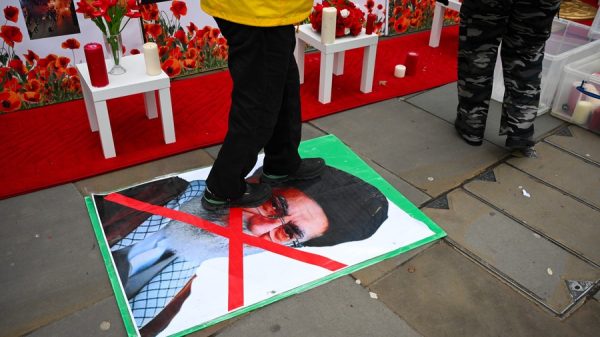 On Feb. 19, 2026, demonstrators gathered outside Downing Street in London in support of anti-government protests in Iran. A photograph of Iran’s Supreme Leader Ali Khamenei was placed on the ground and stepped on by protesters. (Image: Getty Images)
Reports of Khamenei’s death and senior leadership losses
Israeli media broke the news first. Channel 12 and Kan News, citing intelligence sources, reported “mounting evidence” that the 86-year-old supreme leader had “very likely been killed” or critically wounded. His residence and office were directly hit. Contact with Khamenei had been lost. The fate of his son Mojtaba, considered a potential successor, remained unknown.
Iran’s foreign minister told NBC that Khamenei was, to his knowledge, still alive, and that most senior officials had survived with only one or two commanders killed. Iranian state media reported Khamenei had been moved to an underground bunker before the strikes. President Masoud Pezeshkian’s office confirmed he was unharmed.
Confirmed deaths included Defense Minister Aziz Nasirzadeh, who oversaw Iran’s missile and drone programs; Revolutionary Guard ground forces commander Mohammad Pakpour, a central figure in IRGC proxy operations against Israel; and Shamkhani, a senior Khamenei advisor and former navy commander involved in Iran’s nuclear negotiations. Multiple additional IRGC senior commanders were reported killed in Tehran and Hormozgan province. Iranian authorities acknowledged only “a small number of commanders martyred.”
Civilian casualties were also reported. Iranian health officials said nationwide casualties exceeded 100. A girls’ school in Hormozgan province, located near a missile base, was struck by debris, killing between 40 and 70 people, including students and teachers.
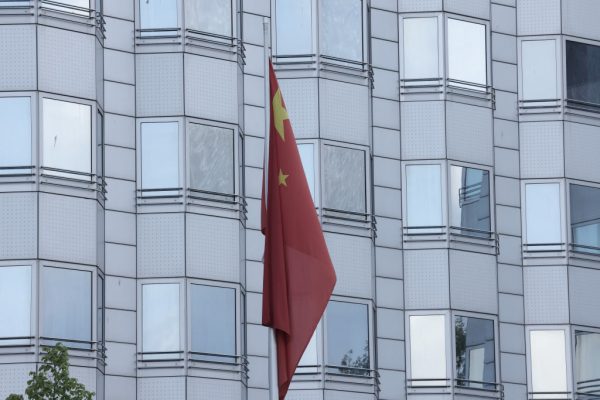 The Chinese flag hangs outside the Chinese Embassy on April 22, 2024 in Berlin, Germany. (Image: Sean Gallup/Getty Images)
The CCP’s strategic exposure: China loses its last major Middle East proxy
Su Ziyun, director of the Institute for National Defense and Security Research in Taiwan, identified a dimension of the strike that received less attention in Western media: the operation targeted Chinese-supplied weapons systems in Iran, including the HQ-9 air defense system and CM-302 supersonic anti-ship missiles. Israel and the United States aimed to prevent these systems from becoming operational, as they would have significantly enhanced Iran’s ability to threaten U.S. and Israeli air superiority in the region.
Su argued that the China-Iran relationship had evolved from energy trade into a strategic military partnership, with Beijing supplying advanced weapons and playing a behind-the-scenes role in Middle Eastern geopolitics. The joint strike was, therefore, an attack on China’s expanding influence in the region as much as it was an attack on Iran’s nuclear capabilities.
If the Iranian regime falls, the consequences for the CCP are severe. Iran has served as the primary remaining Chinese and Russian proxy in the Middle East, supporting Hamas, Hezbollah, and the Houthi movement, and acting as a key node in Beijing’s Belt and Road infrastructure program, the CCP’s flagship initiative for extending economic and political influence worldwide, and its broader effort to counter Western power. Toppling the Khamenei regime would sever this proxy chain, undermine China’s arms sales, energy access, and political leverage in the region, and force Beijing to fundamentally reassess its Middle East strategy. It would also widen fractures in the China-Russia partnership and weaken Beijing’s deterrence posture in other flashpoints, including the South China Sea and the Taiwan Strait.
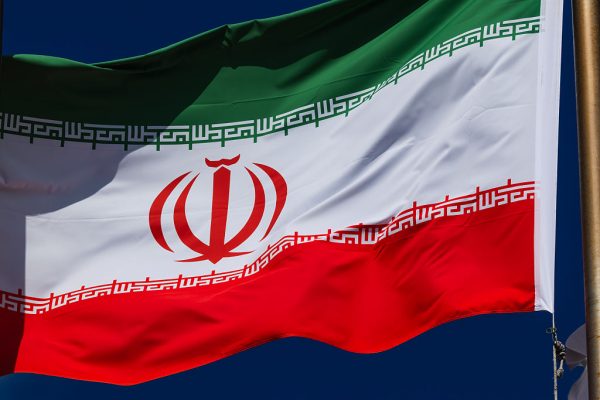 The national flag of Iran is displayed at the Boao Forum for Asia venue on Feb. 28, 2026 in Boao, Qionghai, Hainan Province, China. (Image: Cheng Xin/Getty Images)
Broader geopolitical implications
Song Guocheng, a senior researcher at National Chengchi University’s Institute of International Relations in Taiwan, assessed the strike’s deeper strategic logic. Iran’s nuclear program had advanced to high-enriched uranium stages with potential warhead capability. More fundamentally, Iran functioned as the China-Russia proxy in the Middle East, supporting terrorist organizations and serving as the region’s primary source of instability. The operation aimed to end both the nuclear threat and the regime itself.
Song warned of risks: Iran’s saturated missile attacks could potentially overwhelm Aegis defense systems, damaging carriers and bases, depleting interceptor stocks, and affecting U.S. defense capacity in other regions. Among Arab states, Gulf moderates like Saudi Arabia and the UAE would not publicly oppose the operation and might quietly cooperate, given their dependence on U.S. security guarantees. Popular anti-American sentiment could trigger protests. Qatar and Oman faced particular pressure. Jordan closed its airspace.
If Iran’s theocratic regime is replaced by a democratic secular government, the result would weaken Chinese and Russian influence, improve conditions for the Iranian people, and promote regional stability. A new geopolitical contest would inevitably follow, and Washington would need to manage the transition carefully.
The UN Security Council convened an emergency session. China and Russia condemned the strikes. Russia’s President Putin warned the action “destabilizes the Middle East” and could disrupt global energy supplies. European nations, including Germany and France, had been informed in advance but did not participate.
Iran’s armed forces announced “Operation Honest Promise 4,” declaring all U.S. and Israeli assets in the Middle East legitimate targets. Houthi forces fired missiles at U.S. naval vessels in the Red Sea. Hezbollah launched attacks from the Lebanese border. Trump called on Iran’s military to surrender. Tehran responded that it would “fight to the last person.”
Su Ziyun concluded with a lesson for Taiwan: Israel’s model of universal conscription, autonomous defense industry, intelligence-driven precision strikes, and the willingness to act preemptively over vast distances offers a template for Taiwan’s own asymmetric defense strategy against the CCP threat. Strengthening domestic defense manufacturing, intelligence capabilities, and the population’s willingness to fight, rather than depending on external aid, would be critical in any Taiwan Strait conflict.