
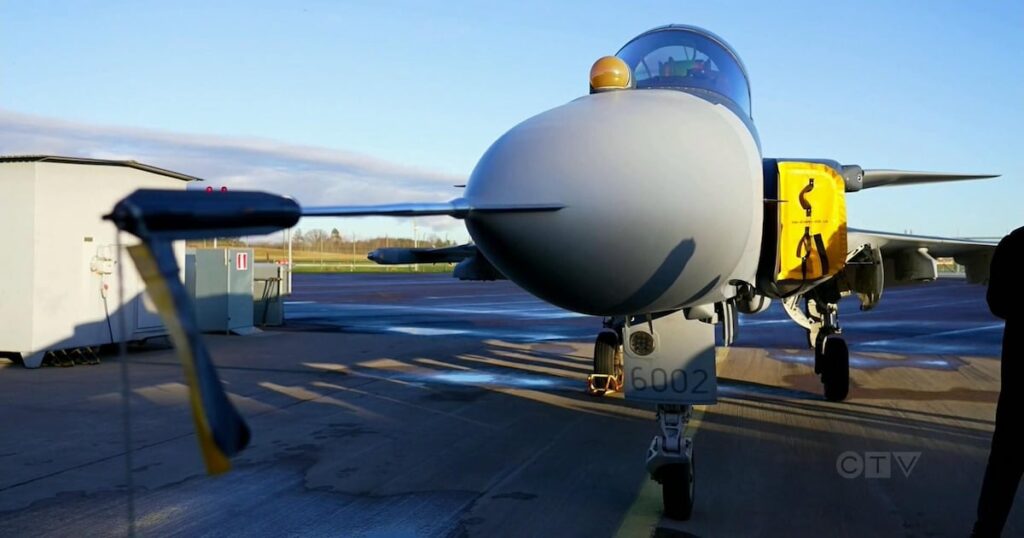
NATO now has eyes on Europe as Sweden deploys fighter jets as a part of a new mission. Genevieve Beauchemin reports.
KEFLAVIK AIR BASE, Iceland — A JAS 39 Gripen fighter jet taxis near a hangar at Keflavik Air Base in Iceland, as brutal winds whip snow across an icy runway.
A team of six Swedish air force personnel greet the jet and begin turnaround procedures, engaging the sequence of manoeuvres to prepare for the next departure.
“Our goal is to re-arm, re-fuel and do all the checks necessary to take off again in roughly 15 to 20 minutes on a regular basis,” says aircraft maintenance technician Emil Lindgren.
He says the Gripen, made by Swedish aerospace giant SAAB, is easy to maintain and fits the harsh climate of the Arctic and the High North.
“We practice at home regularly in these conditions,” says Lindgren. “I would say it’s a match made in heaven.”
Those are among the features SAAB has highlighted in its sales pitch to land a contract to sell Gripens to Canada.
For the first time since it joined NATO in 2024, Sweden is leading an air policing mission for NATO in the region. But other allies will be flying along, including Denmark and four of its F-35 fighter jets. The Danish Air Force says its jets too, perform well in the icy cold region.
“They are well equipped for this type of environment,” says Denmark’s Air Force Commander Jan Dam.
The American-built aircrafts are advanced single-engine stealth fighters. Canada has committed and paid for 16 F-35’S, but a plan to acquire a fleet totalling 88 of the jets to replace an ageing CF-18 Hornet fleet is now under review. Ottawa has yet to decide whether to go with the full fleet of F-35’s or a mixed fleet including both F-35’s and Gripens. Dam declined to give specific details on the interoperability of the two aircraft.
Both jet fighters are signed up for the mission in the highly strategic region of the skies over Iceland in the corridor between North America and Europe. Sweden’s lead mission duties come at a critical time.
“Our great concern is that Russia sees the Arctic as key to its great polar ambition,” says NATO Joint Force Command Norfolk Deputy Chief of Staff of Operations Maj. Gen. Frode Arnfinn Kristoffersen.
“They have been building bases in the Arctic for several years and there is no sign of Russia scaling back on its Arctic ambitions. And now, China has also increased its interest in the region. The concern is, of course, cooperation between China and Russia.”
Since Sweden’s rotation began, no Russian sightings have been reported. The mission has focused on deterrence, but also training to ensure NATO allies are ready to join forces and respond to threats.
The deployment also comes in the wake of demands by U.S. President Donald Trump that Denmark cede Greenland to the Americans.
Iceland’s Defence Directorate of Foreign Affairs was asked at a press briefing at Keflavik Air Base about whether Trump’s threat that he would acquire Greenland “one way or another” had an impact on the mission to protect its skies.
“I have to say our relationship with the U.S. has been very good,” said Director General Jonas G. Allansson. He went on to describe collaboration between NATO allies with a focus on protecting the region from common enemies.
For Sweden, that has also meant a warming of relations with Canada, which some experts say have a common understanding of the issues facing the Arctic and the North.