
Russia’s central bank has filed a lawsuit with the General Court of the European Union in Luxembourg, challenging a December 2025 regulation that indefinitely freezes its sovereign assets across the bloc.
This marks the first time Russia has filed an international legal claim over its sovereign assets in a European jurisdiction.
Follow our coverage of the war on the @Kyivpost_official.
In a statement released on March 3, the Bank of Russia wrote that it submitted a claim on Feb. 27 under Article 263 of the Treaty on the Functioning of the European Union, seeking annulment of Council Regulation No. 2025/2600 adopted on Dec. 12, 2025.
The regulation prohibits any direct or indirect transfer of the Bank of Russia’s assets within the EU for an indefinite period and bars enforcement of court decisions or arbitration awards related to the measures.
The Bank of Russia argues that the act violates “basic and inalienable rights to access justice” and the inviolability of property, as well as the principle of sovereign immunity of states and their central banks under international and EU law.
It also claims the EU Council committed procedural violations by adopting the regulation by qualified majority rather than unanimity, allegedly bypassing the requirements of Article 215 of the treaty.
The Bank of Russia wrote that it reserves “all rights, claims, objections and remedies” in connection with the regulation and any related measures taken by the EU or its member states.
Other Topics of Interest
Ukraine Bondholders Seek Improved Terms After GDP Warrant Swap
Some holders of Ukraine’s dollar bonds are weighing legal action after last year’s GDP warrant swap, arguing the new Class C notes granted stronger protections than their own debt.
Where the money sits
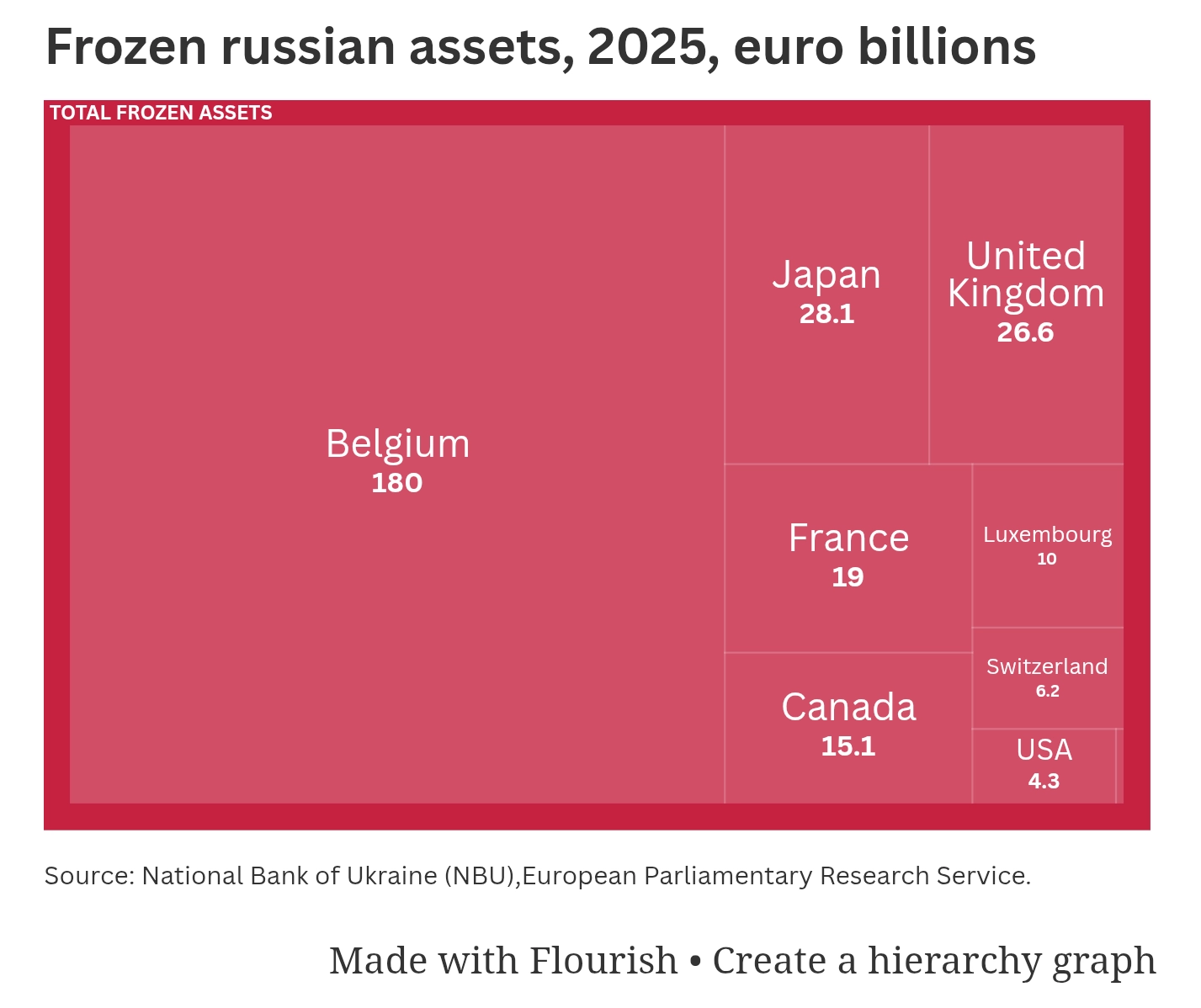
The legal challenge comes as roughly €290 billion ($336 billion) in Russian sovereign assets remain immobilized worldwide, according to estimates published by the National Bank of Ukraine (NBU) and based on data from the European Parliamentary Research Service.
Belgium holds the largest share – about €180 billion ($209 billion) – primarily through Brussels-based clearing house Euroclear, which acts as custodian for a substantial portion of Russia’s central bank reserves.
Japan and the United Kingdom follow, with €28.1 billion ($32.4 billion) and €26.6 billion ($30.1 billion) respectively. France holds €19 billion ($22 billion), Canada €15.1 billion ($17.4 billion), Luxembourg €10 billion (almost $12 billion), Switzerland €6.2 billion ($7.2 billion), and the United States €4.3 billion ($5 billion).
The NBU and Ukraine’s Ministry of Finance have consistently argued that the immobilized assets should be fully confiscated and used to finance Ukraine’s defense and reconstruction amid Russia’s full-scale invasion.
Belgium, others block EU move to tap Russian assets for reparations loan
Brussels has so far stopped short of outright confiscation, citing legal and financial risks.
A proposed reparation loan mechanism backed directly by frozen Russian central bank reserves has stalled amid resistance from several member states, including Belgium, Hungary, Slovakia, and the Czech Republic, as well as concerns over legal exposure and financial stability.
Belgian Prime Minister Bart De Wever has warned that converting frozen assets into long-term financing could expose financial intermediaries such as Euroclear to litigation and pose risks to market stability.
International Monetary Fund (IMF) officials have also urged caution, flagging potential implications for the international monetary system and calling for a clear legal underpinning for any such scheme, in response to Kyiv Post’s question during the 2025 Annual Meetings briefing.
Meanwhile, EU leaders have advanced a €90 billion ($105 billion) loan package widely seen in Brussels as a bridge solution while work continues on a more permanent reparations mechanism.
EU Council President António Costa said in December that leaders had mandated the European Commission to continue developing the reparations-based proposal in parallel with the temporary financing arrangement.
Ukraine’s central bank, the NBU, has maintained that full confiscation would not undermine the euro’s role as a global reserve currency, while analysts at the Kyiv School of Economics have argued that Moscow would have limited viable legal avenues to challenge such a move.