
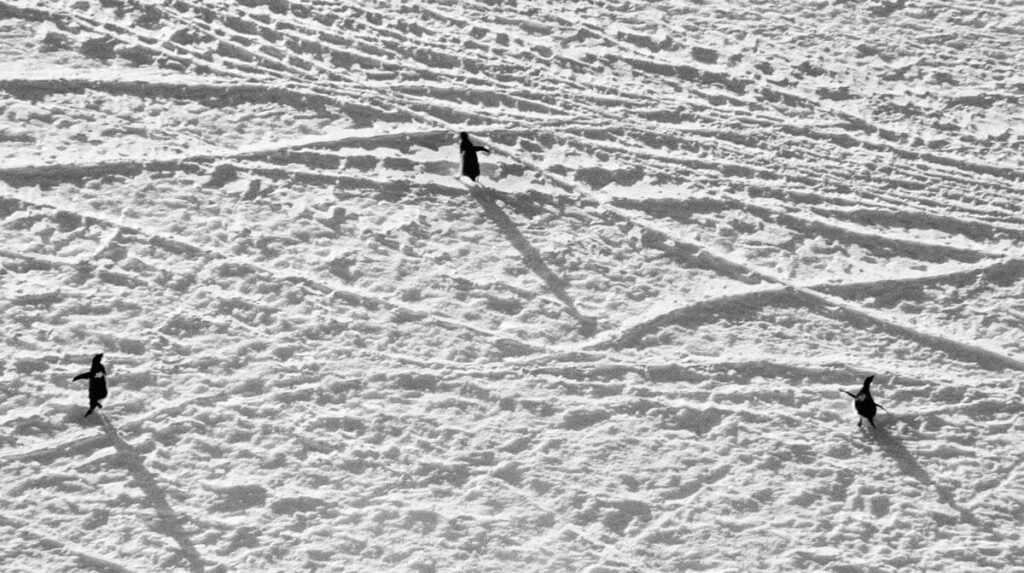
Creative Antarctica: Australian Artists and Writers in the Far South at RMIT Gallery and Design Hub Gallery is the culmination of years of research into Australian art created in Antarctica—a continent with no permanent human population and roughly 90% of the world’s ice. Located in the Southern Hemisphere, surrounded by the Southern Ocean, Antarctica contains a hidden world beneath the 2km thick ice—home to ancient ecosystems with unique microbes and creatures like giant sea spiders that entice scientists to its regions.
The exhibition explores how through art the Australian Antarctic Arts Fellowship provides access to the frozen continent through cultural advocacy. Important data about a place containing around 60% to 90%of the world’s fresh water, which, if melted, could raise sea levels by over 60 metres. Creative Antarctica invites a sense of responsibility in a time of accelerating climate change. “We’re deeply connected to Antarctica [in Australia] in so many ways, and yet, our population still sees it as a fairly remote place,” says Professor of Antarctic Studies at the University of Tasmania, Elizabeth Leane, who worked with artist and curator Philip Samartzis on the exhibition. From over 140 Australian artists, writers and musicians who have been drawn to the icy continent, Leane and Samartzis interviewed 53 artists and writers, with 38 artists in the exhibition and many more writers in their purposely designed writer-showcase ‘salon’— considered moments to showcase writing: decal quotes from their interviews, a wallpaper of words from Cold Words: A Polar Dictionary (2025) by Bernadette Hince, and a ‘fridge poetry’ installation inspired by Branwell Roberts’ research.
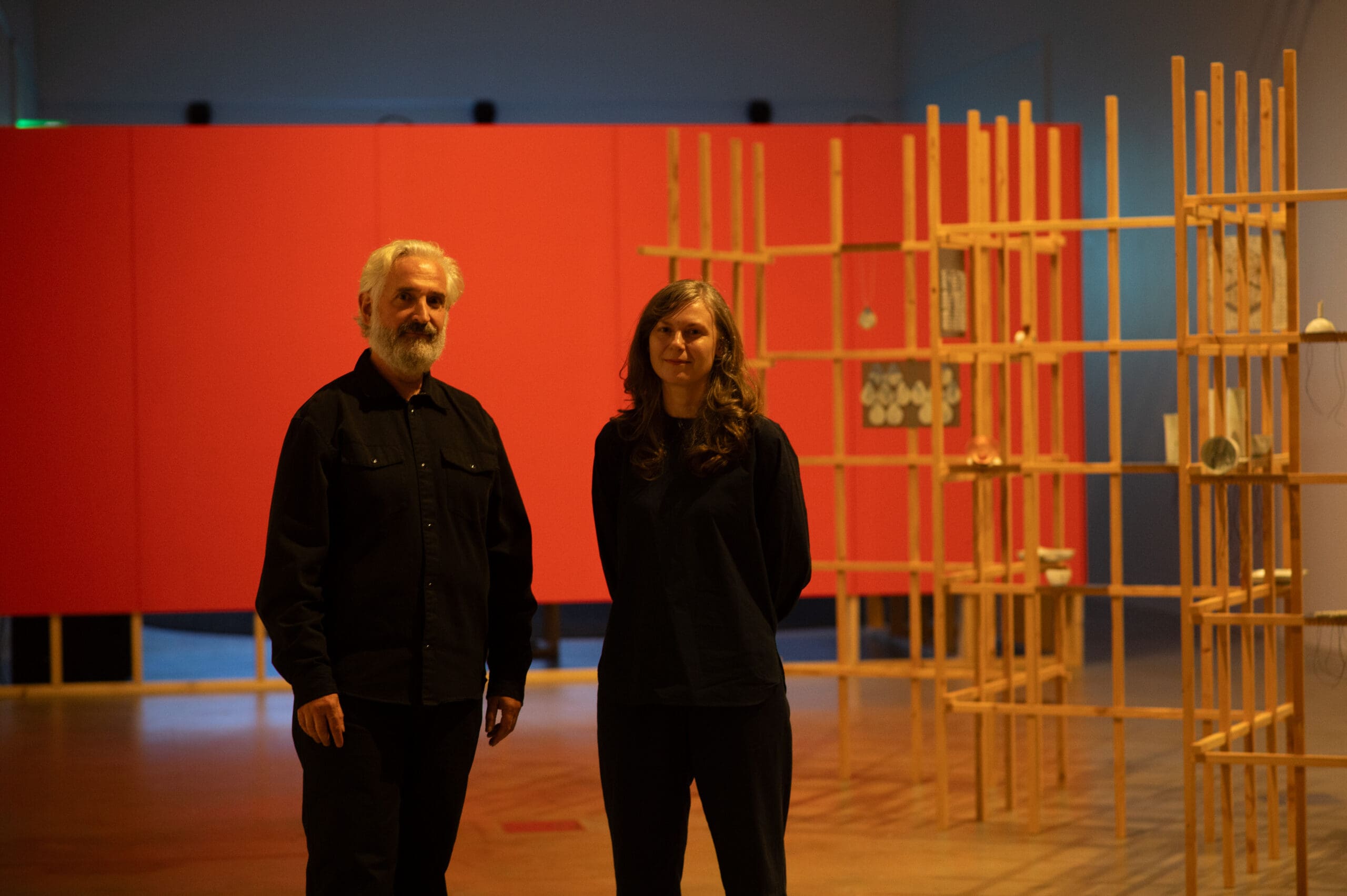
Philip Samartzis and Polly Stanton in front of Kirsten Haydon, ‘Ice Scaffold’, 2025, in ‘Creative Antarctica: Australian Artists and Writers in the Far South, 2026, Design Hub Gallery. Photo by Keelan O’Hehir.
Through personal stories and transformations, Creative Antarctica explores relationships and conversations, with seven new site-specific works displaying artists engaging with the ice continent over the last few years through technological interaction, audio, visual work, installation, spatial and sound, and historical artworks from those early expeditions and travels down prior to the official residency. From Frank Hurley’s photographs of Ernest Shackleton’s expedition in 1916, to Sidney Nolan’s depiction of Mt Erebus in 1964, to Sally Robinson’s vivid capturing of penguins in Atlas Cove, 1993, and Miranda Nieboer’s recent two-channel digital video work and sound installation that places you on location. Equally, we see crossovers between time and mediums. For example, Rachael Mead’s novel The Art of Breaking Ice (2023), which fictionalises the life of Nel Law, the first Australian woman to set foot on Antarctica in 1961, while Law’s beautiful watercolours are also displayed with her husband’s photo of her in Antarctica.
Samartzis wanted to capture the sensory, reflective, and deeply human qualities he found in station life; the exhibition design evokes the industrial for a layer of encounter and experience beyond the artworks. “I was interested in the infrastructure and technologies required to maintain a human presence on station,” he says. “The point of the exhibition is to create a mechanism for discovery.”
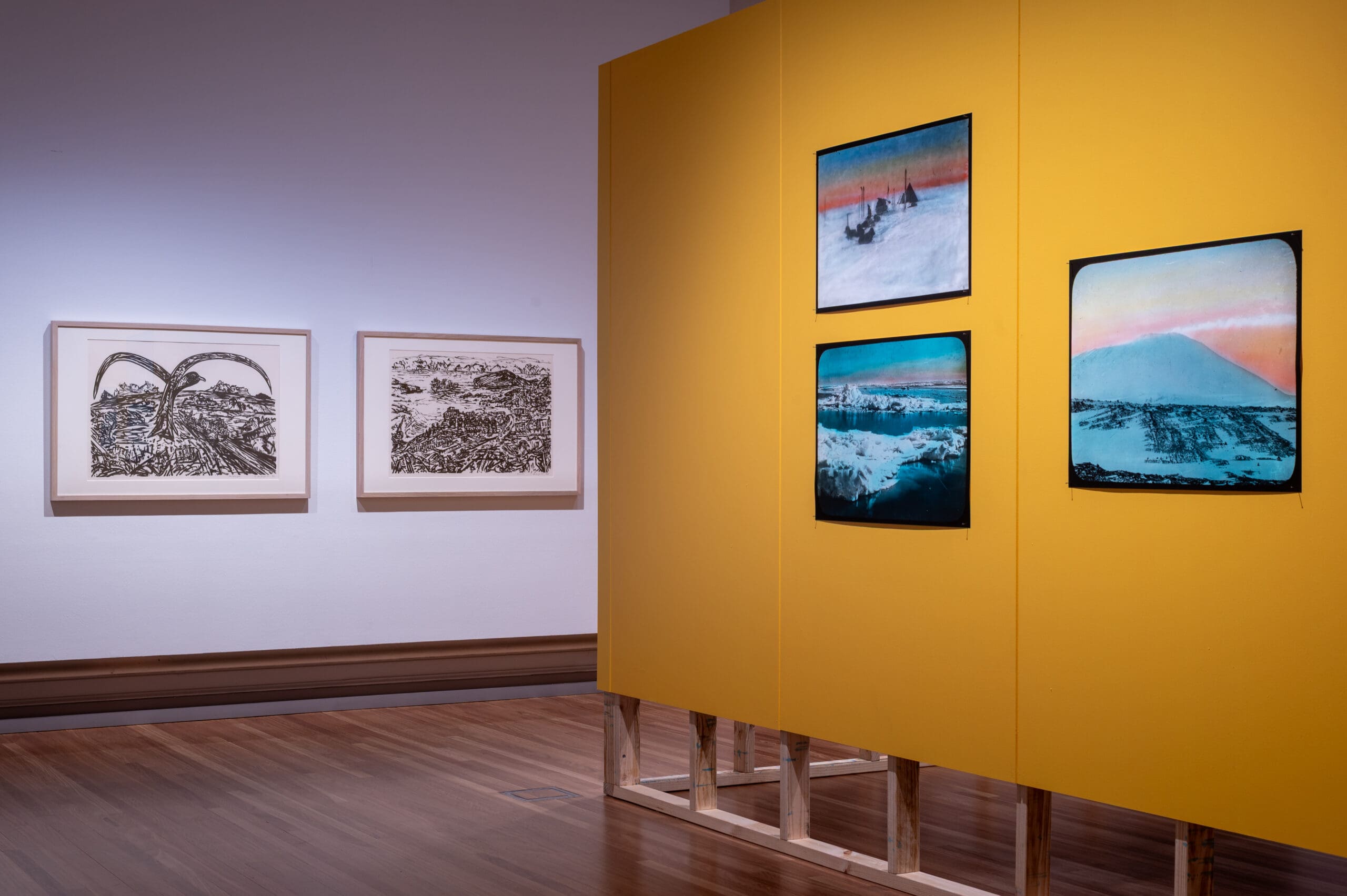
Installation view, Jan Senbergs, Collection of Tasmanian Museum and Art Gallery (left), and Keith Jack, Collection of the State Library of Victoria (right), in ‘Creative Antarctica: Australian Artists and Writers in the Far South, 2026, RMIT Gallery. Photo by Keelan O’Hehir.
Artist and RMIT Senior Lecturer Polly Stanton was recently in Antarctica as the 2025 Arts Fellow, exploring how remote settlements function relationally within the broader ecological and logistical networks of East Antarctica. “The thing that really hits you, even before you get on the ice, is just the logistics, it’s phenomenal,” she says. Stanton has been working on a moving image work of station life and the sounds—both reflecting on the buzz and hum of the technologies that operate nonstop, and on the isolation and sounds of stillness out in the vastness. Landscape artist Stephen Eastaugh has been to Antarctica nine times, with an artwork from his second trip featured: Davis Station – Series of 18 buildings (2003). “I found old, damaged pallets, so I grabbed some of those and started painting depictions of the fascinating buildings,” says Eastaugh. As one of the only artists to visit through winter, he muses on these ‘strange’ villages with extreme climates, where in winter, you need a psychological evaluation to visit the place of perpetual twilight.
Samartzis shares that he last went down in 2016 and thinks about it every day; it never leaves you. “Whenever we talk about climate change, my mind always goes to the ice, and what’s happening there… It’s a very fragile and enormously important location, so we all come back as ambassadors.” Stanton adds, “it’s nothing like what an artist will ever really experience or feel. It’s not like any normal fellowship or residency experience.”
Similarly, the ice got in the veins of renowned children’s book writer and illustrator, Alison Lester, who’s journeyed down five times. Her art fellowship residency on the Aurora Australis was a six-week trip from Hobart to Mawson, Casey, and back through Macquarie Island, which she documented for those back home. Her artwork in Creative Antarctica, All the Tracks of the Aurora Australis (for Sophie Scott Goes South) (2012), is a collaborative effort between the author and children around the world. “I asked the kids to draw their responses and to send me copies of their drawings,” says Lester. “There were so many pictures of the ship, I decided to put them all together… showing the tracks going through the icebergs. It was a lovely process, and as I can’t trace all the kids, all the profits go to the Royal Children’s Hospital.” She adds, “It’s lovely being able to be the eyes and ears for people who can’t go… if you can help people engage with the science about Antarctica emotionally, then they’ll want to protect it as well.”
Creative Antarctica invites a journey, taking place over two galleries with an extensive public program. It’s an exhibition to savour. Go back to. Spark your own research. “It’s been wonderful to see how artists have responded to their own encounters with the ice through different mechanisms, through different materials, different scales of expression,” Samartzis concludes. “Together, they create a compelling narrative of Australia’s long-term engagement in the region and how influential it’s been on so many of our artists here.”
Creative Antarctica: Australian Artists and Writers in the Far South
RMIT Gallery and Design Hub Gallery
Until 2 May