
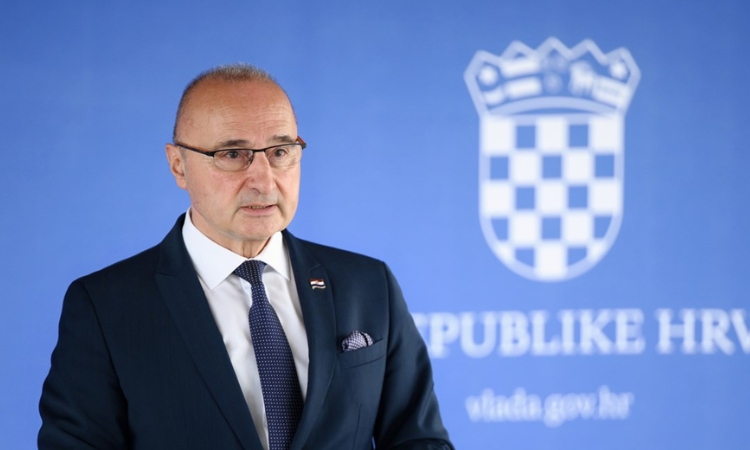
Croatia’s foreign minister on Monday publicly questioned President Zoran Milanović’s decision to withdraw Croatian troops from Iraq and Lebanon, saying the move had not been coordinated with the government and underscoring that Croatia bears obligations as a member of international organizations.
Speaking to reporters, Foreign and European Affairs Minister Gordan Grlić Radman said that while Croatia has the sovereign right to decide whether to participate in international missions, its membership in the United Nations and NATO entails certain responsibilities.
“Croatia can choose to participate or not,” he said, “but as a member of the United Nations and NATO, it certainly has obligations toward those organizations.”
The comments came after President Zoran Milanović ordered the withdrawal of Croatian troops from Iraq and Lebanon in response to escalating tensions in the Middle East. Grlić Radman suggested the president had not consulted the government before making the decision.
“Why he did it, you should ask him,” the minister told reporters, adding that consultation had not taken place.
Debate Over International Commitments
The minister framed Croatia’s participation in international missions as an expression of solidarity, recalling that during Croatia’s war of independence in the 1990s, the presence of international peacekeeping forces had been welcomed.
He noted that since 1945, roughly 170 conflicts have occurred without a United Nations mandate, pointing to structural limitations within the Security Council, where veto powers often constrain action. He cited NATO’s 1999 intervention in Kosovo as an example of military action taken without explicit United Nations authorization but aimed at preventing humanitarian catastrophe.
Commenting on recent strikes by Israel and the United States against Iran, Grlić Radman said international appeals to halt Iran’s ballistic missile development and nuclear program had not yielded results, and that developments must be viewed in that context.
“We regret the inflexibility and lack of credibility in negotiations, which led to military intervention,” he said.
Citizens in the Gulf Advised to Relocate
The minister also addressed the situation of Croatian nationals in the Gulf region. Approximately 2,000 Croatian citizens are currently in the United Arab Emirates. Grlić Radman advised them to consider traveling to Oman, which he described as safe and reachable within about an hour’s drive from the Emirati border. Oman’s capital, Muscat, is approximately four hours away by road.
About 110 Croatian citizens are currently in Oman, he said.
The ministry remains in continuous contact with Croatia’s general consulate in Dubai, and the minister said he had spoken with the foreign minister of the United Arab Emirates, who assured him that authorities were looking after the safety of approximately 380,000 European citizens residing there.
Croatia is also coordinating with European allies on potential joint repatriation efforts, although evacuations remain complicated. Commercial airlines are reluctant to resume operations until full air traffic security is guaranteed, the minister said.
As tensions ripple outward from the Middle East, Croatia’s internal debate over foreign policy authority and alliance obligations has unfolded alongside urgent questions about the safety of its citizens abroad.
CNN’s Fareed Zakaria says Iran made a ‘foolish mistake’ by conducting retaliatory strikes against the Gulf States in the aftermath of the US and Israel launching a major attack on Iran.