
Ever since Maria von Trapp twirled across the Austrian Alps in the opening scene of “The Sound of Music,” the movie musical has claimed its place as one of the most beloved films of all time. It won five Academy Awards in 1965, and its sweeping scenery now draws an estimated 300,000 visitors to Salzburg each year, all eager to revel in that silver screen magic for themselves.
Premiering on March 2, 1965, the film’s legacy has endured for more than six decades and is marking its 61st anniversary this week. With indelible songs like “Do-Re-Mi,” “My Favorite Things,” and “Edelweiss,” featuring music by Richard Rodgers and lyrics by Oscar Hammerstein II, the film adapted the duo’s Tony-winning 1959 Broadway musical, itself based on the real-life Maria von Trapp’s 1948 memoir, “The Story of the Trapp Family Singers.” Though set against the shadow of World War II, the story continues to resonate across generations.
“Our movie is among the top reasons that tourists come to Salzburg … and it’s easy to feel that you’ve been transported back in time and into our film,” Julie Andrews, the star of the film, said in the 2015 documentary “The Sound of a City: Julie Andrews Returns to Salzburg.” “Every corner that you turn, there’s something beautiful to see.”
For me, growing up in an immigrant household, “The Sound of Music” was one of the few American classics that filled our home. My sister and I choreographed our own version of “So Long, Farewell,” and I once sang “Sixteen Going on Seventeen” at a local vocal competition. The refrain from “Climb Ev’ry Mountain” followed me into adulthood — I even printed it on a yoga mat as a reminder.
Julia Andrews as Maria in a still from the 1965 musical The Sound of Music.
20th Century Fox/Bettmann Archive/Getty Images
In 2012, my personal nostalgia for the film led me to book a European trip with two friends with one goal: trace Maria and her children’s footsteps through Salzburg. We signed up for the original four-hour “The Sound of Music” tour with Panorama Tours, indulged in The Sound of Salzburg dinner show, and tracked down as many filming locations as we could on our own.
In honor of its anniversary week, I’m simply remembering a few of my favorite things: the best “The Sound of Music” filming locations in and around Salzburg.
Nonnberg Abbey
Nonnberg Abbey, with views of the Alps.
goce/iStockphoto/Getty Images
When the film’s location scouts first visited the Benedictine abbey where the real Maria von Trapp once lived, they dismissed it in their notes as a “drab, uninteresting pile of stucco,” Andrews recalled in the documentary. But when Andrews filmed there in May 1964, her perspective shifted. She said she could “feel a sense of tranquility that must have so appealed to the woman I was playing.”
I felt it, too. The abbey sits at the end of a steep road in the foothills of the Festungsberg, removed from the bustle of Salzburg’s Old Town. I arrived around noon, well outside the nuns’ regular choir schedule—daily at 6:45 a.m. and again around 5 p.m.—and assumed the grounds would be quiet. I thought my imagination was running a little too wild when I thought I heard singing. But as my friends and I made eye contact, we realized we had stumbled upon an unannounced session, proving that the sound of music does indeed float through Salzburg.
Residenzplatz Square’s Residence Fountain
The Residenzplatz in Salzburg, Austria.
Joaquin Ossorio-Castillo/Adobe Stock
This central Old Town square, designed by Italian architect Vincenzo Scamozzi, hosts everything from concerts to sporting events and festivals, including its annual Christmas market. At the heart of it is the Residence Fountain, a Baroque work by Italian sculptor Tommaso di Garone, featuring four horses and three dolphins.
In the film, Maria and the children dash through the square while learning “Do-Re-Mi,” and she trails her hand through the fountain in “I Have Confidence.” And you can bet I reached into the waters to try to make a splash too during my Salzburg visit.
Mirabell Palace and Gardens
The Pegasus Fountain in Mirabell Gardens.
Salvador-Aznar/iStockphoto/Getty Images
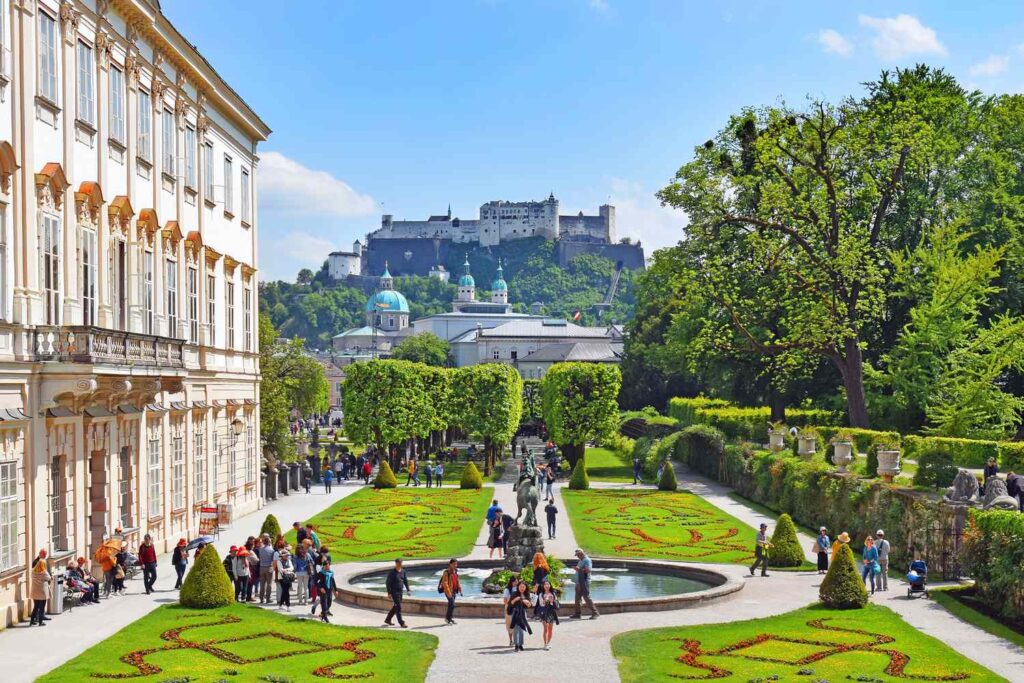
Perhaps the most recognizable of Salzburg’s filming locations, Mirabell Palace and Gardens set the stage for the final stretch of “Do-Re-Mi.” The palace dates to 1606, and in 1690 the geometric gardens were reshaped by Baroque architect Johann Bernhard Fischer von Erlach, giving it a stately grandeur.
That patterned backdrop frames one of the film’s most exuberant sequences: Maria leading the von Trapp children on their first free-wheeling adventure through Salzburg. They march around the Pegasus Fountain, hop up and down the Rose Garden steps, and tap the head of one of the 17 dwarf statues carved from Untersberg marble.
Schloss Leopoldskron
Leopoldskron Palace in Salzburg, Austria, with Gaisberg mountain rising behind.
utamaria/Adobe Stock
As a kid, I always envied the von Trapps’ backyard. It was so massive that it came with its own lake to tumble into from a rowboat. That outdoor scene, along with all of the home’s exterior shots, was filmed on the terrace of Schloss Leopoldskron. Today, the 18th-century palace operates as a historic boutique hotel, with 12 suites in the main palace and 55 rooms in the renovated Meierhof. Andrews called it her favorite filming location.
Built in 1736, the 17-acre estate provided the backdrop for some of the film’s most dramatic moments: the children learning the Baroness would become their stepmother, Maria returning after fleeing to the abbey, and, of course, Gretl announcing that her finger had been caught between Friedrich’s teeth.
Felsenreitschule
An orchestra performs at the Felsenreitchule theater in Salzburg, Austria, as part of the Salzburg Culture Festival.
Franz Neumayr/AFP/Getty Images
One of the most underappreciated characters in the film has to be Frau Schweiger, the performer who can’t stop bowing as she accepts her music festival prize. My sister and I used to count every bow out loud, then imitate her dramatic flourish ourselves. That niche devotion is what led me to seek out the Felsenreitschule, which translates to “Rock Riding School,” where the scene was filmed.
Designed by Johann Bernhard Fischer von Erlach and completed in 1633, the venue later became a 1,437-seat performance space for the Salzburg Festival beginning in 1926. Its defining feature is the wall of 96 arches carved directly into the Mönchsberg mountain. In the film, Nazi guards fill those stone arcades, watching the von Trapps perform just moments before the family slips away into Switzerland.
Schloss Hellbrun Gardens
Hellbrunn Palace is home to the gazebo featured in The Sound of Music.
mRGB/Adobe Stock
Although no scenes were filmed on the palace grounds themselves, Schloss Hellbrunn has become a staple on “The Sound of Music” tours thanks to the reconstructed gazebo from “Sixteen Going on Seventeen” and “Something Good” in its gardens. The original scenes were shot on the 20th Century Fox lot in Los Angeles, but a copy sat in the background on the Schloss Leopoldskron grounds for the exterior scenes.
After filming wrapped, the city of Salzburg relocated the gazebo to these public gardens so fans could visit the film’s most romantic setting. Visitors can no longer step inside, but you can pose beside it and do a few dramatic twirls (it definitely made me want to take a few leaps like Liesl).
Mondsee Basilica
The Sound of Music’s wedding scene was filmed in the St. Michael in Mondsee, Austria.
Brian Scantlebury/iStockphoto/Getty Images
About 19 miles northeast of Salzburg is the lakeside town of Mondsee, home to the medieval Mondsee Basilica, founded in 748. The church served as the production’s first on-location set, hosting the wedding scene of Maria and Georg on April 23, 1964, with 600 locals filling the pews as extras. Today, the basilica remains a sought-after wedding venue, with the parish hosting as many as eight ceremonies a day, according to the church’s priest.
Much of that appeal stems from how they captured the space on film. In the documentary special, Julie Andrews recalled being struck by the profile shots that followed her down the aisle. “Each beautiful archway was captured,” she said. “I think he did the basilica proud.