
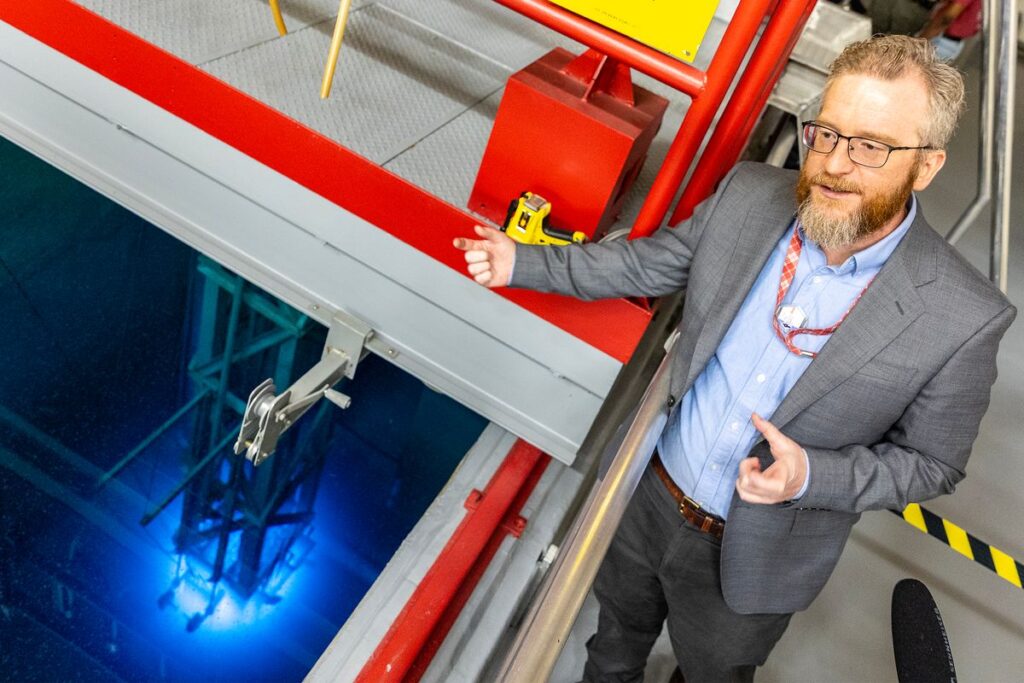
PULLMAN — About 65 years since its reactor became active, staff at Washington State University’s Nuclear Science Center say they’re working to ramp up capacity for research and workforce training in the coming years.
For decades, the facility has provided radioisotopes for various research facilities and national laboratories, as well as partnering with Idaho National Laboratory to be the sole provider of radioisotopes used for first responder field training.
According to the International Atomic Energy Agency, radioisotopes are the unstable form of an element that emit radiation to transform into a more stable form.
The center also trains students, many of whom are undergraduates, to earn their reactor operator licenses. That’s unique, said Corey Hines, the center’s director. Many people don’t start in the nuclear workforce until they’re at the graduate level.
“What we’re hearing from the industry is we need people, way earlier on, to get interested in this,” he said. “We need people that are health physicists, that are radio chemists, that are welders, that are technicians.”
Last year, eight students earned their reactor operator license, Hines said, and he expects over 10 this year. But that’s not all the university has planned.
According to industry estimates, around 300,000 people will be needed to meet nuclear workforce needs by 2050, said Kim Christen, vice president for research at WSU. In response, she said, WSU plans to expand its available courses.
“We’re developing a series of degrees, certificates, and micro-credentials,” she said.