
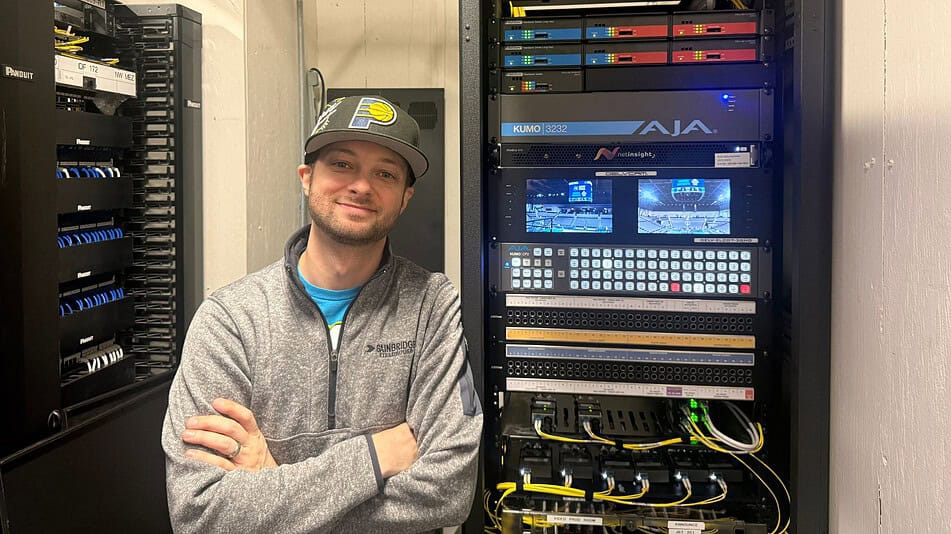
The production method, which spans a distance of 36.2 miles, was designed and implemented by the Pacers’ in-house engineers
When the Noblesville Boom became an official franchise in spring 2025, the new G League Affiliate of the Indiana Pacers was in the midst of building a home at The Arena at Innovation Mile (AIM). After its subsequent opening last summer and with the help of an IP-based control room at the Pacers’ Gainbridge Fieldhouse, Pacers Sports & Entertainment (PSE) has remotely produced the Boom’s home broadcasts despite a 36.2-mile distance between Indianapolis and the town of Noblesville, IN.
“When our G League team moved to Noblesville, we had to figure out what we wanted to do,” says Emily Wright, AVP, broadcast engineering and operations, Pacers Sports & Entertainment. “This model allows our production team to continue to use all the resources they know and are familiar with using for all our productions at Gainbridge Fieldhouse.”
Finding the Answer: Engineers Determine the Best Course of Action
For an engineering team as forward-thinking as the PSE crew — which also includes Senior Broadcast Engineer David Hentz, Broadcast Engineer Cameron Smolinske, and IPTV Engineer Noah Jordan — this was a hefty but realistic problem to solve. At the end of the day, both the G League and the Boom required their games to be livestreamed on the league’s website and on NBATV, ESPN+, and Tubi.
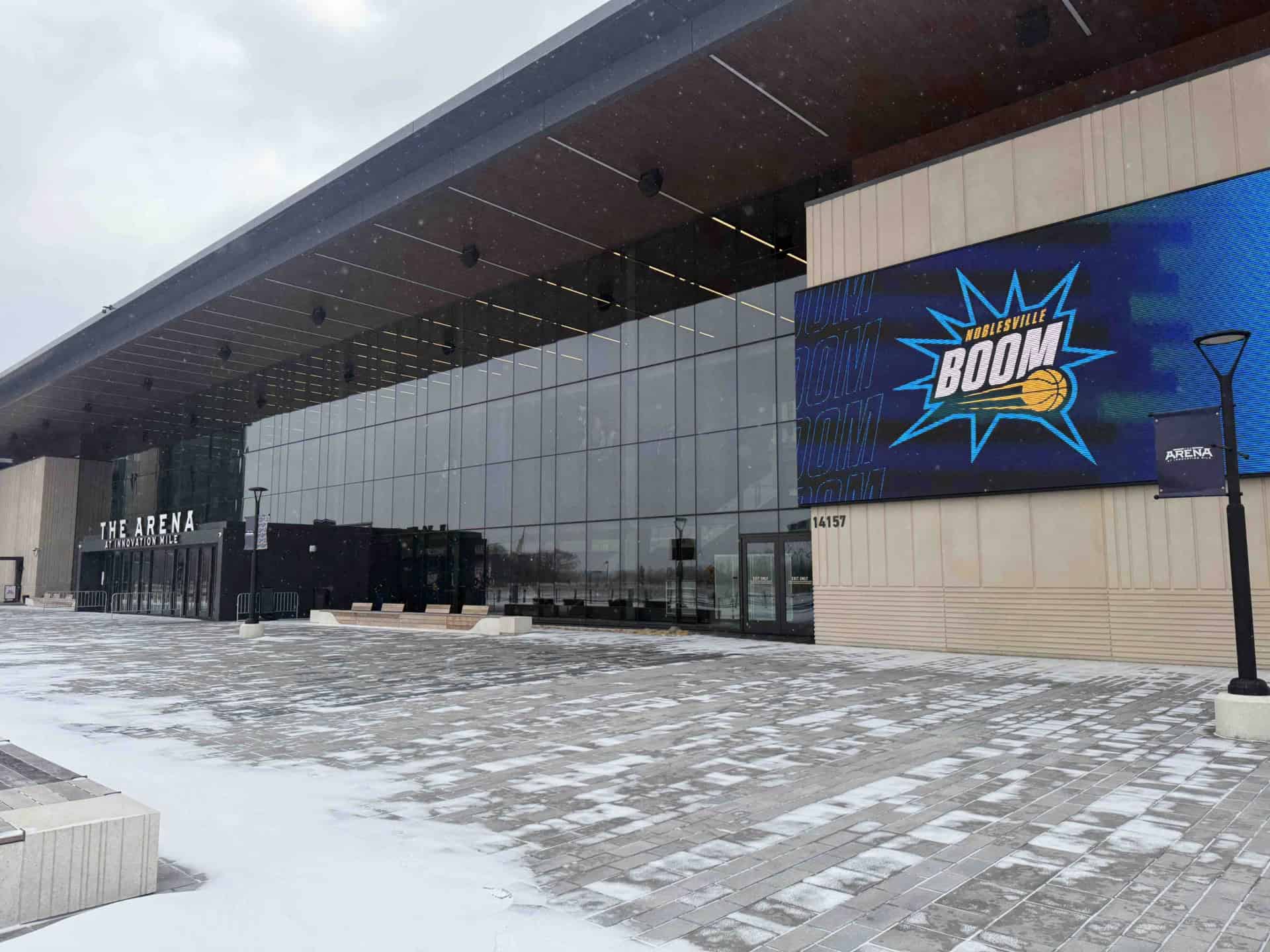 The Arena at Innovation Mile, which opened last summer, is the new home of the Noblesville Boom.
Initial conversations about what could be done took place in January 2025; with a project of this size, any and every potential solution was discussed. Ideas ranged from building a permanent control room at AIM, using a mobile unit parked outside the venue as a traditional onsite model, or, the most tedious, setting up and striking a temporary production environment for every home game.
The third option was a possibility: it’s what Smolinske did when the former Fort Wayne Mad Ants shifted their home games to the state’s capital city. Ultimately, though, the strategy was scrapped.
“We had leveled up our G League production when the team came down from Fort Wayne and played at Gainbridge for a few seasons, and we did not want to go back,” Wright explains. “Re-creating our control rooms in Noblesville was not a realistic option, and we considered just about everything else.”
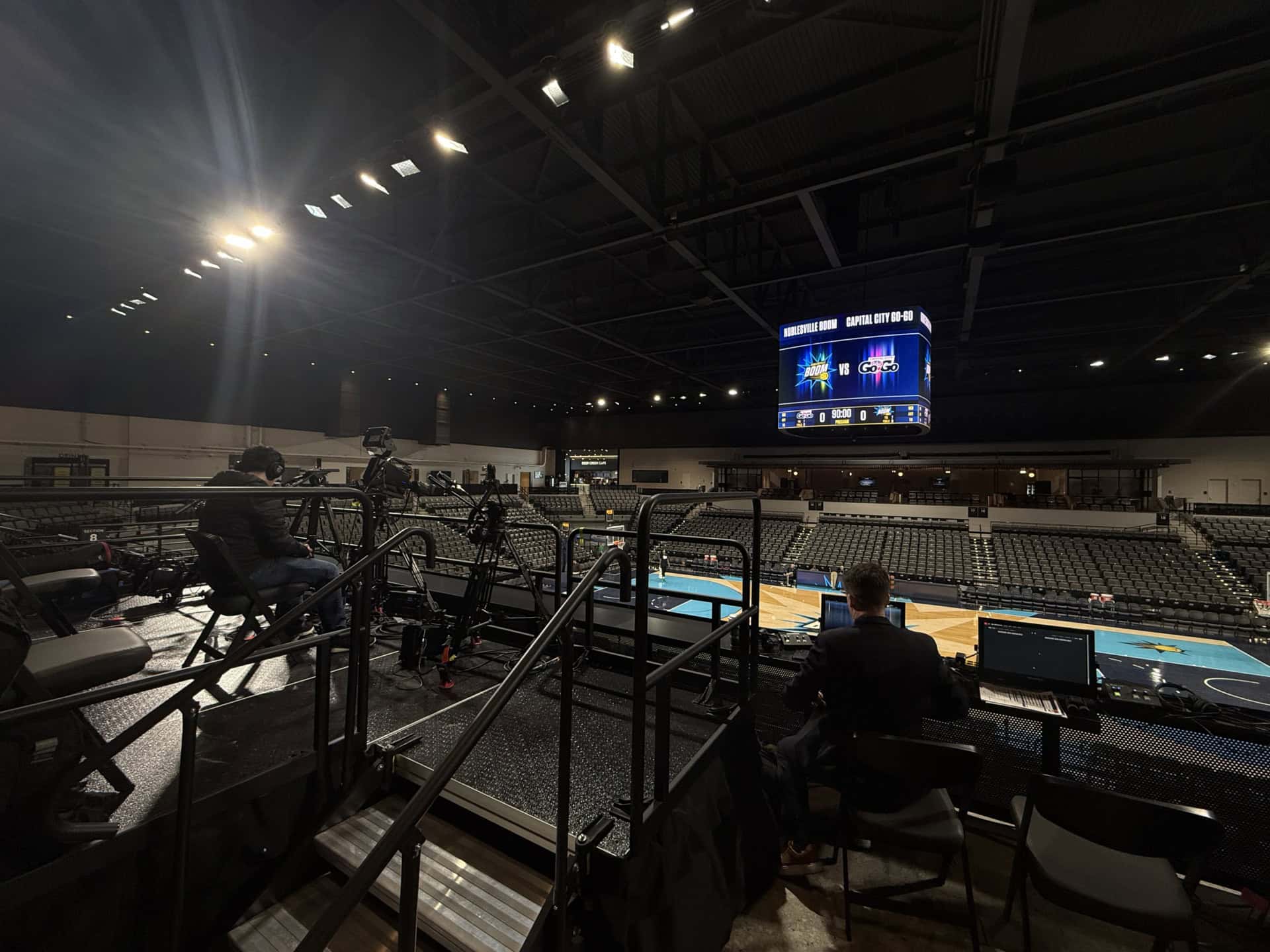 The venue is located 36.2 miles from the control room in the northwest Indianapolis suburb of Noblesville, IN.
Understanding Smolinske’s experience and how time-consuming this style of production would be, along with how costly building a control room at AIM or deploying a mobile unit would be, the team needed to find a way to replicate the production values generated at Gainbridge Fieldhouse without re-creating yet another setup. The answer was closer than expected: the remote-production route in the SMPTE ST 2110–powered control center. Featuring two control rooms, the facility, which opened in 2023, is more than capable and has become reliable during a calendar that has gotten busier by the year.
“We wanted to have the same amount of horsepower to make those shows the best they can be,” says Smolinske. “It was a push from us because we have the capabilities and can do this now.”
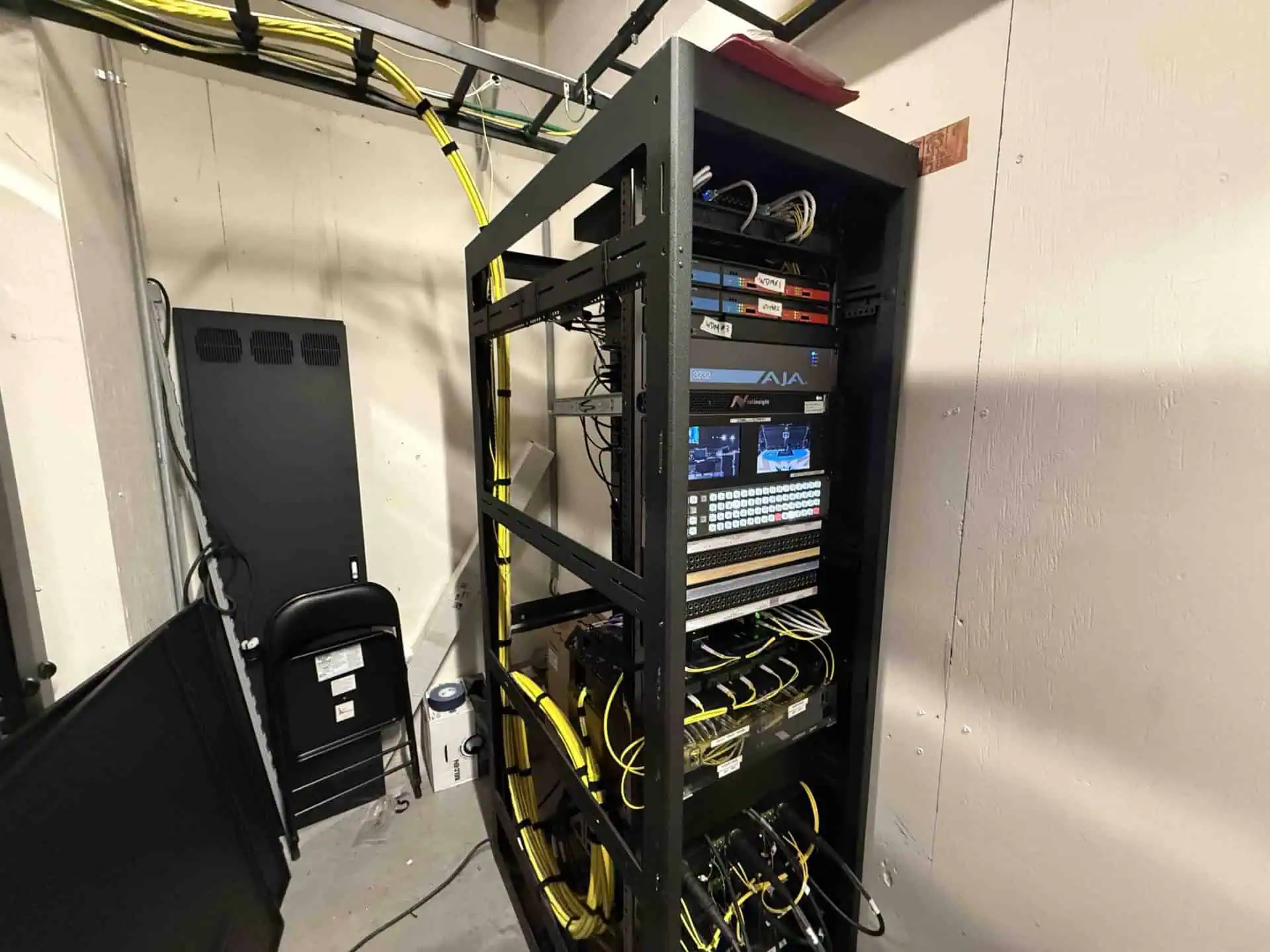 The remote-production setup, which officially went online in December 2025, is driven by a permanent tech stack of AJA Kumo’s local-routing technology and MultiDyne gear connecting to Gainbridge Fieldhouse in Indianapolis.
The result was a lightweight and low-footprint solution at AIM. The setup, installed during the venue’s opening and launched in December 2025, features a permanent tech stack of AJA Kumo’s local-routing technology and MultiDyne gear connecting AIM to Gainbridge Fieldhouse via the venue’s rack room; in addition, two flypacks help send and receive 18 video feeds.
At Gainbridge Fieldhouse, two workflows in the rack room — EVS Cerebrum and similar gear from MultiDyne — allow any PSE engineer to natively tap into the remote network and stay connected to the Boom’s home arena, respectively. This behind-the-scenes operation is creating a high-energy, fun-filled environment for Boom fans.
“The fact that we can bring all of this to a production at AIM, which is 36.2 miles away, translates into a better guest experience for our fans all around,” says Carl Ceresoli, chief information officer, PSE.
Closing the Gap: System Has Multiple Backup Plans, Near Zero-Second Latency
On the surface, the system seems straightforward, but, behind the curtain, Hentz is figuring out ways to ensure that contingency plans are in arm’s reach and create ways to improve broadcast delivery. For the former, redundancies were baked into the initial design. Via intercoms installed in the control room at Gainbridge Fieldhouse, the crew can fix any issues remotely from Indianapolis or onsite in Noblesville to keep the broadcast on-air without interruption.
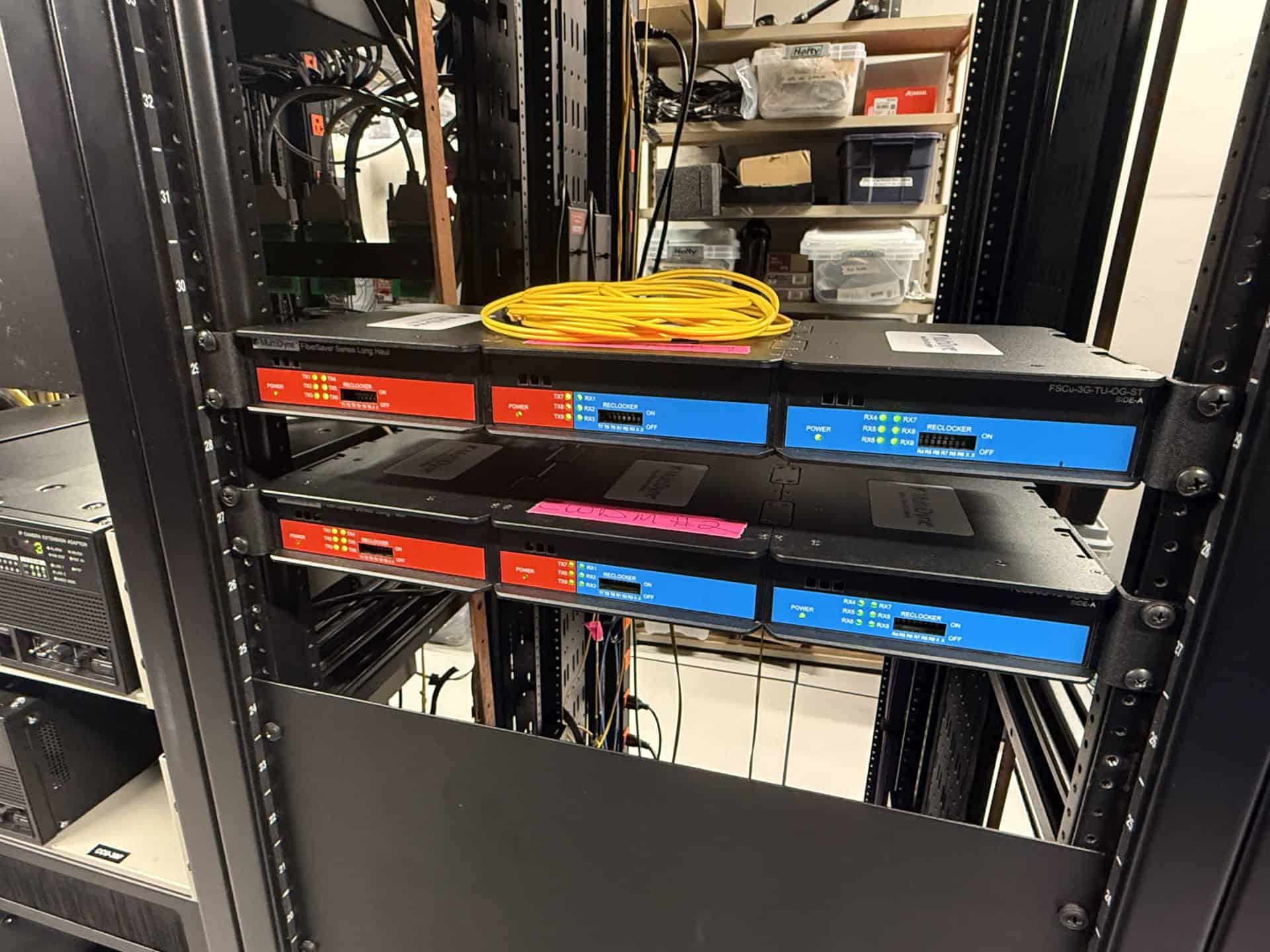 At Gainbridge Fieldhouse, MultiDyne hardware receives and sends 18 video feeds for the broadcasts.
“If we were to lose a fiber path,” says Hentz, “we’re able to choose cameras from different sources and re-marry everything with a push of a single button. We also have four failover plans, including one that takes over the audio that gets used [for the in-venue production], uses the videoboard feed at AIM, embeds everything together, and sends the new feed to G League in no time.”
For that plan, one of Hentz’s main goals is to maintain the lowest latency possible. The 36.2-mile distance is quite long, and establishing connectivity to cover it can be expensive, but, with a preexisting fiber corridor in Noblesville, PSE needed to construct only a mile of fiber. Constructing all 36.2 miles would have cost $8.5 million. With a sturdy backbone in place, Hentz has calculated less than a third of a millisecond of latency, which to the naked eye makes the in-person experience and the televised broadcast nearly identical.
“This allows immediate interaction with our director, producer, and camera operators and shows real-time reactions [by on-air talent] when a player does something exciting,” he says. “Our crew gets to just feel the game instead of having to think about it. Since we’re leaning on the production crew to be masters at what they do, we need to be proactive from an engineering perspective. That means communicating and labeling our technologies properly but also fleshing out extra resources to deal with redundancy, failover, flexibility, and eventual growth. We’re using about half the [system’s] power, so we still have a lot of room to grow.”
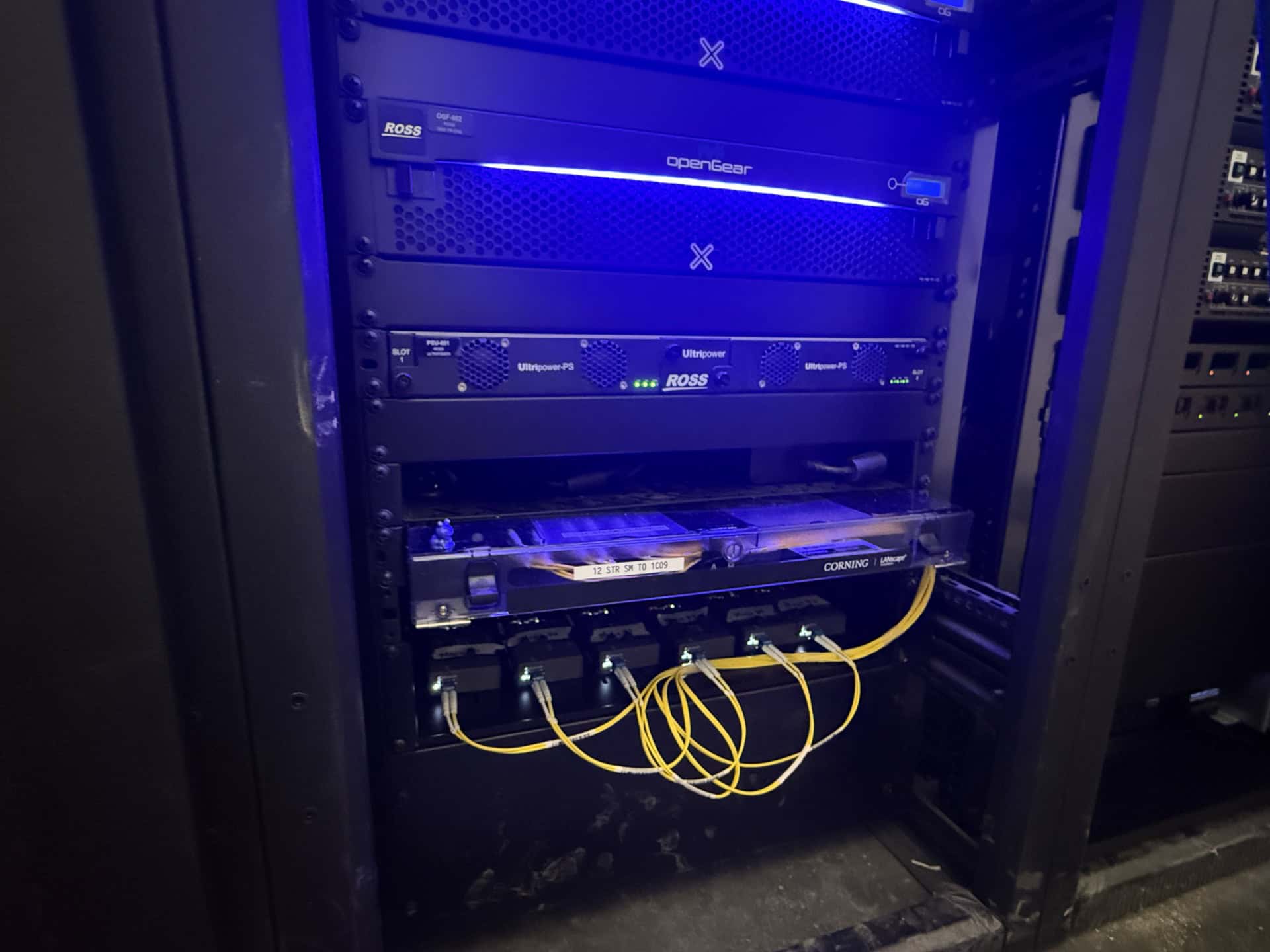 As a backup plan, technology in the control room at AIM sends a videoboard feed to Gainbridge Fieldhouse.
These two aspects of the operation can be overloaded if the main control room is in use for basketball games at Gainbridge Fieldhouse. On Sunday, Feb. 22, the crew was tasked with producing simultaneous productions for the broadcast of the Noblesville Boom vs. Capital City Go-Go at 3 p.m. ET and the Indiana Pacers vs. Dallas Mavericks in-venue show at 5 p.m. Both the control center and tech stack at Gainbridge Fieldhouse were certainly put to the test, but, with proper planning and prep work, the two workflows had minimal hiccups.
“We need to be detailed for a single production but even more so for dual productions,” adds Hentz. “It’s not overly difficult, but it’s more about being aware about documentation and pre-building your infrastructure.”
Truly One of One: Vendor-Agnostic Approach Enables Customizable Solution
Whether it’s the all-star group of engineers that PSE assembled or a production trail that hasn’t been traveled, the project thrives by harnessing a different mentality than most. Many projects require systems integrators or certain equipment that works well together from an interoperability standpoint, but Wright and her crew opted for a vendor-agnostic system optimized with the best hardware and software on the market.
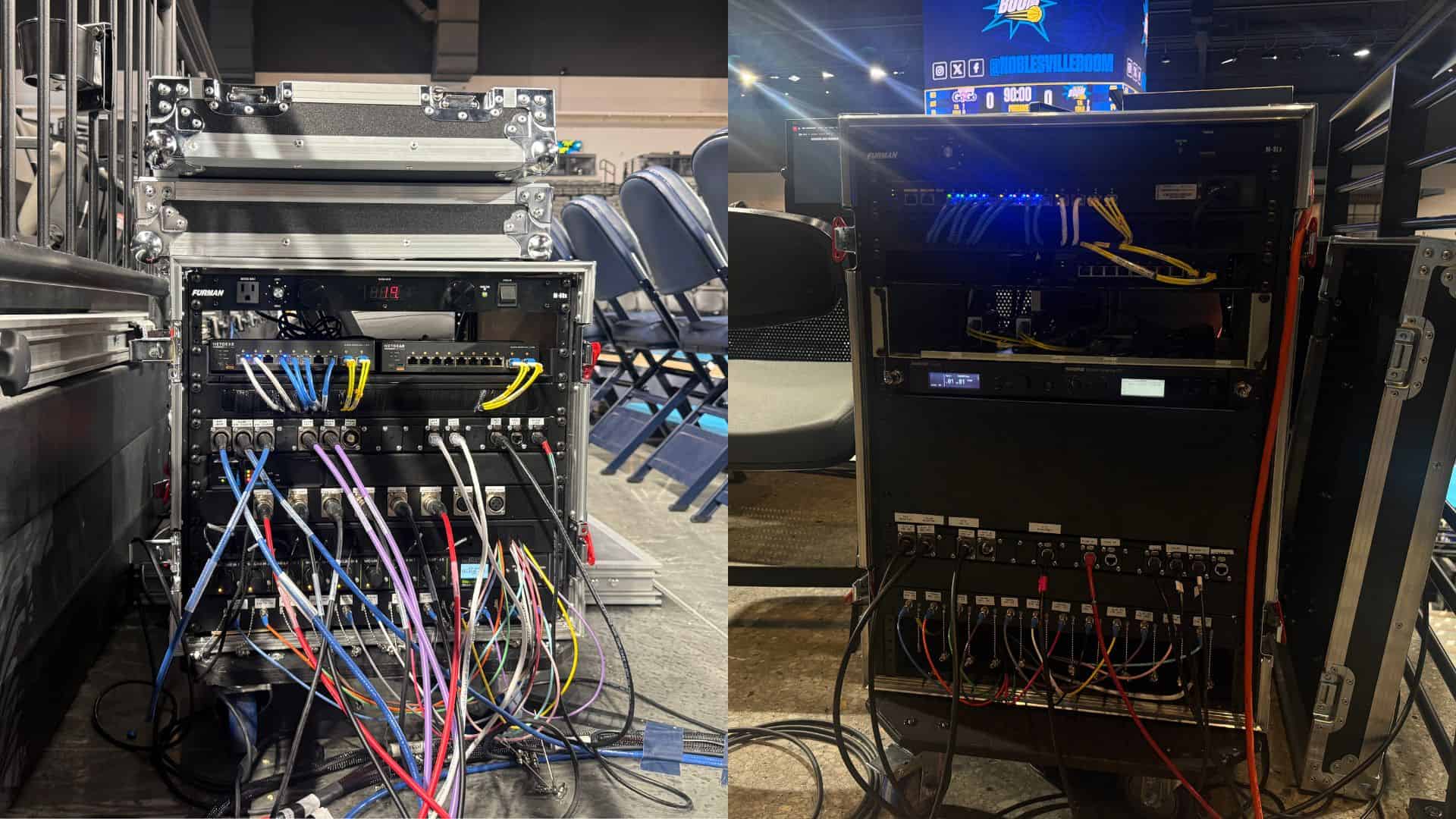 Two flypacks are deployed at AIM: one near the court (left), the other next to the camera platform on the concourse.
“We took a different approach by allowing our full-time PSE broadcast-engineering team to design, source, and implement the whole thing,” says Wright. “While it required considerable effort at the outset, this resulted in a solution perfectly tailored for PSE and the Noblesville Boom. While others may use CWDM [Coarse Wavelength Division Multiplexing] to transmit video and network signals over fiber, no one has combined all these elements into a complete control-room solution. This design is genuinely unique.”
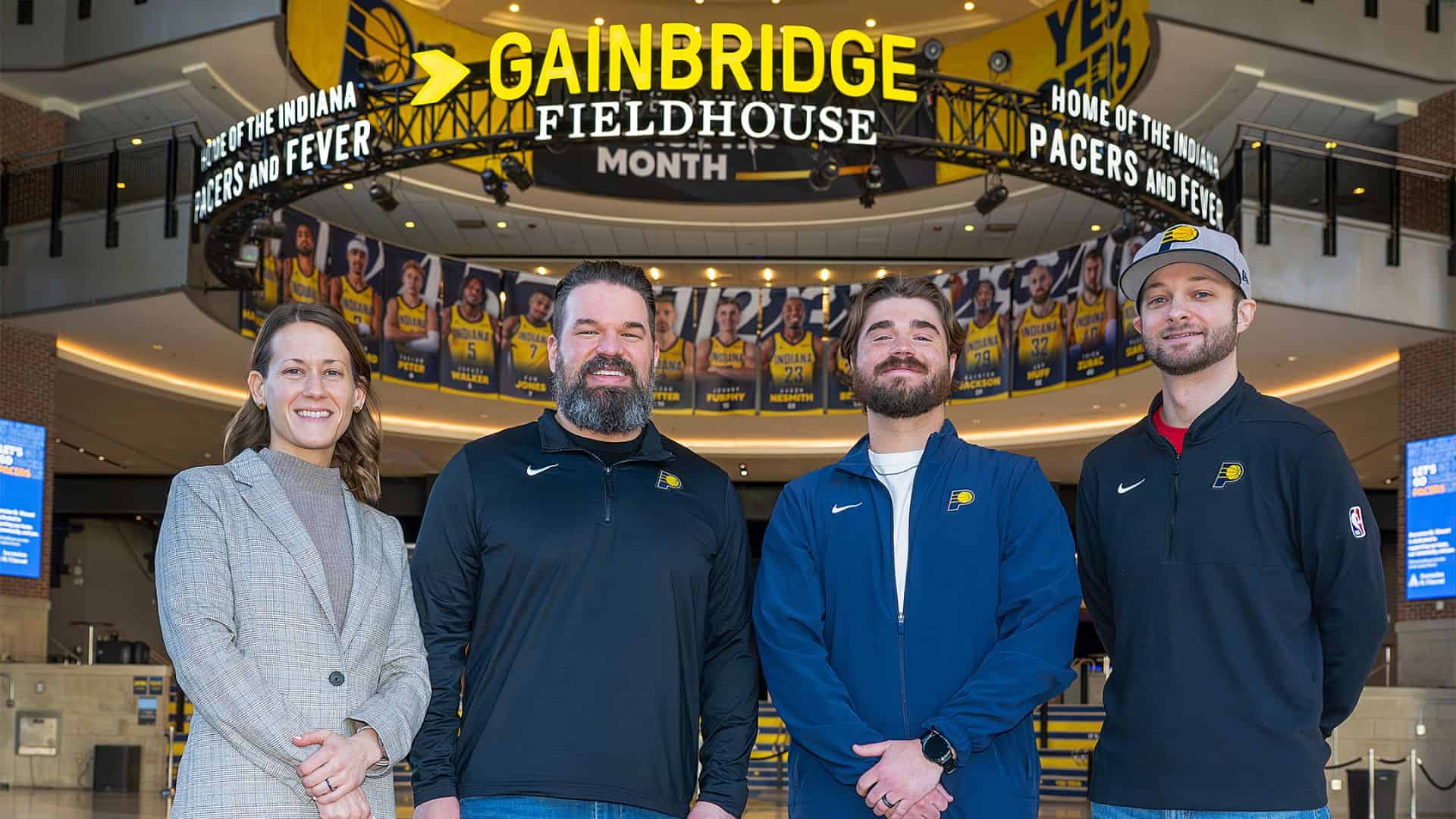 Pacers Sports & Entertainment engineering team: (from left) AVP, Broadcast Engineering and Operations, Emily Wright; Broadcast Engineer Cameron Smolinske; IPTV Engineer Noah Jordan, and Senior Broadcast Engineer David Hentz
Experimentation and innovation were a hallmark of the engineering team’s approach to this project; Ceresoli and other PSE executives have created an environment that encourages the team to branch out and test new workflows. In a workplace built on ingenuity, resourcefulness, team collaboration, and fearlessness, systems like these can turn from conception into reality.
“We’re focused on setting a standard,” adds Hentz. “Executives in our C suite want this to succeed and give us the freedom to do it. The G League constantly reaches out to us to see what we’re doing and how we’re doing it, because they want other teams to emulate [this plan].”
The Status Quo: Remote Solution Results in the Same Production Quality
Although complex and in need of constant communication and tinkering, the project is quite ironic: if the system is working normally, Boom fans, as well as production staff in the control room, shouldn’t be aware of it.
Hentz, who has poured time and passion into this one-of-a-kind deployment, would rather the system go unnoticed to ensure a smoother production. “If you watched a game before this change and a game after it, you would have had no idea that we deployed this new system. The fact that it’s status quo behind the scenes that not even our production crew sees a difference, that’s an unmeasurable win.”
For the person leading this team, it’s another feather in an already crowded cap. “I’m incredibly proud of our team for this achievement because this technology is truly remarkable,” says Wright. “Our production has always been a source of pride for us, and this latest innovation is no exception.”