

Could some mix of the Mossad and IDF special forces carry out a targeted ground penetration of a critical and sensitive target in Iran, such as abducting specific Iranian leaders, seizing nuclear program-related items, or some other issue that is too sensitive to leave to an airstrike from a distance?
In September 2024, Israel’s Shaldag special forces raided an underground Iranian facility in Maysaf, Syria, which was due to eventually produce long-range precision missiles for striking Israel.
Pieces of the operation were leaked at the time, but in January 2025, virtually every detail one could imagine about the operation was leaked, and in mid-2025, a key operation participant openly interviewed about it.
Can lessons from Maysaf, Syria, be applied to Iran?
Without getting into any highly specific details, until the US and Israel dropped a combined 6,000 bombs on Iran’s armed forces starting on February 28, the Islamic Republic’s military was far stronger than Syria’s forces of 2024.
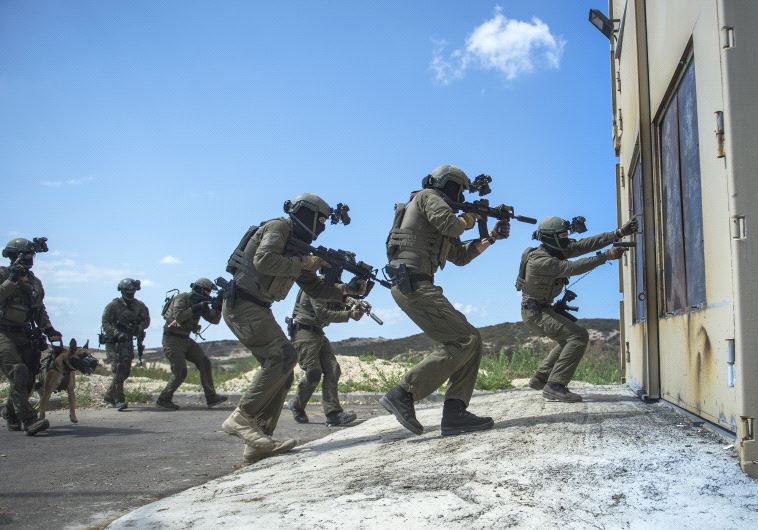
Also, if the Mossad or IDF special forces wanted to carry out an operation at the underground Fordow or Isfahan nuclear facilities, both are far deeper than Maysaf.
And there are a variety of other challenges that could potentially be worse and harder in the Islamic Republic than in Syria.
And yet, without getting into the details in this sensitive period, Israel succeeded in “proof of concept” in September 2024: that it could raid a highly guarded underground site in a foreign country, destroy it, and get out without losing a single soldier.
How did they do it?
There were five Syrian underground tunnels to the Maysaf facility, guarded by 11 different Syrian posts clumped together in three main positions, manned by around 30 Syrian troops.
This was no walk in the park.
Israeli aircraft, drones, and helicopters attacked the Syrian positions before four helicopters dropped off dozens of Shaldag special forces to proceed to the facility on foot.
Shaldag forces came from two different directions, while the primary force was dropped off around 700 meters from the main Maysaf facility entrance, where the IDF would penetrate inside.
An initial attack by Israeli air power and the first wave of IDF special forces killed around 26 of the 30 Syrians, while four survived.
Shaldag forces then advanced and killed the remaining four Syrian guards.
At least two of those killed were guarding the entrance to the base, and some Syrians were in jeeps or a motorcycle that tried to approach and assist.
The mix of a first strike, which caught the guards by surprise, and then rapidly eliminating any remaining guards was essential to the IDF special forces’ exit strategy from Syria before large reinforcements might arrive to overwhelm the relatively large Israeli ground forces.
During the around two-and-a-half hour operation, dozens of additional Syrian forces dashed to the area to try to oust the IDF special forces from the site, but getting there took them. Even once they arrived, a mix of IDF airpower and portions of Shaldag forces defending the perimeter blocked them from interfering with the covert operation.
However, IDF sources estimated that if the operation had gone on another hour or so, hundreds of Syrian forces, including with greater firepower, would have arrived and potentially could have killed the Shaldag forces.
After the initial fighting, the Shaldag forces used unspecified classified means to break open the main doors of the facility, which were locked in a very complex way.
This process took some significant time, and carrying it out as fast as possible was another critical part of the mission planning to avoid the Shaldag forces being overtaken by large Syrian reinforcements.
Once the door was breached, another element of Shaldag forces with a mini-tractor and a variety of explosives and specialized trained explosive experts entered the facility along with dozens of IDF special forces to ensure the destruction of various Syrian weaponry and weapons production facilities inside.
In theory, all of these tactics could be used – with necessary tactical modifications to the specific target, guard arrangements, tactics for securing or destroying the target, and exit strategy arrangements – in Iran as well.
How would IDF elite units operate in Iran?
Adjusting tactics would be critical, though, since, for example, recalling how much deeper underground Fordow and Isafahan are compared to Maysaf.
However, throughout June 2025, the IDF did not carry out such an operation – it appears that regarding Iranian territory, it was considered more dangerous even during the bombing.
Given that Iran is a country of around 90 million people and the Islamic Republic has tens of thousands of IRGC forces and up to two million Basij militia forces, carrying out a ground operation may still be highly dangerous, even given the more extensive bombing of the regime during the current conflict.
So any decision to launch such a ground operation would truly need to justify why only such an operation could achieve Israel’s aims.
Regarding the nuclear issue, if Israel wanted to retrieve some of the 60% Iranian enriched uranium as opposed to destroying it or keeping it buried under rubble, that could be a rationale.
Such an operation with IDF special forces might also be preferable to a completely covert, much smaller Mossad spy operation, with no special forces and less air support, if specific hardware or heavy tools like those needed in the Maysaf operation could not be easily sneaked into and around Iran under the security forces’ radar.
While the Mossad did manage to secure many trucks and flame throwers to seize Iran’s physical nuclear secret files, apparently, all of the elements the spy agency brought to bear still carried a smaller footprint than the size of the force and the equipment used in the Maysaf operation.
Simply put, there are some operations that can be carried out covertly by a small cell of spies, and some that require a larger complement of special forces.
There are other large-scale operations that could require special forces in addition to any Mossad agents already on the ground, or even operations to be led by the CIA and American special forces, with Israeli covert operators playing a junior role.
Numerous foreign reports have talked about American efforts to mobilize the Kurdish region of Iran into an open rebellion using force against the regime.
In that sense, it is worth remembering that Maysaf showed that one scenario of using special operations ground forces in Iran, which might have been dismissed as wildly too risky before September 2024 and before the current intense bombing weakened the regime, is in fact quite possible.