
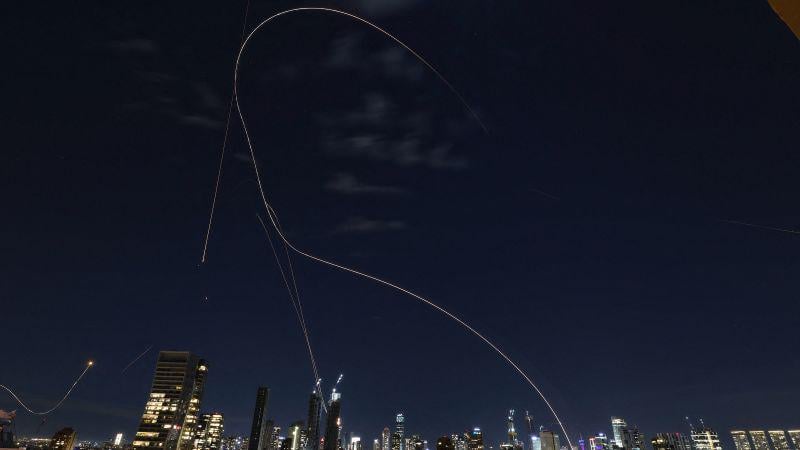
Four days into war with Iran, at least one of the United States’ Gulf allies is already running low on crucial interceptor munitions used to defend against Iranian missile and drone attacks, two sources told CNN.
That mirrors concern across the region, including in Israel, about the stockpile of weapons needed to defend against Iranian attacks, especially as President Donald Trump has floated an extended timeline for the campaign.
Now that the war is expanding, it’s a numbers game: How many interceptors will the US and its regional allies need to continuously shoot down Iranian missiles and how many, if any, of those weapons will need to be redirected from other stockpiles earmarked for US forces in the Pacific? US rivals like China will be watching closely.
The immediate concern is the stock of defensive weapons held by Gulf allies, not the US. In the war’s early days, Gulf countries such as Bahrain, Qatar, the UAE and Saudi Arabia have in general tried to shoot down every missile or drone from Iran. The munitions crunch might force a change in tactics for Gulf countries, according to Becca Wasser, defense lead for Bloomberg Economics, who said that eventually they may have to become “more selective” in what they target.
https://edition.cnn.com/2026/03/04/politics/missiles-weapons-stockpile-iran-us-war
18 Comments
Submission statement:
This article raises the issue of the competing stockpiles of US interceptors and Iranian drones and missiles. While US stockpiles are not in immediate danger, they can be severely exhausted in the case of a protracted war, which is what we’re looking at happening based on Trump’s latest rants. The bigger issue is not actually US stockpiles but the stockpiles of US allies in the region, they may soon be forced to be more selective with which attacks they try to stop and which ones they have to let through.
I have seen the comment made that Iran may be holding back ballistic missiles, while flooding regional neighbors with lower cost shahed drones. The flood will deplete interceptor munitions, and waves of ballistic missiles could then be used to inflict severe damage with impaired defence capabilities.
I am ignorant of how Iranian forces launch their munitions. Is it feasible for US and Israeli forces to diminish those launch capabilities significantly before allied defensive capabilities are substantially degraded?
Probably of greater concern is that a regime change is more remote by the day, if the war ends inconclusively, US will need to come back and “mow the lawn” for the foreseeable future.
The only long term solution would be regime change in Israel and US, but we don’t have anyone strong enough to force t.
This article, like similar recent discussions on Reddit, only looks at half the equation. How many missiles does Iran have? How quickly is Iran expending those missiles? And how quickly is Iran losing missiles to US airstrikes?
These discussions implicitly assume Iran has an unlimited supply. Unlike Russia (wrt Ukraine ) Iranian missile launchers, storage facilities, production facilities, nor supply lines are safe from US strikes.
It is unlikely that Iran will sustain any significant ballistic missile production.
So the real question is: will interceptor stocks run out before Iran runs out of missiles?
Recently Joint Chiefs Chairman Gen. Dan Caine remarked strike operations are proceeding more inland, I assume in the mountainous regions. Perhaps this is in response.
Can someone educate me on how Iran can attack various perceived allies of the US without being an international pariah and not triggering any defensive pacts or severe retaliation?
I predict the carriers need to retreat by end of this week, to avoid their defenses getting saturated and running out of interceptors.
Prediction recorded here: [https://falsify.app/p/xDw4ogEWu9VTMdlXbfha](https://falsify.app/p/xDw4ogEWu9VTMdlXbfha)
And Iran’s missile stock is either static or growing? Doubtful.
General Caine said during today’s briefing that irans volume of fire for ballistic missiles is already down 86% since the start of war.
The layered effects of US and Israeli strikes:
Destruction of the missile launchers : missiles outnumber launchers. Iranian launchers are getting destroyed right after launch along with their crews, reducing availability and producing fear
Heavy bombers are destroying stored stockpiles and industrial infrastructure . The remaining missile stock is diminishing and the production capacity is paralyzed and degrading
Command and control degradation as layers of command are taken out and crews run out of preplanned actions
I think after this week the primary problem for the us will be shaheds rather than miissiles.
For the missiles the problem is the American and Israeli platforms overhead will see geolocate and track them immediately once they detect the heat signature of the launch , with a strike coming down in minutes. They have to launch when a tactical fighter or drone is not overhead, or they are dead . A tactical fighter at 50000 feet is silent and invisible from the ground. Without a functioning radar network the missile crews won’t know when it’s safe.
Speed up production of new ones, we have the war powers act use it to divert money and resources into weapons production facilities. Seriously if we have to go to war with China things will be significantly harder than Iran so use this crisis to stress test solution for how to deal with China shoild that day ever come.
Iran is being supplied by China. They have ammunition for days.
No one is shooting THAAD’s at overbuilt RC planes.
We have CRAM’s and other guns for that.
I guess everyone in here is a CNN subscriber. I’m more annoyed that a link got posted that you have to subscribe to CNN to view. Nobody in here mentioning that lol…..
The real question is not how many interceptors exist today – it is whether the production ramp Congress authorized in 2023 (roughly $3.5B for munitions) translates to delivered units fast enough. Procurement to production to delivery runs 18-36 months for complex systems. That math does not favor a war measured in weeks.The Gulf states running low within four days reflects pre-existing depletion. Saudi Arabia has been fighting Houthi drone and missile campaigns since late 2021, burning through Patriots at rates analysts flagged as unsustainable before this war even started. The US had to accelerate PAC-3 deliveries to Riyadh twice in 2024.The real question is not how many interceptors exist today – it is whether the production ramp Congress authorized in 2023 (roughly $3.5B for munitions) translates to delivered units fast enough. Procurement to production to delivery runs 18-36 months for complex systems. That math does not favor a war measured in weeks.The article focuses on interceptor quantity but misses the production side.a
A smart strategy honestly. To counter it they should warn the regime government that reparations will imposed for all damages. Those who pushed the button will be charged for war crimes in those Arab countries and they will definitely get the death penalty.
Who do we send the bills to?
The truth is, nobody knows what percentages of munitions that have been depleted. However, I feel like you can safely assume that the United States and Israel would not even think about launching an attack without a healthy supply of missiles and interceptors.
When it comes to Gulf Allies, Iran seems to be involving more and more countries, which doesn’t seem to be a smart way of going about it. Feels like they are stretching thinner and thinner each day.