
PHOENIX (AZFamily) — Sandro Cilurzo was a cybersecurity officer at a Swiss healthcare facility when the same problem kept landing on his desk every month: falls.
Nine years later, his AI-powered radar device called Paul has helped some Arizona senior communities reduce falls by up to 72% within weeks of installation.
Across the United States, falls are common and the consequences can be dire. 14 million Americans age 65 and older fall each year. Death rates from falls rose 71% from 2003 to 2023.
Healthcare spending on fall-related injuries hit $80 billion in 2020 and is projected to reach $101 billion by 2030, with Medicare covering two-thirds of the costs.
But Cilurzo’s company, Helpany, is showing AI can make a dramatic difference.
“Paul can understand human motion patterns,” Cilurzo said in the latest episode of Generation AI. “The underlying artificial intelligence is where the heavy lifting and the magic is coming from. Because the AI truly understands not only that there is motion, like a regular motion sensor. Paul understands what kind of motion pattern is happening [and] where in the room.”
6 Billion Motion Measurements From Switzerland to Phoenix
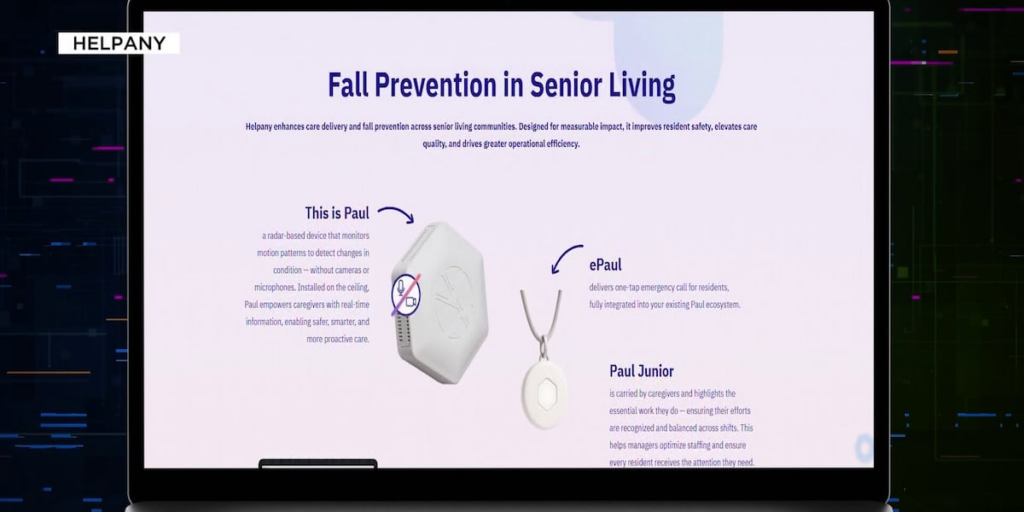
The device looks like a smoke detector mounted on the ceiling, and Cilurzo confirmed that’s by design. It uses radar technology without cameras or microphones to track how residents move through their apartments.
“Paul understands gait, posture, stability of walking, stride length. How does a resident take their steps from A to B? How do they get from a standing position into a seated position? How do I get out of my chair in the evening? Quality of the nighttime recovery. How do I sleep?” Cilurzo explained. “All of that matters because these are often early signs if a resident has an elevated risk of falling, given on how they move through space.”
The AI draws from a massive dataset. Since launching in Switzerland in May 2019, Paul has collected over 6 billion motion measurements from seniors. This helps the device adapt to individual baselines while applying broader patterns it has identified, Cilurzo said.
Helpany started serving Arizona communities in January 2024, and Cilurzo moved to Phoenix full-time a few months later. The company now has thousands of devices deployed across the Phoenix metro area and Tucson.
First Month Impact: 67% to 72% Reduction in Falls
The company’s early results from three Arizona case studies are striking. Park Senior Villas saw a 67% reduction in falls. Fellowship Square Mesa achieved 69%. Westminster Village in Scottsdale hit 72%.
“The impact was immediate,” Cilurzo said. “Literally after Paul was installed and we roll out what we call the Help Any program. This is literally the workflow which is introduced to these communities from the first month onward. It’s a radical drop.”
A broader analysis across 11 Arizona senior communities showed an average 66% monthly fall reduction, Cilurzo said. The company’s results have not been independently validated by outside research, but Cilurzo suggested that’s part of the plan going forward.
The device works by alerting staff when residents show elevated fall risk patterns. At 2 a.m., if someone gets out of bed with an unsteady gait, staff receive a preventive alert to check on them.
“Paul is not preventing the fall. The caregivers are the heroes,” Cilurzo emphasized. “The heroes on the floor are the humans, which leverage that information to be much faster in spotting potential challenges, changes in conditions, a rising risk, and make through that proactive interventions.”
The Hawthorne Effect Question
I pressed Cilurzo on whether the positive impact of the device might actually stem from the Hawthorne effect, a psychological phenomenon where people tend pay more attention to their tasks when they know they’re being monitored.
Maybe the staff at these nursing homes are paying more attention to residents because they know the device is monitoring them, I suggested.
“We can be really certain from the impact size because the numbers are really significant,” he responded. “You can literally say that as soon as you have a look into the communities when they start serving different level of care. They implement it, for example, first in assisted living then, maybe memory care. So you see it’s a timed rollout and you can literally see how the impact unfolds over time.”
He acknowledged that other variables do influence the outcome, but framed that as part of the design. Paul, he said, creates a new culture of proactive care. It’s one where caregivers are enabled to spot rising risks before a fall ever happens.
“And yes, there are of course many different variables which influence the outcome,” Cilurzo said. “And this is part of the program because it is really a holistic approach.”
“It creates a new dedication to excellence, which influence these numbers,” he added.
What’s Next for Paul and AI in Elder Care
Cilurzo sees the technology as part of a broader shift in how the healthcare industry approaches aging.
AI is “the perfect match to address some of the really big problems,” he said. ”We have the demographic changes. More older people will be there. [The population] is growing really fast. We need to have more assistants. And I see that AI has the ability to change the paradigm.”
When asked whether Paul’s radar technology could eventually be applied to detecting cognitive decline or other health conditions, Cilurzo said the potential is there.
“In theory, yes, absolutely,” he said. But at the moment, he said Helpany is focused on solving the biggest problem facing seniors today: falls. In the last several months, Helpany has expanded from operating only in Arizona to three states.
See a spelling or grammatical error in our story? Please click here to report it.
Do you have a photo or video of a breaking news story? Send it to us here with a brief description.
Copyright 2026 KTVK/KPHO. All rights reserved.