
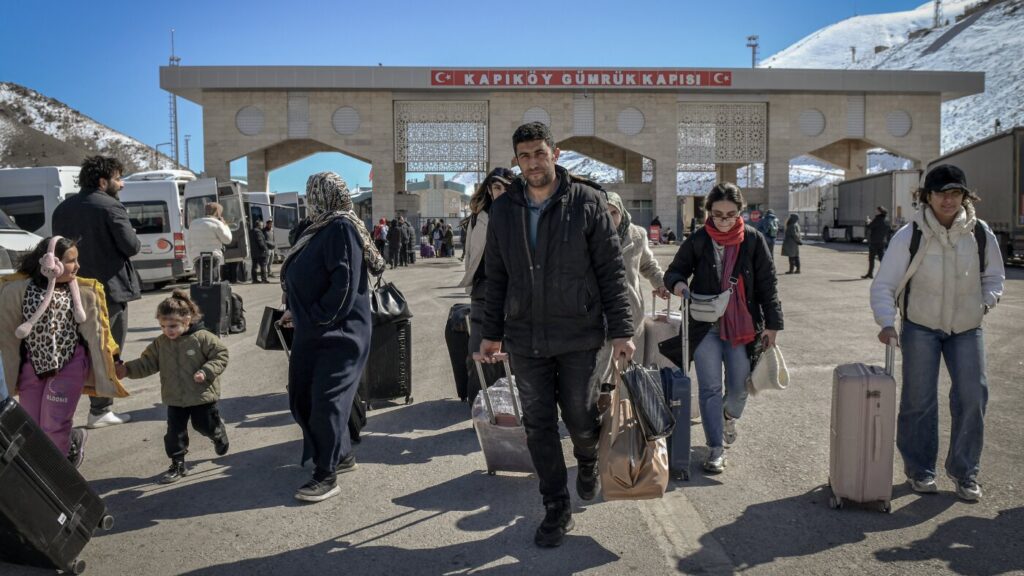
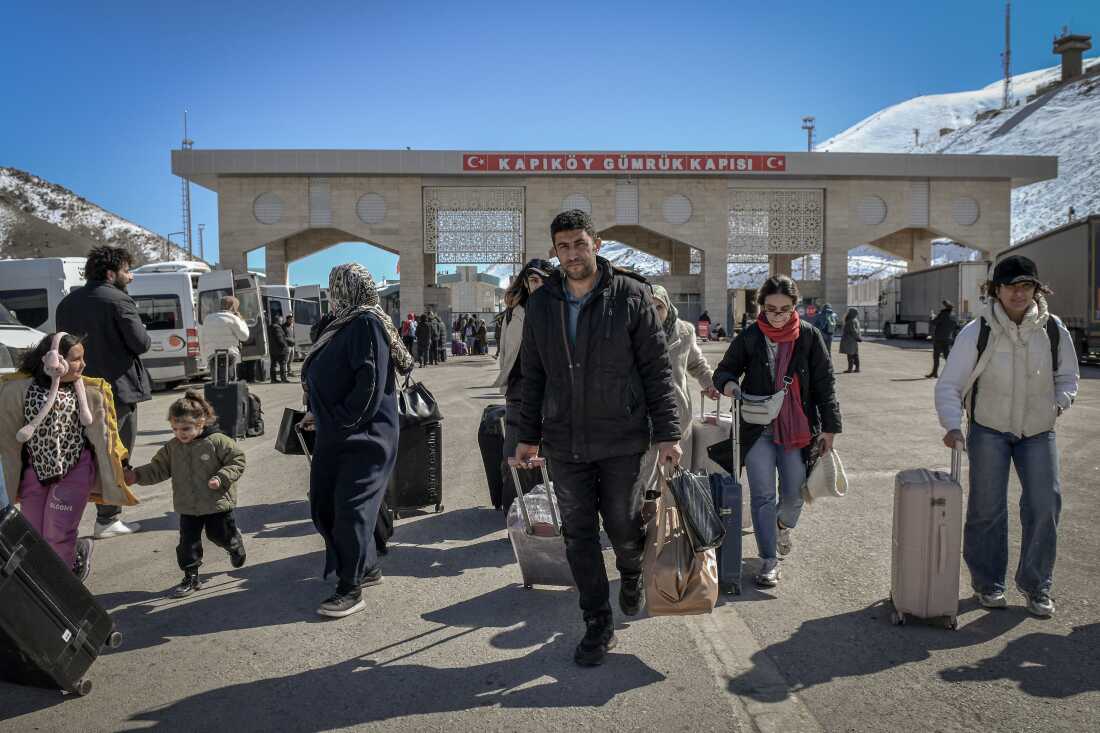
Iranian nationals arrive in Turkey after passing through the Razi-Kapiköy border crossing in Van, northeastern Turkey, on Tuesday, a day after Turkey and Iran mutually suspended day-trip crossings at their border as Israeli-U.S. strikes continued to pound the Islamic Republic.
Ali Ihsan Ozturk/AFP via Getty Images
hide caption
toggle caption
Ali Ihsan Ozturk/AFP via Getty Images
The war with Iran continued to widen Thursday as Azerbaijan, a key U.S. ally, said drones launched from Iran hit an airport in its Nakhchivan region, while U.S. and Israeli forces struck more targets inside Iran.
Azerbaijan’s Foreign Ministry said it demanded an explanation after the drones crashed into the airport’s main terminal building and another landed near a school, injuring two civilians.
Also on Thursday, Iran’s Revolutionary Guard claimed in a statement that its naval forces struck an American oil tanker in the northern Persian Gulf. The U.S. made no immediate comment.

The claim comes as the fighting has disrupted commercial shipping through the Strait of Hormuz, one of the world’s most important energy corridors. Traffic through the normally busy route faded in the first days of the conflict, after Iran declared it closed and attacked some ships that attempted to cross through it.
U.S. Central Command and Israel’s military said they conducted new strikes inside Iran overnight. The Israeli military said Thursday that its air force dismantled an armed ballistic missile launcher near the city of Qom that it said was ready to fire at Israel. It also said it struck an Iranian air defense system in Isfahan.
Since the attacks began, more than 920 people in Iran have been killed, according to the Iranian Health Ministry, including Iranian Supreme Leader Ayatollah Ali Khamenei and more than 160 people in a strike on a girls’ school.
Here are more of the key updates NPR is reporting on.
To jump to specific areas of coverage, use the links below:
China | Iran |Israel war aims | Lebanon | House war powers | U.S. soldiers identified
China urges a return to negotiations and names an envoy
With the conflict widening, China urged Tehran and Washington to return to negotiations as the war around Iran unnerves global energy markets.
China is the world’s largest importer of oil and gas and has seen crude prices jump by 10%, while natural gas prices have risen even higher. Ship traffic in the Strait of Hormuz — through which about a fifth of the world’s crude oil and natural gas typically passes — has all but dried up.
China’s foreign minister, Wang Yi, told Saudi Arabia’s foreign minister “the indiscriminate use of force is unacceptable” and that nonmilitary targets should not be attacked.
China on Thursday said it would dispatch Zhai Jun, who has served in the Middle East as a Chinese envoy since 2019, to the region to help mediate the conflict. But the Foreign Ministry didn’t provide more details or say specifically which countries the envoy would visit.
Iran’s foreign minister says the U.S. will “bitterly regret” sinking an Iranian warship
Iran’s foreign minister, Abbas Araghchi, accused the United States of escalating the conflict after the sinking of an Iranian naval vessel in the Indian Ocean, off the coast of Sri Lanka. In a post on X on Thursday, Araghchi called it an “atrocity at sea” and warned the U.S. would “bitterly regret” sinking the frigate Dena, which he said was a guest of India’s navy and was struck in international waters without warning.
U.S. Defense Secretary Pete Hegseth said Wednesday that the U.S. was behind the sinking of the Iranian vessel and said the ship, which was hit by a U.S. submarine, was the first to be downed by a torpedo since World War II.
Sri Lanka’s navy said it rescued 32 people and recovered 87 bodies from the sea where the ship sank, The Associated Press reported.
The U.S. has deployed 50,000 troops, more than 200 fighter jets and two aircraft carriers in the region, according to U.S. officials. CENTCOM chief Adm. Brad Cooper said this week that U.S. and Israeli strikes have hit about 2,000 targets and severely degraded Iran’s air defenses and missile-launch infrastructure.
Israel details reasons and goals for Iran war
New details are emerging about the reasons and objectives for the Israeli-U.S. attacks on Iran.
Israel learned five days in advance that Iran’s supreme leader, Ayatollah Ali Khamenei, would be meeting top Iranian officials this past Saturday, Caroline Glick, an international affairs adviser to Israel’s prime minister, told NPR.
She said that was one factor that led the U.S. and Israel to launch the Iran attack that day.
Other reasons included Trump’s concern that Iran would attack U.S. forces and would take its missiles and nuclear programs deep underground where they would be immune from attacks, she said.
Glick said there is no timeline for the operation, but echoed Trump’s remarks earlier in the week that they are “ahead of schedule.”
“We’re ahead of schedule for just about all of our objectives, or all of them,” Glick said. “We’re very, very happy with the pace of operations.”
She said Israel’s objective is to create the conditions for Iranians to topple their regime through protests. Rights groups say the Iranian authorities killed thousands of Iranian protesters earlier this year. Glick said, “We’d like to be able to see a situation where they’re able to do that sort of thing without being mowed down.”
She said she is aware public opinion in the U.S. is mixed on support for the war, but she believes success in the campaign would help persuade those who do not support it.
Separately, Israeli Ambassador to the United Nations Danny Danon was asked about calls for diplomacy to bring the war to an end. He said this is not the time yet, because the U.S. and Israel have to first “finish the job.”
Over 80,000 displaced in Lebanon
In Lebanon, aid groups say conditions are deteriorating for families fleeing strikes in the south, near the border with Israel. Lebanese officials say more than 80,000 people have been displaced, with many staying in shelters in schools or sleeping in cars, and that shelter capacity is running thin.
Israeli strikes in southern Lebanon continued overnight. The Israeli military says it is targeting installations belonging to Hezbollah, the Iran-backed Lebanese militant group, which launched rockets into northern Israel earlier this week.
Hezbollah said its attacks were in response to Israel’s strikes in Iran and the country’s continued strikes in Lebanon even after a ceasefire was brokered last year.
Lebanese officials said more than 70 people have been killed, including children, in Israeli strikes since the war in Iran began over the weekend.
Israel also issued new evacuation warnings for everyone south of the Litani, a river considered a front line in the conflict. This raised fears that Israel could begin a ground offensive in southern Lebanon.
On Thursday, French President Emmanuel Macron pledged to strengthen cooperation with Lebanon’s armed forces.
“For Lebanon we must act. Everything must be done to prevent this country, so close to France, from once again being drawn into war,” he wrote in a lengthy post on X.
Macron said he spoke with Lebanese leaders to “establish a plan to bring an end military operations currently being carried out by Hezbollah and Israel on either side of the border.”
House vote expected on war powers measure
In Washington, the House of Representatives is expected to vote Thursday on a measure aimed at limiting President Trump’s ability to expand the war without congressional approval.

The measure is widely expected to be defeated, as a similar effort in the Senate failed to advance Wednesday. The vote was 47-53, largely along party lines.
The measure was built around the 1973 War Powers Act, a Vietnam-era law designed to give Congress a check on the president’s executive war authority. It requires the president to notify Congress within 48 hours of deploying U.S. forces into conflict, and to end the deployment within 60 days unless lawmakers authorize it.
Six U.S. soldiers killed have been identified

The Pentagon released the names of all six U.S. soldiers who have been killed since the U.S. and Israel attacked Iran. They were in the Army Reserve and died on Sunday during a drone attack in Port Shuaiba, Kuwait, the Department of Defense said Tuesday.
- Capt. Cody A. Khork, 35, of Winter Haven, Fla.
- Sgt. 1st Class Noah L. Tietjens, 42, of Bellevue, Neb.
- Sgt. 1st Class Nicole M. Amor, 39, of White Bear Lake, Minn.
- Sgt. Declan J. Coady, 20, of West Des Moines, Iowa
- Maj. Jeffrey R. O’Brien, 45, of Indianola, Iowa
- Chief Warrant Officer 3 Robert M. Marzan, 54, of Sacramento, Calif.
All six soldiers were assigned to the 103rd Sustainment Command, Des Moines, Iowa. The department said the attack is under investigation.
Daniel Estrin contributed to this report from Tel Aviv, Israel, Durrie Bouscaren contributed from Istanbul, Hadeel Al-Shalchi from Beirut, Jennifer Pak from Beijing, and Michele Kelemen and Ayana Archie from Washington, D.C.