
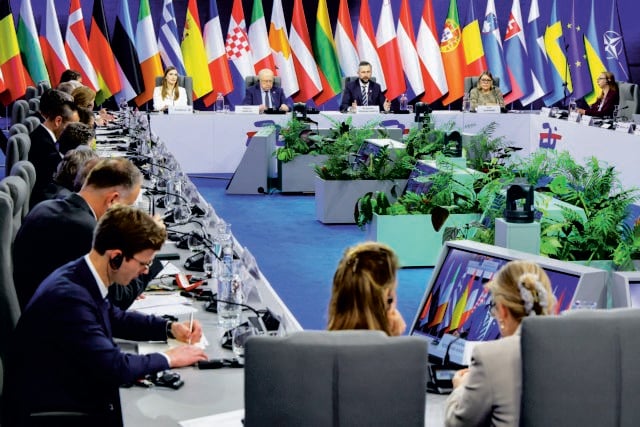
The EU Security Forum, organized as part of Poland’s presidency of the EU Council to discuss increasing European defense capabilities within the framework set forward by the White Paper, took place at Warsaw Citadel on Wednesday, April 2. [Pawel Supernak/EPA]
A few hours in Brussels, and contacts and discussions with officials of the European bureaucracy are enough to confirm the problematic image that the European Union conveys in terms of how it deals with crises and manages relations with other powerful players in the global economic and geopolitical scene.
The lack of internal coherence is now a serious problem in the functioning of the bloc. It is not only the frequent difference of opinion expressed by the Hungarian prime minister, and sometimes other leaders. There are also deep differences, which often slide into head-on clashes within the union’s institutional bodies.
Conflicting interests and personal disputes, as well as the blurred boundaries of responsibility – which became evident in recent days by European Commission President Ursula von der Leyen and the EU’s top diplomat Kaja Kallas divergent reactions toward the US-Israeli attack on Iran – are damaging the EU’s image and limiting its ability to act substantively.
A few hours after the bombings began, there were “competing” statements with a different approach by the two officials. The presence of another president, that of the European Council, adds to an unnecessary institutional diversity. All these factors make it difficult to immediately formulate a common and therefore more effective approach.
The relationship with the US becomes more difficult when an American president – especially the current one – believes that there is no clear interlocutor in Brussels and that the positions of some countries are not necessarily the same as those of the EU as a whole.
There is also a problem with the EU’s defense policy, where the fragmentation of weapons systems creates problems in interoperability and does not allow for economies of scale.
The US is pushing for an increase in defense spending – a necessary condition for Europe to play a leading role – but the issue is not only quantitative, it is also qualitative. It is quite problematic when Germany and France – and in an ideal scenario, also Italy, Spain, and even the UK – cannot agree on the co-production of a next-generation fighter jet.
In any case, the EU’s subpar response to the global conflagration we are experiencing is the latest alarm bell for the need for reforms and behavioral changes if Europe wants to become, and – equally important – be treated, as a truly powerful global player.