
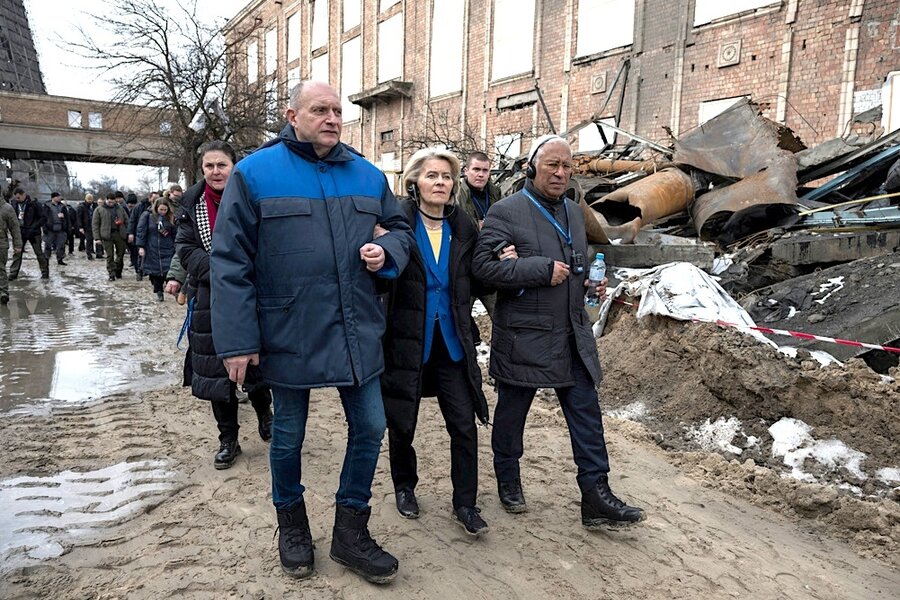
Ukraine’s ability to fend off more than four years of relentless military assaults by Russia has forged a resolute unity and focus among its people. At the same time, its example in surviving the crucible of war has helped steel the geopolitical resolve of the European Union and led the 27-nation bloc to reassert its founding values.
The war has reminded Europeans “of what unites them,” stated Pawel Zerka of the European Council on Foreign Relations. “The values of democracy, rule of law, human rights, civil society, and freedom went from abstract terms to something very tangible,” he wrote soon after the war began in 2022.
Since the fourth anniversary on Feb. 24, Europe’s declarations of support for Ukraine – and for European unity – have grown even stronger. “There is no moral ambiguity,” France’s EU commissioner wrote in Le Monde. Aiding Ukraine is both “an act of solidarity” and “an investment in building a stronger, safer and more united Europe.”
One big divide in Europe might be on the mend. Nearly a decade after Brexit, when the United Kingdom left the EU, it has moved closer to the bloc on migration, trade, and defense. “It is time to reset the [EU-U.K.] partnership … to respond to today’s realities,” European Parliament President Roberta Metsola said in a speech.
Russia’s war in Ukraine “was meant to weaken our alliance,” she observed. Instead, she pointed out, Europe’s “defense industry has been revitalized” and its bureaucracy “made faster,” and it has “mobilized some €90 billion [$104 billion] in support for Ukraine.”
In an interesting twist, the narrative is no longer just about the West coming to Ukraine’s aid. “European nations are snapping up Ukrainian front-line know-how [to] … rewire themselves for a transformed battlefield,” stated The Wall Street Journal. The United States, too, is weighing purchases of Ukrainian-made interceptors to use against Iranian drones.
Perhaps the EU’s boldest move has been to fast-track Ukraine for membership in the bloc, which is seen as a prelude to possibly giving security guarantees against Russian aggression. While some EU members worry about Ukraine as an economic partner, they see the value of enlarging the EU tent. The situation recalls the words of Britain’s legendary World War II leader, Winston Churchill, from 80 years ago.
In a March 5, 1946, speech in Missouri, Mr. Churchill warned about the “iron curtain” that Soviet Russia, as he called it, was drawing across Eastern Europe. “The safety of the world requires a new unity in Europe,” he said that day.
Later that same year, he went further: The task is “to recreate the European family,” he said, “to provide it with a structure under which it can dwell in peace, safety and freedom. We must build a kind of United States of Europe.” Little did he realize how a former Soviet republic, Ukraine, would someday nudge the continent to fortify its safety and freedom.