
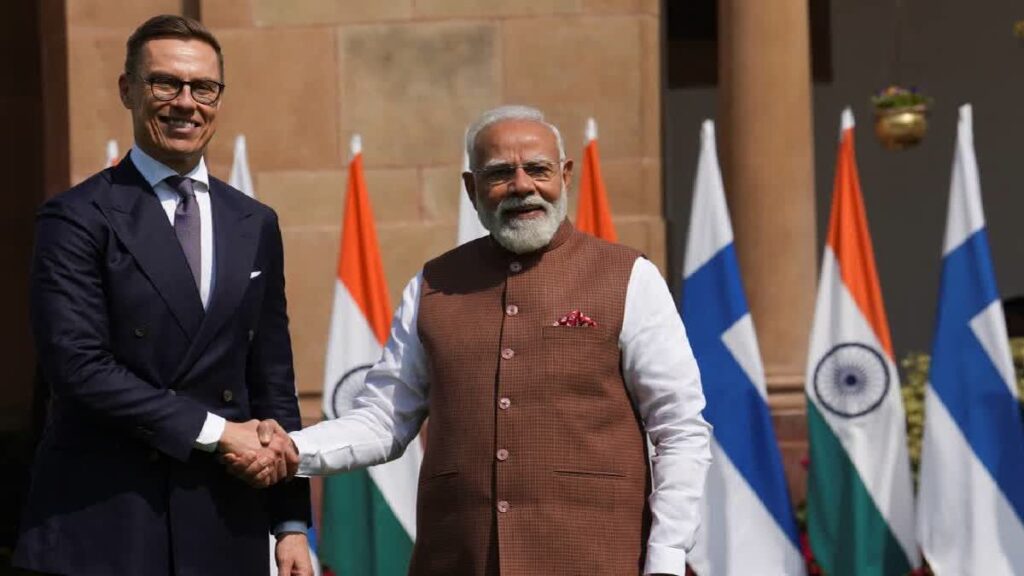
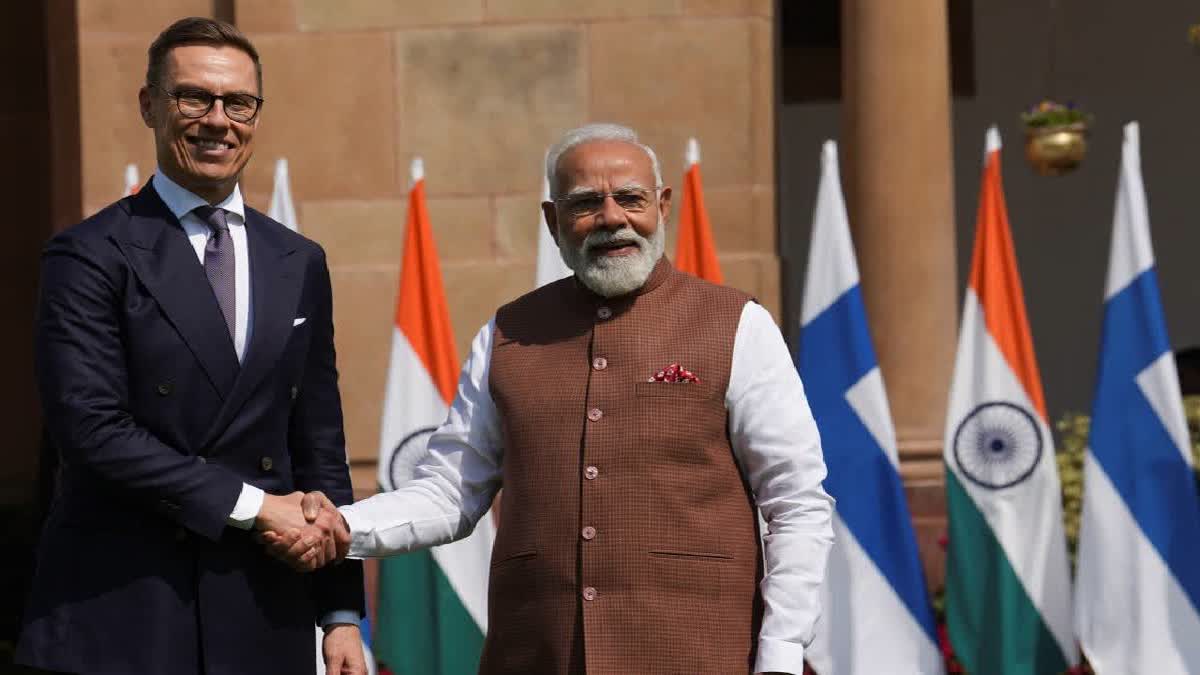
Prime Minister Narendra Modi, right, exchanges a handshake with Finland President Alexander Stubb. (PTI)
New Delhi: Stating that the Global South will decide what the next world order will look like, President of the Republic of Finland Alexander Stubb on Thursday said that India, as a major power, will be a big force in deciding whether the world will tilt towards conflictual multi-polarity characterised by deals, transactions and spheres of interests.
“Or whether we can build a new cooperative, fair and representative multilateral world order based on international institutions, rules and norms. The policy choices that India and other key powers make truly matter in this time of transition. They will set the direction for the future,” said Stubb while giving the inaugural address at the Raisina Dialogue 2026 in New Delhi.
Asserting that India has been under no illusions, Stubb said, “For your entire independence, you have based your foreign policy on a pragmatic, realistic world view. You have shown the rest of the world what strategic caution and safeguarding autonomy mean. All the while championing multilateralism and global cooperation. It is time we all became a bit more Indian.”
Whether you call it non-alignment or multi-alignment, you have been careful not to rely solely on the goodwill of one partner or bloc. You have invested in your own security and actively developed partnerships in many directions, he said.
“Your approach makes sense. You represent one-fifth of the global population. You cannot be a mere follower; you have to be an active, independent actor. The Europeans have now also been taught a lesson from India: passivity is not a strategy. We have to develop our own capabilities, avoid harmful dependencies and strengthen our global partnerships,” said Stubb.
He said that the global balance of power has shifted. “The Global South has both demography and economy on its side. The era of a Western-dominated world order is over. This is obvious, but it will take some time to sink in across the West,” said Stubb.
Despite not being part of a formal alliance, India does not isolate itself. Its power is based on active engagement, he said. “A timely example of this is the EU-India Strategic Partnership that took major steps forward earlier this year with the conclusion of a comprehensive Free Trade Agreement and the launch of a security and defence partnership. This agreement, and the other major trade agreements signed by both India and the EU in the past year, underline the fact that we still believe in multilateral cooperation and the benefits it brings,” said Stubb.
“Our deal was not just a Mother of All Deals, but a strategic choice and a gesture that opens up a new era in our relationship. Together, we are building a partnership that can set an example to the rest of the world—a partnership built on mutual respect and common interests that serves to strengthen the multilateral system, not undermine it,” he said.
Stating that the voices of the Global South must be heard much louder than today, Stubb said that the obvious place to start is the UN Security Council. “I have proposed two new permanent seats for Asia, two for Africa and one for Latin America. Clearly, India should hold a seat,” he said.
Highlighting that India and Finland understand what it means when power goes unchecked, Stubb said, “We have both gone through difficult periods in history and fought for democracy, equality and sovereignty. We don’t want to see these values forgotten.”
In many ways, according to Stubb, India has been applying values-based realism for far longer than we have. “Thousands of years ago, Kautilya’s Arthashastra recognised that the international system is competitive and interest-driven. It called for a pragmatic and realistic approach to statecraft. At the same time, the ruler’s ultimate duty was to uphold values and ethics, guided by the concept of dharma,” said Stubb.
Read more