
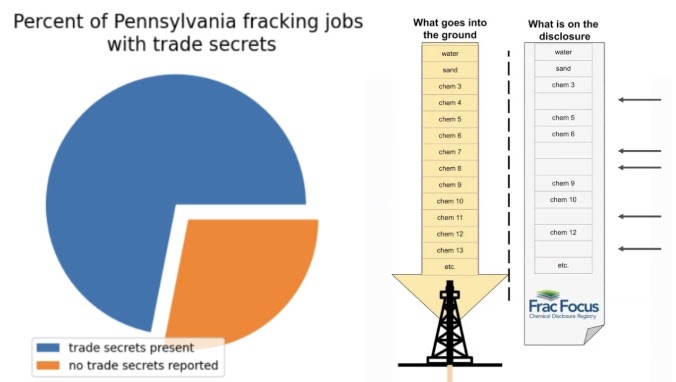
The Exposing Sources of Industry Related Health Impacts Panel featured a presentation by Gary Allison, PhD of Open-FF, who spoke about the disclosure of chemicals used in fracking and shale oil and gas drill sites and trade secret protection of those chemicals that prevents full disclosure.
Dr. Allison also talked about what the chemical disclosures required by a 2022 Colorado law are telling us about how incomplete the information is on fracking chemicals in FracFocus, the database most states and the public use to learn about drilling chemicals.
Here are his remarks-
My talk’s going to focus on one critical aspect of understanding the health effects of fracking. That’s the chemicals that are involved.
Our understanding of fracking chemicals has long relied on FracFocus, which is a national registry.
Today, I’ll show you that this data set is significantly incomplete and I’ll use Colorado’s new disclosure law to outline the scope of that missing information.
A key thing to keep in mind throughout this talk is that the public’s understanding and even many regulators’ understanding of what chemicals are actually used in fracking is largely derived from FracFocus.
FracFocus Listings
Many fracking states require submission to FracFocus.
In Pennsylvania, for example, there are over 11,000 disclosures of distinct fracking events.
And FracFocus can tell us a lot about the presence and quantity of many of the chemicals used.
For example, even though fracking is exempt from the [federal] Safe Drinking Water Act, we can still learn which regulated chemicals are being used and sometimes how much is being used.
For example, one chemical regulated by the Safe Drinking Water Act is ethylene glycol.
In Pennsylvania, 4.2 million pounds of the chemical were reported in 2024 fracking jobs.
The largest use that year was by the operator Chesapeake in Bradford County– 230,000 pounds– and that’s just in one well.
This is the kind of data that we could pull from FracFocus, and it’s really helpful.
Here is an example disclosure from just last December.
This is a single well in Washington County operated by EQT.
You probably can’t read the small print here, but you may see that there’s a lot of information, lists of chemical names, their ID numbers, their concentrations, the brand names of products, even the companies that supply them.
It’s a complex document filled with details and jargon.
And in fact, when we approach these disclosures, we might have the impression that they are comprehensive lists.
This slide represents a common starting point for many of us.
I know it was for me that if a chemical goes into the ground, it’s going to appear on the list that there is a one-to-one relationship.
That’s not an unreasonable expectation because in other high risk industries, we don’t allow mystery variables when public health is at stake.
But I want to mention two reasons why that naive expectation is undermined.
Trade Secrets
You probably know about the first reason, and Erin mentioned it– trade secrets are allowed in FracFocus and they are common.
Back at that same disclosure we saw before, we see that for this product, the chemical name of one of its ingredients is just a code and the ID number is replaced by the words “proprietary.”
In other words, it’s a trade secret and we can’t tell what chemical it is.
In Pennsylvania, 75% of disclosures contain masked chemicals as trade secrets.
In total, we’re talking about 200 million pounds of materials where we know a chemical was used because it’s flagged in FracFocus, but the industry has withheld its identity.
Material Safety Data Sheets Incomplete
The second reason why full disclosure is undermined is harder to notice and it’s more buried in the details in the weeds, but a clue is in the fine print at the bottom of every disclosure.
Ingredient information for chemicals is obtained from suppliers safety data sheets.
So in other words, the operating companies use these safety data sheets as their ingredient lists.
You may be familiar with these safety data sheets. They’re the 5 to 25 page informational packets that can have lots of important public health information on the hazards of products.
And there is a required table within these safety data sheets that lists chemical components of a product. Operating companies are using that component table for their FracFocus disclosures.
The problem is that these tables of components often don’t include all the ingredients in the product.
This is a typical example. It’s a table from a product by Chemplex.
There are three chemicals listed and the chemical identity is clearly marked, the CAS number there, but their contribution to the product is far less than 100%.
Instead, the listed chemicals comprise somewhere between 32 and 46%. The other 50%+ is not mentioned anywhere on the safety data sheet.
Now these safety data sheets are written by manufacturers of the products, and it’s the manufacturers who determine which chemicals make it onto the safety data sheet.
That is, which are the chemicals of concern.
A chemical that gets left off the list might be just water or something else the manufacturer considers inert, or it could be some chemical that has not been studied for its health impacts, and that’s within these fracking chemical lists, at least that’s very, very common.
The point is, many ingredients go into the ground that will not make it onto the FracFocus disclosures.
They aren’t just data gaps, they’re unknown variables in public health research.
Because FracFocus has essentially been the only source of data about chemical uses, we run up against a wall when we try to get a picture of what might be in those gaps.
Colorado Disclosure Law
But in 2022, Colorado passed a law that essentially broke through this wall.
This law created a new disclosure instrument that’s managed by the state’s regulatory body, the Energy and Carbon Management Commission.
I’m going to call it the ECMC.
This new law explicitly set out to plug some of the known holes in FracFocus so that the public could have a more complete picture of the chemicals used near their communities.
At this point, it’s important for me to acknowledge the extensive efforts of many people that helped pass this law, the Physicians for Social Responsibility, including both the Colorado chapter and the National Office and the Sierra Club were vital in that process.
Their combined work was critical in exposing the extensive use of trade secrets in Colorado, which in turn motivated the need for a legislative change.
Furthermore, both organizations put in the hard work to get the new law passed in the state.
No Trade Secrets
So the law tries to plug those holes in FracFocus first by mandating that chemical identities can no longer be masked as trade secrets.
They’re simply prohibited.
Second, it shifted the reporting burden of those chemical lists to the manufacturers, the people who actually know the full ingredient list rather than the operators.
Colorado brought the manufacturers into the law. If they want their products to be used in the state, they must disclose the chemical ingredients first.
The law also expanded reporting to include drilling and other phases, not just fracking.
I’m not going to say much more about that issue here, but it’s an important expansion to our understanding of the chemical landscape of a well pad.
No PFAS Chemicals
Two other things that are not on this table, the law forbids any PFAS [‘forever’] chemicals, and it requires that operators directly share the list of chemicals with residents and schools and hospitals within a half a mile of the well pad.
Colorado Law Shows Gaps In FracFocus
Now, these ECMC disclosures do not replace FracFocus, but are reported in addition to FracFocus.
And that’s actually a big opportunity for us because now we have kind of a natural experiment.
For the first time, we have two independent records for the exact same well pad, the FracFocus report and the ECMC report.
We can now scrutinize FracFocus using the ECMC data as the ground truth. We try to answer some questions–
— Given the greater transparency of the Colorado law, how much more is disclosed in the ECMC system than the FracFocus system?
— And are any of these newly disclosed chemicals even important from a public health perspective?
Slow Start
Now, before we try to answer those questions, I want to take a short detour to show a time series graph of how this new law rolled out because it has some interesting lessons.
The law went into effect in the summer of 2023 and new disclosures were to be made public by the end of that year.
The climbing line here is the number of wells that were fracked under the timeline of the law.
All of these should show up in the ECMC disclosure system, but implementation was very slow to start.
The ECMC released the first disclosures more than nine months late, and apparently only a few of the operators had disclosed to the system.
By May 2025, nearly two years after the law took effect, compliance was dismal.
Less than 40% of the required disclosures had been posted. Many operators appeared to be effectively ignoring the new transparency requirements.
Before that time, PSR Colorado and the Sierra Club had tried to communicate with the ECMC to understand what the delay was, but there was little response.
So those groups, along with FracTracker, prepared a report that documented these discrepancies. [Read more here]
And with that, they calculated the estimated fines that these companies would owe by Colorado law if it was the operators who were actually at fault, and we couldn’t tell at this point.
Those estimates were in the millions of dollars for some of the bigger operators, and The Guardian picked up the story.
Within days of the release of the report– that’s the green line on that chart– disclosures started flooding into the ECMC website, and within a few months, disclosure rates were over 95%.
And so only after public pressure and media scrutiny did we see this surge in filings.
And it just reminds us that transparency isn’t just a matter of law, it requires active external oversight to ensure compliance.
Comparing Disclosure Lists
Okay. Onto the results of the comparison between FracFocus and ECMC.
Let’s start by just looking at the results from a single well pad by the operator Extraction Oil & Gas. It’s on the outskirts of the Denver Metro Area and has 17 wells on it.
The first thing that we note is that in the FracFocus data, there are six distinct trade secrets and together they comprise over 750,000 pounds.
Next, we look at the overlap where FracFocus and ECMC disclosures report the same materials.
They overlap on 27 different chemicals, including 100,000 pounds of methanol and half a million pounds of hydrochloric acid.
This set includes other typical things we see such as ethylene glycol and cinnamaldehyde, but it’s this last section that we’re really interested in.
Considering that there are six trade secrets in FracFocus, we might expect six chemicals on the ECMC-only list that would represent those proprietary chemicals.
What we find instead is that there are an additional 28 chemicals.
Again, these are chemicals that went into the ground, but are not on the FracFocus disclosures.
These include some things with concerning hazard profiles like formaldehyde and ethylene oxide, which are both suspected carcinogens.
So this is a comparison across just one well pad. Now let’s look across a larger set, 160 pads.
These are all pads where we could verify we were looking at identical wells and identical fracking events.
I’m going to show these maps of Colorado to illustrate some of the patterns we find.
The blue dots you see on the Colorado map are the well pads where the chemical ethylene oxide is reported to both FracFocus and ECMC.
Ethylene oxide is a carcinogen with a number of other hazardous properties, but there are a handful of other pads here marked in red where the ethylene oxide is only on the ECMC data.
The pattern is similar for acrylamide, another carcinogen.
A large number of well pads reported in both FracFocus and the ECMC, but just as many other well pads report the chemical only in the ECMC system.
And finally, for formaldehyde, it only shows up in the ECMDC disclosures at all across these comparison wells.
FracFocus never reports it.
140 Chemicals Omitted From FracFocus
From a public health standpoint, a significant finding is that around 140 different chemicals were omitted from some FracFocus disclosures across these comparison pads.
While some things like sucrose, cellulase, and guar gum aren’t an issue, we found quite a few known hazards.
These include the materials I’ve already mentioned, plus things like methanol, naphthalene, propargyl alcohol, and there are more known hazards.
One thing that concerns me is that the hazards of a lot of these materials are largely unknown as they have not been adequately studied.
This is a summary of how much we know about those 140 different chemicals.
It’s an analysis based on the EPA’s chemical assessment programs.
At the top line, that’s the chemicals that are thoroughly studied and recognized in formal programs. That’s 8%.
You can ignore those colored bars that are out of place. Below that highest level of hazard assessment is provisional recognition.
The third level is where some assessment has been done on chemicals, but they’re not formally recognized. That’s more than half.
And then the line you can’t see is the chemicals that have little or no assessment. That’s about a third of the chemicals that are in that 140.
The materials I’ve been talking about– formaldehyde, acrylamide, naphthalene– they’re all in that group that’s most thoroughly studied, but clearly among fracking chemicals, there are far more that are not well studied at all.
And by the way, I’d love to talk to anyone who has ideas about how we can bring these unknown hazards into a picture of a chemical landscape, both for public health questions and for environmental impact questions.
So these are the results we have so far for Colorado, and it’s still evolving. This is still a new disclosure.
FracFocus Has Big Holes
What are the implications for other states?
Well, two features of FracFocus I mentioned earlier, trade secrets, safety data sheets give us a clue.
Both of those features are systematic and so occur in all states.
Trade secrets are heavily used. Here, the orange part of the pie charts are the fraction of the state’s disclosures that have trade secrets.
So at least three quarters of the disclosures have trade secrets in all of these states. And the use of abbreviated lists from safety data sheets is common.
It can be hard to get access to safety data sheets in the fracking industry, but Halliburton makes all of theirs available.
Across more than 5,000 of their products, 62% of safety data sheets report less than half of the composition of the product. Many of them way less than half.
And of course, as you can imagine, Halliburton products are used throughout FracFocus.
So yes, very likely all states suffer from these FracFocus holes. And hopefully the takeaway is clear that FracFocus is not a complete record.
If your state relies solely on it, you’re likely missing a significant portion of the chemical profile.
When the industry claims they’re being transparent through FracFocus, the Colorado data provide ample evidence to challenge that claim.
And to recap all of this, FracFocus is still an important source of information as it’s the only source of information we have in many places, but Colorado disclosures make it clear that there is significant under reporting.
That is due at least in part to systematic problems with FracFocus, and that exists in all states.
These absences make it difficult to profile health hazards.
Colorado’s system may provide a good model for improving transparency in your state.
And finally, I’d like to ask just for some help.
We want to make this kind of chemical data more useful for community advocates and for public health professionals.
How can we use this data to better support your work? How can we present data that helps communities better understand nearby hazards?
How can we leverage what we’re learning in Colorado to build a better understanding of chemicals in your state?
And finally, I’d like to thank FracTracker Alliance for supporting the work on the Open-FF Project and thank you for your attention.
Pennsylvania Specific
In response to a question about what the Colorado data may tells us about what’s going on in Pennsylvania and does DEP know more about the chemicals used than what is disclosed to the public, Dr. Allison said–
The problem with applying it to Pennsylvania is that many products that are used in Colorado are not used in Pennsylvania and vice versa.
That there are a lot of companies that operate only in Pennsylvania chemical companies. And so we don’t know.
We can’t use the Colorado data to show exactly everything that’s used in Pennsylvania.
In Pennsylvania that’s supposed to be the case, that for trade secrets, there’s a list of chemicals that the Pennsylvania DEP keeps, and the labels that go into FracFocus are used to be on that list for Pennsylvania DEP, knowing what the chemicals are.
Whether or not all the trade secrets are in that, it looks like not, that there are plenty of others that aren’t known by the regulators.
Visit the Open-FF for more information.
Click Here for an Open-FF Profile of Pennsylvania Shale Gas Well Chemicals
PA Shale Gas and Public Health Conference
Visit the PA Shale Gas and Public Health Conference webpage for the Conference agenda.
Click Here to view the PA Shale Gas Conference presentations (free account sign-up required).
Other Conference Presentations–
— PA Shale Gas & Public Health Conference: Supervisor Cindy Fisher – How Cecil Township Adopted 2,500 Foot Setbacks From Shale Gas Well Pads With Extensive Public Involvement Facing Threats And Intimidation [PaEN]
— PA Shale Gas & Public Health Conference: Dr. Lauren Minsky – People’s Cancer Incidence Screening Tool Reports Cancer Rates In Washington County Up To 16 Times Higher Than PA Averages [PaEN]
Background On Setbacks
Legislation has been introduced in the House and Senate to increase setbacks from 500 to 2,500 feet across the state consistent with the 2020 state Grand Jury Report.
Rep. Greg Vitali (D-Delaware) introduced House Bill 1946, which was the subject of a Committee hearing in November. Read more here.
The bill remains in the House Environmental and Natural Resource Protection Committee.
Sen. Steven Santarsiero (D-Bucks) and Sen. Carolyn Comitta (D-Chester) introduced Senate Bill 1083 also increasing setback distances from unconventional shale gas wells.
The bill remains in the Senate Environmental Resources and Energy Committee without action.
EQB Petition
In December, the Environmental Quality Board, which adopts DEP regulations, voted to accept a 358-page rulemaking petition for study first proposed in October 2024 to increase the minimum setback from 500 to 3,281 feet. Read more here.
DEP had already determined the Board had the statutory authority to adopt a change in setbacks before asking the Board to accept the petition for review. Read more here.
On March 10, the Environmental Quality Board is due to provide an update on its review of the petition. Read more here.
PA Senate Republicans Vote To Punish Communities
On May 7, 2025 Republicans on the Senate Environmental Resources and Energy Committee voted to report out legislation– Senate Bill 102 (Bartolotta-R-Washington, Yaw-R-Lycoming) to punish communities taking steps to protect their residents from the health and environmental impacts of shale gas drilling by doing things like increasing setbacks from well pads. Read more here.
The bill would prohibit municipalities from receiving Act 13 drilling impact fees if they set protective standards on the development of natural gas that “imposes a standard or condition on well development that conflicts with or exceeds those contained” in state law. Read more here.
The legislation was, in fact, prompted by an ordinance adopted by Cecil Township in Washington County.
Sen. Camera Bartolotta (R-Washington), the prime sponsor, represents Cecil Township in the state Senate.
The bill is now in the Senate Appropriations Committee.
(Illustration – Trade Secrets hide fracking chemicals in Pennsylvania; Gaps in FracFocus highlighted by Colorado’s new disclosure law.)
Resource Links – Setbacks:
— Environmental Quality Board Votes To Accept Petition To Study An Increase In Setback Safety Zones From Shale Gas Wells; And 3 Petitions From Oil & Gas Industry To Change Other Requirements [12.9.25]
— 500 Feet Isn’t Enough – House Hearing I: Shale Gas Industry Says Setbacks Won’t Protect Residents, Public Health, Environment From Shale Gas Operations, Only ‘Rigorous Oversight’ Will; Standards Have Not Changed In 9 Years [PaEN]
— 500 Feet Isn’t Enough- House Hearing II: As A Township Supervisor We Have An Obligation To Protect The Health, Safety And Welfare Of Our Township Residents From Shale Gas Development [PaEN]
— 500 Feet Isn’t Enough – House Hearing III: What It’s Really Like Living Next To A Shale Gas Well Pad – Nosebleeds, Headaches, Nausea, Air Pollution, Vibrating House, Sleepless Nights, Anxiety, Truck Traffic [PaEN]
— 500 Feet Isn’t Enough: 42 Scientific Studies, 20+ Years Of Experience With Shale Gas Drilling In PA; A State Grand Jury Report; Criminal Convictions; Public Complaints; Lawsuits; Media Reports All Document The Need To Increase Setbacks From Shale Gas Wells [PaEN]
— 500 Feet Isn’t Enough: Michelle Stonemark Tells What It’s Really Like Living Next To A Shale Gas Well Pad – Nosebleeds, Headaches, Nausea, Air Pollution, Vibrating House, Sleepless Nights, Anxiety – In Cecil Twp., Washington County [PaEN]
— 500 Feet Isn’t Enough: Environmental Groups Urge Environmental Quality Board To Accept Rulemaking Petition For Study Increasing Setbacks From Shale Gas Wells [PaEN]
— House Environmental Committee To Hold Oct. 30 Hearing On Bill Increasing Setback Safety Zones From Shale Natural Gas Drilling Sites, Infrastructure Based On Latest Science, Grand Jury Report [Background on the Issue] [PaEN]
— Sen. Yaw, Republican Chair Of Senate Environmental Committee, Calls Bill To Reduce Shale Gas Industry Impacts On Health, Environment ‘Stupid’ [October 2023]
— Rep. Vitali Introduces Legislation To Increase Setbacks From Unconventional Shale Gas Wells From 500 Feet To 2,500 Feet From Homes, 5,000 Feet From Schools, Hospitals [10.15.25]
— Senators Santarsiero, Comitta Introduce SB 581 Increasing Setback Safety Zones From Natural Gas Drilling Sites, Other Infrastructure, Based On Latest Science [January 2024]
— Marcellus Drilling News: Capital & Main Resolves Legal Challenge From CNX Resources Over Its Reporting With Editor’s Note Explaining What It Did Not Say Or Write About In An Article [PaEN]
— Environmental Hearing Board Agrees There Is ‘Acute’ Danger In CNX Misusing A Deposition In An Appeal Before The Board To ‘Punish’ An Environmental Advocate For Her Advocacy Against CNX [PaEN]
Resource Links – Health, Environmental Impacts:
— Environmental Health Project Releases New White Paper: PA’s Shale Gas – What We Can Do Now To Better Protect Public Health [PaEN]
— Environmental Health Project: Lois Bower-Bjornson Shares Her First-Hand Experiences With Shale Gas Health, Environmental Impacts In Washington County [PaEN]
— State Dept. Of Health Apologizes For Not Listening To Communities Suffering Health Impacts From Shale Gas Development; New Health Study Results ‘Just The Tip Of The Iceberg’ [August 2023]
— University Of Pittsburgh School Of Public Health Studies Find Shale Gas Wells Can Make Asthma Worse; Children Have An Increased Chance Of Developing Lymphoma Cancer; Slightly Lower Birth Weights [August 2023]
— State Dept. Of Health Invites Citizens To File Environmental Health Complaints Related To Natural Gas Development; Health Will Also Review Environmental Test Results [September 2023]
— State Dept. Of Health Pushing For Changes To Reduce Adverse Health Impacts From Natural Gas Development [November 2023]
— New State Health Plan Identifies Health Issues Related To Natural Resource Extraction, Climate Change In Top 5 Threats To Health Outcomes [April 2023]
— 2025 PA Shale Gas & Public Health Conference Attended By Nearly 480 People Featured Health Experts, Scientists, Advocacy Groups On Health, Environmental Impacts Of Shale Gas Development [February 2025]
— Presentations Now Available From 2022 Shale Gas & Public Health Conference In Nov. Hosted By PA League Of Women Voters & University Of Pittsburgh Graduate School Of Public Health [December 2022]
— Fact Sheet: How Oil and Gas Operations Impact Your Baby’s Health
— Frackland Video Tour, with Lois Bower-Bjornson, Clean Air Council
— Senate Hearing: Body Of Evidence Is ‘Large, Growing,’ ‘Consistent’ And ‘Compelling’ That Shale Gas Development Is Having A Negative Impact On Public Health; PA Must Act [June 2022]
— House Committee Hearing On Increasing Safety Setbacks Zones Around Natural Gas Facilities Heard About First-Hand Citizen Experiences On Health Impacts, From Physicians On Health Studies And The Gas Industry On Job Impacts [October 2023]
— Sen. Yaw, Republican Chair Of Senate Environmental Committee, Calls Bill To Reduce Shale Gas Industry Impacts On Health, Environment ‘Stupid’ [October 2023]
— Senators Santarsiero, Comitta Introduce SB 581 Increasing Setback Safety Zones From Natural Gas Drilling Sites, Other Infrastructure, Based On Latest Science [January 2024]
Resource Links – Local Impacts Of Oil & Gas Development:
— Freeport Township Declares Disaster Emergency After Residents Impacted By A Gas Related Water Contamination Event Have Been Without Permanent Water Supplies For 3 Years– We’re Not Blaming Anybody, We Just Want Good, Clean Drinking Water [August 2025]
— Springhill Township Becomes 2nd Township To Declare Disaster Emergency After Residents Were Impacted By A Gas Related Water Contamination Event In Greene County [August 2025]
— Observer-Reporter: Study Shows Probable Link Between Freeport Twp. Water Well Contamination And Fracking In Greene County [PDF of Article]
— Independent Research Study By Pitt, Duquesne Ties Water Well Contamination To Shale Gas Drilling In 2 Greene County Townships That Declared Water Disaster Emergencies [9.17.25]
— PA American Water Identifies Water Source For New Public Water System To Replace Water Wells Contaminated By Shale Gas Fracking 20 Years Ago In Dimock Twp., Susquehanna County [3.13.25]
— Coterra Energy Fined $299,000 For Contaminating 13 Private Water Supplies In Lenox Twp., Susquehanna County – Just A Few Miles From Dimock [7.29.25]
— Late Night Road Dumping: Conventional Oil & Gas Wastewater Continues To Be Dumped On Dirt, Gravel, Paved Roads; DEP Expected To Provide Update At April 24 Meeting [4.9.25]
— PA Environment Digest: Click Here to learn more about oil and gas industry impacts.
Resource Links – Oil & Gas Compliance:
— Criminal Convictions; Record Penalties, Restitution Of Over $158.3 Million Highlight Big Shale Gas, Related Petrochemical Industry Compliance History In Pennsylvania [March 2025]
— DEP Reports 575 Water Supply/Stray Gas Complaints About Oil & Gas Operations In Last 2 Years; Investigation Can Take A Year, Sometimes 2-3 To Find Those Responsible [March 2025]
— Freeport Township Declares Disaster Emergency After Residents Impacted By A Gas Related Water Contamination Event Have Been Without Permanent Water Supplies For 3 Years– We’re Not Blaming Anybody, We Just Want Good, Clean Drinking Water [August 2025]
— Springhill Township Becomes 2nd Township To Declare Disaster Emergency After Residents Were Impacted By A Gas Related Water Contamination Event In Greene County [August 2025]
— Daily Grind Living Next To Oil & Gas Industry: Spills, Polluted Water Supplies, Smells Like Gas, Noise, Air Pollution, Explosions, Truck Traffic, Erosion, Radioactive Waste, Gas Flares, Dust, Lights, Road Dumping Waste, Abandoned Wells [March 2025]
— AG Shapiro: Grand Jury Finds Pennsylvania Failed To Protect Citizens During Natural Gas Fracking Boom [June 2022]
— Senate Hearing: First-Hand Account Of Health, Environmental Impacts From Road Dumping Conventional Oil & Gas Wastewater – ‘Inhaling Oil & Gas Wastewater 24-Hours A Day’ [April 2024]
— House Hearing: A First-Hand Account Of How Repeated, Unlimited Road Dumping Of Oil & Gas Drilling Wastewater Is Tearing Apart Dirt Roads And Creating Multiple Environmental Hazards [June 2024]
— House Hearing: Penn State Expert Says ‘Pennsylvania Should Ban Road Spreading Of Oil & Gas Wastewater;’ Contaminants Exceed Health, Environmental Standards [June 2024]
Related Articles This Week:
— Environmental Quality Board Meets March 10 On Final Stream Redesignations Package; Report Due On DEP Review Of The Petition To Increase Setbacks From Shale Gas Wells, 4 Other Petitions [PaEN]
— Protect PT To Hold Workshops In Plum Boro March 12, Monessen March 19 On How To Protect Your Community From Environmental Threats Caused By Shale Gas Development [PaEN]
— DCNR House Budget Hearing: House Republicans Propose More Shale Drilling In State Forest Land, Under State Parks; Gas Drilling Has Caused The Loss Of 30,000 Acres Of Core State Forest Land So Far [PaEN]
— Senate PUC Budget Hearing: PUC Chair Says PJM Market Auction Not Designed For Data Center Demands; PA Needs Diversify Fuels Used To Generate Electricity; Bring Your Own Power Critical [PaEN]
— Guest Essay: Pennsylvania Needs To Act Now To Prevent A New $700 Million Increase In Electric Costs For Ratepayers – By Steve DeFrank, Chairman, Public Utility Commission [PaEN]
— Sen. Yaw Urges FERC To Allow PJM To Keep Charging Pennsylvania Ratepayers Record High Capacity Auction Prices For Power, But Charge Other States Even More [PaEN]
— House Committee Reports Out Bills To Require Data Centers To Disclose Energy, Water Use, Direct DCED To Develop Model Data Center Ordinance [PaEN]
— New Comprehensive Report Lays Out Case For 3-Year A.I. Data Center Moratorium To Be Introduced In Pennsylvania [PaEN]
— Energy Efficiency Alliance: March 12 Webinar – How Virtual Power Plants Strengthen Our Grid, Protect Ratepayers [PaEN]
NewsClips:
— The Derrick: War In Iran To Cause Massive Disruption In Oil Industry, According To Oil City Native & Middle East Expert Andrew Tabler [PDF of Article]
— Williamsport Sun: Oil, Gasoline Prices Rise Sharply Throughout The Region
— Warren Times: Gasoline Prices Skyrocket After Iran Air Strikes
— Financial Times: Coal Prices Jump As Utilities Seek Alternative To Spiking Natural Gas Prices Due US President’s War With Iran
— Reuters: There Is Little LNG Producers Can Do To Immediately Replace Lost Qatari Cargoes
— Pittsburgh Business Times: How PA Natural Gas Producers May Help Ease The Impact Of President’s War On Iran On LNG Exports; European Gas Prices Jump 40% [War Is Good For The Oil/Gas Industry]
— TribLive/AP: Energy Prices Surge As Tanker Disruptions And Facility Shutdowns Rattle Global Supply [US Natural Gas Prices Linked To World Markets Thanks To LNG]
— Bloomberg: European Natural Gas Prices Hit 3-Year High As Qatar LNG Halt Rocks Markets [US Natural Gas Prices Linked To World Markets Thanks To LNG]
— The Economist: The Nightmare Iran Energy Scenario Is Becoming Reality [PDF of Article]
— Bloomberg: President’s War On Iran Has Traders Staring Down An Energy Crisis [War-Caused Price Spikes Good For Oil & Gas Companies, Bad For Consumers]
— Financial Times: US Shale Drillers Resist Quick Ride To Rescue For Iran War Oil Disruption [PDF of Article]
[Posted: March 6, 2026] PA Environment Digest