


The fight over the the GOP primary for Senate District seat 38 has moved from the Indiana Election Commission to the Clay County Circuit Court. (Photo/Pexels.com)
By Marilyn Odendahl
The Indiana Citizen
March 6, 2026
In the increasingly bitter Republican fight over who can be on the May primary ballot for the Senate District 38 seat, a nearly 20-year-old opinion from former Indiana Attorney General Steve Carter has new relevance in the attempt to get one candidate tossed from the race.
The attorney general’s opinion is one of eight exhibits included with the memorandum in support of the petition to disqualify Alexandra Wilson as a candidate. Filed on Wednesday, the memorandum is part of the second phase of this dispute that began at the Indiana Election Commission, when Jeffrey Gallant, an attorney and Vigo County resident, challenged Wilson’s candidacy.
Famed conservative lawyer James Bopp, representing Gallant, who is also his employee, argued before the Election Commission that Wilson is barred from running for office by Indiana Code 3-8-1-5, also known as the disqualification statute. Under the law, Bopp asserted, Wilson is ineligible to be a candidate for the legislature, because she pleaded guilty in 2010 to resisting arrest.
The two Democrats on the commission voted to deny Gallant’s challenge, so Wilson was allowed to remain on the ballot. Bopp responded by filing a petition for judicial review of the commission’s decision on Monday in Clay County Circuit Court.
Pointing to the attorney general’s 2007 opinion regarding the disqualification statute, Bopp said the analysis of the law shows his arguments before the commission were correct.
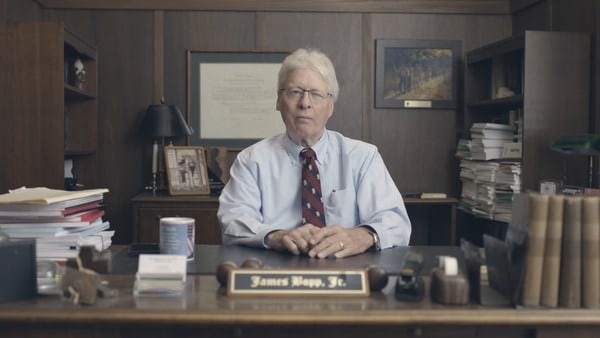 James Bopp Jr.
(Photo/provided by the Bopp Law Firm)
“So, it demonstrates that this is just politics,” Bopp told The Indiana Citizen, referring to the ruling that enabled Wilson to stay in the primary race. “The Democrats (on the commission made) a political decision in order to benefit a Republican candidate that they favor.”
Sen. Greg Goode, R-Terre Haute, is the incumbent running to retain his seat in Senate District 38. However, he was among 21 Republican state senators who blocked the midcycle congressional redistricting effort in December 2025, defying pressure from President Donald Trump and Gov. Mike Braun, and he is now facing a primary challenge.
Goode has two opponents and they both share the same last name – Wilson. Citing the similarity in an interview with The Indiana Citizen, Bopp accused Alexandra Wilson of entering the race just to confuse voters and take support away from the other Republican primary candidate, Brenda Wilson.
Also, Bopp told The Indiana Citizen that not only did the commission misread the law, but the attorney general’s opinion supports his interpretation of the disqualification statute. The statute prohibits anyone from running for state or local office who has pleaded guilty to a felony, he said, no matter the final resolution of the case.
In his memorandum, Bopp reiterated his arguments made to the commission. He said Wilson is disqualified from the May 5 primary, because she pleaded guilty to resisting arrest, a Class D felony that was subsequently reduced to a Class A misdemeanor.
Indianapolis attorney Samantha DeWester, representing Alexandra Wilson, pointed to the plea agreement and other court documents that, she said, showed the charge was reduced to a Class A misdemeanor before her client pleaded guilty. Wilson entered a guilty plea to a misdemeanor and the court entered a judgment of conviction to a misdemeanor.
“There is no felony anywhere on her record,” DeWester told the commission about Wilson. “She is not a felon. She did not plead to a felony.”
Bopp dismisses potential conflicts in the case
In his court filings, Bopp introduced the attorney general’s opinion, which he said bolsters his argument that Wilson pleaded guilty to a felony and cannot run for office.
“The Indiana Attorney General has advised, in effect, that the Indiana Legislature intended for the Disqualification Statute to trigger disqualification on the basis of a guilty plea to a felony and the conversion to or judgment as a Class A misdemeanor does not affect the disqualification,” Bopp wrote in his memorandum.
Moreover, Bopp told The Indiana Citizen that he wondered what Indiana Attorney General Todd Rokita’s office would do since, he said, “surely, they can’t argue against their own opinion.”
The Election Commission is a named party in the judicial petition and, as a state agency, is being represented in court by the attorney general’s office.
Bopp brushed off a question about whether Carter’s prior opinion creates a conflict of interest for the current attorney general.
“It’s not a conflict for a lawyer to say that a legal argument has no merit, so I’m not going to make it,” Bopp said. “I don’t know what a client does in that case, but the lawyer is doing something perfectly appropriate and ethical. We are obligated to not make invalid arguments that have no merit.”
Similarly, Bopp dismissed other questions and concerns about possible conflicts of interest surrounding Rokita’s office’s involvement in this case.
One issue of concern is Rokita’s previous working relationship with Bopp.
Rokita signed Bopp to a $250,000 contract in 2023 to serve as outside counsel for the attorney general’s office. That contract has since been terminated and Bopp said he is not doing any work now for the state’s top lawyer. Also, Bopp, noting that earlier in his legal career he worked full time as a deputy attorney general for Indiana for two years, said his past employment will not impact this case.
The other issue is Rokita’s ties to the other GOP primary candidate, Brenda Wilson.
Wilson is an employee in the attorney general’s office. According to her campaign website, Wilson is a member of the Vigo County Council and is an “Outreach Representative for the Indiana Attorney General.”
Bopp did not see any problem with Wilson’s employment in the AG’s office, saying she is not a client or party to the case.
“I know she is a victim of the phony candidate recruited because of the name confusion that this generates,” Bopp said. “But she’s not a party in any respect to this. She’s collateral damage.”
A motion filed, then withdrawn
In its first filings with the court in this case, the Indiana Attorney General’s Office stumbled a bit on Wednesday.
Rokita filed a motion to dismiss, arguing the Clay County Circuit Court did not have jurisdiction over appeals of candidacy disqualification rulings made by the Election Commission. Rather, the AG asserted, this dispute should have been filed with the Court of Appeals of Indiana.
However, the statute which the attorney general sites to support his argument, Indiana Code 3-8-8, governs a general election, not a primary election, as is the situation here. The statute applies specifically to qualification challenges for candidates running in a general election.
A motion asking the court to withdraw the request for dismissal was filed a short time later from the attorney general’s office. The motion said the filing “was made in error and the contents should be disregarded.”
Bopp conceded misreading that statute is easy and he credited the attorney general’s team for taking immediately action.
“They did the honorable thing,” Bopp said. “They didn’t pursue something they knew had not merit. You’ve got to give people credit for correcting their mistakes.”
Friday, Bopp and the attorney general’s office filed a joint motion stipulating the events leading up to this court case.
Adding another party to the case
Bopp has also asked the court to add Alexandra Wilson as a party to the case.
In a motion filed on Wednesday, Bopp argued Wilson was a party to the proceedings before the commission, so, under state statute, she should join the Election Commission in being named a respondent.
The circuit court has not ruled on any of the motions filed so far. However, DeWester said her client wants to be a part of this case.
“She obviously could have intervened (in this case), as well,” DeWester said in a statement to The Indiana Lawyer, “but if they add her, that’s fine. We welcome it. She’s allowed her day and time in court.”
The case is Jeffrey Gallant v. Indiana Election Commission, 11C01-2603-RA-000185
Dwight Adams, an editor and writer based in Indianapolis, edited this article. He is a former content editor, copy editor and digital producer at The Indianapolis Star and IndyStar.com, and worked as a planner for other newspapers, including the Louisville Courier Journal.
The Indiana Citizen is a nonpartisan, nonprofit platform dedicated to increasing the number of informed and engaged Hoosier citizens. We are operated by the Indiana Citizen Education Foundation, Inc., a 501(c)(3) public charity. For questions about the story, contact Marilyn Odendahl at marilyn.odendahl@indianacitizen.org