
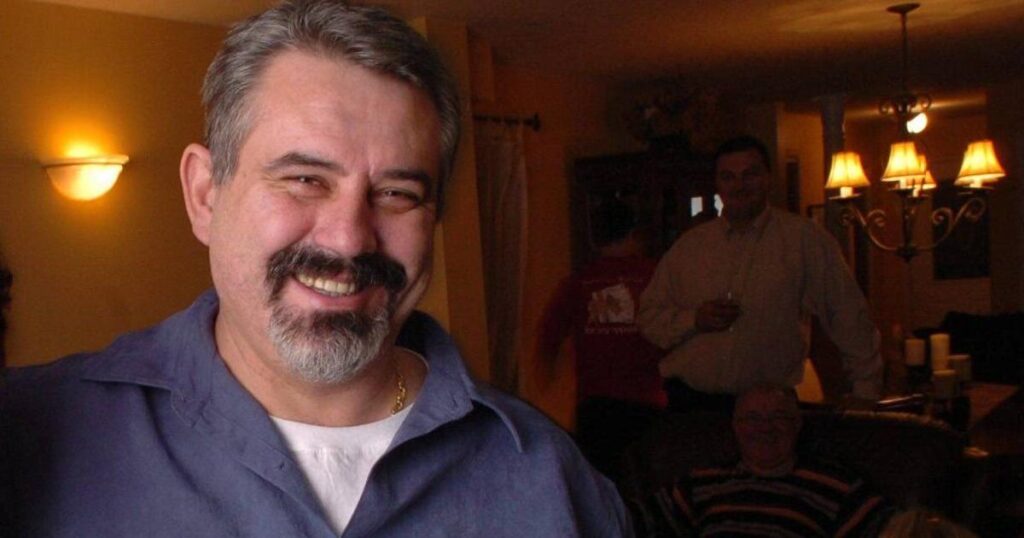
It was a big story in 2007, when it broke. Croatian prosecutors had accused Kitchener immigrant Goran Pavic, 42, of committing war crimes in 1991 in his Croatian homeland.
He denied it. Canada took no action until 2024, when it asked the Federal Court to find that Pavic fraudulently obtained citizenship by concealing his complicity in the murder, imprisonment and forcible transfer of civilians.
If that finding is made, the government can revoke his citizenship and remove him. But why wait almost two decades to act? The government will not explain it.
“The government is committed to procedural fairness and does not take the revocation of citizenship or the decision to remove someone from Canada lightly,” a spokesperson for Immigration, Refugees and Citizenship Canada said in an emailed statement.
The statement also said: “Canada is committed to international justice and the fight against impunity for genocide, crimes against humanity and war crimes.”
Waiting 17 years to act has put Pavic at a disadvantage, said his lawyer, Jared Will.
“It’s not just a question of the prolonged stress and anxiety and worry about the situation that stretches out for almost 20 years now,” Will said.
“It’s just harder to prove things that happened a long time ago than things that happened recently.”
Pavic, 60, asked Federal Court in October to dismiss the case against him, arguing the government waited too long to target his citizenship.
Justice Andrew Little ruled last month the case against Pavic can proceed because the government has set no time limit on revoking citizenship.
As Will sees it, the government feels revoking citizenship obtained by fraud is so important, it must be done no matter how much time has passed.
“That of course begs the question, if it’s so important to do, why are you not doing it in a timely manner?” he said.
It’s not the first time the government has not acted in a timely manner on war crimes allegations.
In his February ruling, Little twice cited a court ruling involving Helmut Oberlander, a Waterloo homebuilder whose citizenship was revoked over his membership in a Nazi death squad in the Second World War.
Canada was told in 1963 that Oberlander served in a death squad. The government waited 31 years to claim that he concealed this to fraudulently obtain citizenship, and took an additional 24 years to revoke his citizenship and initiate deportation.
Oberlander died in Canada in 2021 before a deportation hearing concluded.
What are the allegations against Pavic?
Prosecutors in Croatia accuse Pavic, an ethnic Serb, of being among 17 Serb paramilitary members who helped terrorize, kill or deport Croat neighbours during ethnic cleansing in the village of Sotin in 1991 and 1992.
Sotin is beside the Danube River that today separates Croatia and Serbia. In 1991, its population was a mix of Serb and Croat ethnicity.
Serbian troops and paramilitaries seized Sotin in September 1991 after Croatia declared its independence in the breakup of the former Yugoslavia. The war that followed left an estimated 20,000 dead before ending in 1995.
Dozens of civilians were not seen again after disappearing in Sotin. Since the war, authorities have dug up at least 41 bodies nearby, including 13 found in a mass grave in 2013.
Croatia told the International Court of Justice in 2010: “So extensive were the crimes committed in Sotin that at one point people were unable to go more than 500 metres from the area because of the smell of decaying bodies.”
The federal government asserts that Pavic rounded up non-Serbs to force them to the Sotin police station for interrogation, participated in the forceful removal of non-Serbs from the village by bus, and helped transport 13 non-Serbs to a vineyard outside the village where they were executed.
He committed or was complicit in crimes against humanity that include murder, forcible transfer and imprisonment, the government said in its statement of claim.
Pavic was 26 at that time, a married father of four. More detailed allegations against him were made in 2006 in the Croatian indictment.
A witness said Pavic performed an illegal search of his house, with two other Serb paramilitary members. The witness was beaten during the search.
Another witness said Pavic was among a group of accused who repeatedly searched her property. They turned her house upside down, and searched haystacks by sticking them with rifles and knives.
The same witness said Pavic came to her house on the afternoon of Dec. 26, 1991. He ordered her family to assemble the next day at a village café, from which they would all be expelled from Sotin. The mass expulsion happened Dec. 27, 1991.
Another witness said Pavic, in uniform and armed with an automatic rifle, came to his house on the morning of Dec. 27, 1991. Pavic ordered the witness and his wife to go to the same café for the expulsion that happened later that day.
Several witnesses said they saw Pavic, armed and in uniform, at the café where Croats were forced onto buses for the mass expulsion from Sotin on Dec. 27, 1991.
One witness said she learned from other villagers that her father and mother were taken away by Pavic and another accused. Her parents disappeared and were not seen again.
One witness said Pavic seized her son’s red Yugo car and drove away with it. She was later told by others that Pavic took her husband and son away for interrogation. Her husband was beaten by someone else, and later died in hospital.
One witness saw Pavic wearing a military uniform on Nov. 25, 1991, while she was in Sotin applying for an exit pass to leave the village.
What does Pavic say?
Pavic came to Canada with his wife and children as a refugee in 1997, sponsored by his sister who lived in north Waterloo. He became a citizen in 2002 and eventually settled into a home in a west-end Kitchener suburb.
He denies wrongdoing, telling the Federal Court he was conscripted involuntarily and without pay into the Serbian Territorial Defence Forces in September 1991 and assigned to Sotin police in October 1991.
In his statement of defence, he said he “harboured no prejudice or antipathy towards his Croatian friends, neighbours and acquaintances in Sotin. On numerous occasions during the period of his conscription, he assisted them in whatever way he could.”
He acknowledged learning that by Dec. 27, 1991, certain non-Serb detainees “had been driven to a brickyard outside of the village and killed. He learned this by overhearing a group of individuals who had been involved in the murders who were boasting about the murders.”

In applying in 1996 to settle in Canada, Goran Pavic indicated by document that he’d never been involved in a war crime.
Federal Court
Pavic wrote a letter by hand to the Serbian prosecutor for war crimes in 2010.
“I did no harm to anybody in Sotin during the war,” he wrote from his Kitchener home, according to a translation prepared for Canada’s Department of Justice. “I never touched a hair on anyone’s head, let alone beat someone, let alone kill anyone.”
He told the Serbian prosecutor he only followed orders, and that he helped people including Croats during the war. He identified other people he served with in Sotin who mistreated civilians.
“I am ready to disclose their names to you,” he wrote. “I do know a lot.”
He asked to become a witness, to have his name removed from international arrest warrants and to have Croatia stop seeking his extradition from Canada.
“I am dying slowly, my life lost all meaning, there is no sense of joy or happiness in it,” Pavic told the Serbian prosecutor. “This is why I ask for your help, because I did not do anything to anyone.”
Through his lawyer, Pavic declined to be interviewed. He did not respond to requests for comment left at his home and with a relative.
What’s happened since Pavic was accused of war crimes?
Croatia indicted Pavic for war crimes in 2006. He was arrested in Detroit in 2007 while trying to drive a truck across the U.S. border, as he had done many times before in his job as a truck driver.
Border agents found an international arrest warrant for him. Pavic spent 44 days in jail before the U.S. returned him to Canada.
“Those were the hardest days of my life,” Pavic wrote to a Serbian prosecutor in 2010. “For an honest man to spend so many days with Blacks and all sorts of criminals. This is very humiliating for an honest person.”
By 2008, the Croatian government asked Canada to return Pavic to his homeland to stand trial there for war crimes.
“We all have a responsibility to ensure that all war crimes are not left unpunished,” Vesela Mrden Korac, then-Croatian ambassador to Canada, told The Record at that time.
Canada did not send Pavic back. It has no extradition treaty with Croatia.
Croatia and Serbia have agreed since 2006 to co-operate on war crimes investigations. Courts in both countries have tried suspects for Sotin war crimes, collectively resulting in two convictions and five acquittals.
Serbian prosecutors convicted two suspects of Sotin war crimes in 2016. This background information is published by the Serbian government.
Serbian office for war crimes
In 2007, a Croatian court acquitted two suspects of physically and mentally abusing Croats while occupying the village, according to a report by the Organization for Security and Co-operation in Europe.
In 2016, a Serbian court convicted two suspects in the killings of 16 Croat civilians in Sotin between October and late December in 1991, according to records posted online by the Serbian public prosecutor’s office for war crimes.
Convicts were sentenced to nine and 15 years in prison in the Serbian prosecution. Three suspects were acquitted.
The Sotin case has “not been fully resolved” because one suspect moved to Australia and another suspect (identified by initials G.P.) moved to Canada, according to online records from the Serbian public prosecutor’s office for war crimes.
Three other suspects in Sotin war crimes died before they could be tried, online records state.