
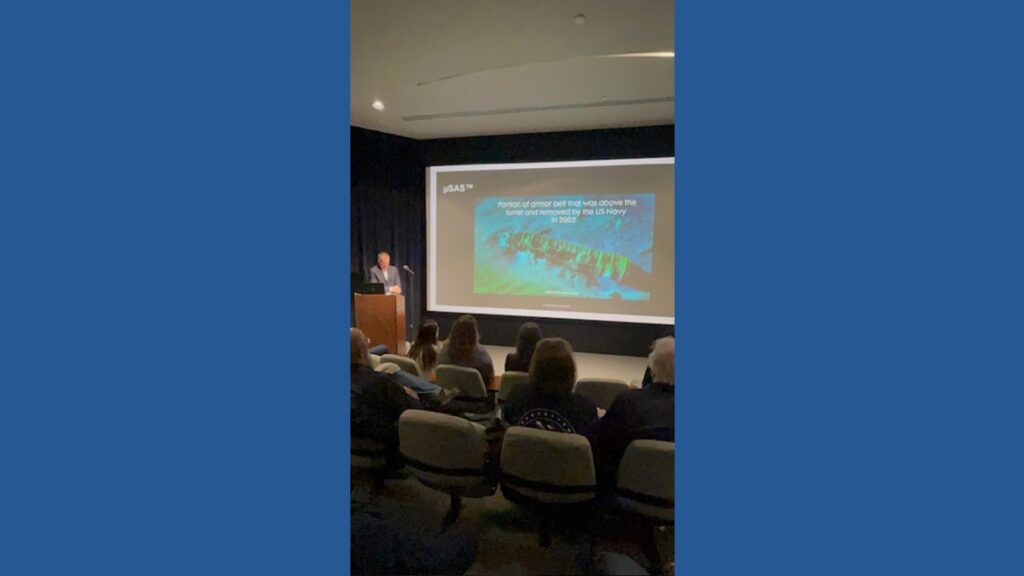
Experts unveiled high-resolution sonar scans of the USS Monitor, captured by cutting-edge underwater technology at the Mariners’ Museum and Parks.
More than 160 years after the historic clash that changed naval warfare, the USS Monitor is still revealing new details about its story.
On Saturday, experts gathered at The Mariners’ Museum and Park in Newport News to unveil never-before-seen high-resolution sonar images of the famous Civil War ironclad. The scans were captured using advanced underwater technology that researchers say could transform the way shipwrecks are studied and preserved.
The announcement came during the museum’s annual commemoration of the Battle of Hampton Roads, the legendary Civil War battle between the Monitor and the Confederate ironclad CSS Virginia.
Now, thanks to cutting-edge sonar imaging, scientists can see the shipwreck in greater detail than ever before.
A New Look Beneath the Ocean
The wreck of the USS Monitor rests roughly 240 feet below the surface of the Atlantic Ocean off Cape Hatteras, North Carolina. Poor visibility and deep water have long made it difficult for researchers to fully document the site.
In September 2025, scientists from the National Oceanic and Atmospheric Administration partnered with engineers from Northrop Grumman and researchers from Stantec to conduct a new survey of the shipwreck.
Using an autonomous underwater vehicle, the team deployed micro synthetic aperture sonar, known as µSAS, to scan the wreck site.
The technology creates extremely detailed images of the seafloor even in dark, murky water.
Jeff Gray with NOAA’s Office of National Marine Sanctuaries says the technology is allowing researchers to see parts of the ship that were previously difficult to visualize.
“When we look at Monitor and these new technologies that Northrop Grumman has brought to us, it’s really showing that inner ship construction that we could see there, that’s the internal framework of that shipwreck,” Gray said.
How the Technology Works
The sonar system used in the survey represents a significant advancement over older side-scan sonar technology.
Kevin Gallagher, a sonar architect with Northrop Grumman, explained that the µSAS system uses advanced techniques to maintain high resolution throughout the scan.
“Micro-SAS overcomes this by using a sophisticated set of techniques, including compensating for vehicle motion to produce very high-level imagery,” Gallagher said. “The resolution that each pixel represents is a half-inch by half-inch portion of the seafloor. The total swath of the imagery is over two football fields.”
That level of detail allows scientists to identify features of the shipwreck and surrounding debris field that were previously difficult to see, including structural components of the hull and objects scattered across the ocean floor.
The survey produced the first fine-scale sonar mapping of the USS Monitor wreck site.
A Ship That Changed Naval Warfare
The USS Monitor is one of the most famous ships in American naval history.
Launched in 1862 during the Civil War, the ironclad warship introduced revolutionary technology, including its rotating gun turret. Its battle against the Confederate ironclad CSS Virginia during the Battle of Hampton Roads marked the first clash between ironclad warships and forever changed the future of naval combat.
Sabrina Jones with the Mariners’ Museum says the Monitor has remained a symbol of technological innovation since the day it was built.
“From its construction to changing the face of naval warfare, to serving as the basis for the largest marine metals conservation project in the world, just a few steps from us,” Jones said.
After sinking in a storm off Cape Hatteras in December 1862, the wreck remained undiscovered for more than a century.
In 1975, NOAA designated the wreck site as the nation’s first national marine sanctuary, now managed as Monitor National Marine Sanctuary.
Artifacts recovered from the wreck, including the ship’s iconic turret, steam engine, and Dahlgren cannons, are conserved and displayed at the Mariners’ Museum in Newport News.
Technology Transforming Shipwreck Research
Researchers say the new sonar images could play an important role in monitoring and protecting the shipwreck site.
By comparing scans over time, scientists can track how the wreck changes due to corrosion, storms, or ocean currents.
Gray says the technology represents a major leap forward in how underwater cultural heritage is studied. “I never could have dreamed about the heights of technology that we’re reaching today,” Gray said. “But where we are now allows us to interpret, study, and manage these shipwrecks, and also use them as tools to share them with the public.”
Inspiring the Next Generation
Scientists also believe the project could inspire future engineers, archaeologists, and ocean explorers.
Gray says bringing together history and cutting-edge technology helps connect students and young visitors to potential careers in science and engineering.
“How are we bringing that next generation of engineers, software developers, archaeologists?” Gray said. “That’s the link we want to make, and this is what technology helps us to do.”
The sonar scans are now being used to create interactive digital models and educational tools that allow people to explore the USS Monitor virtually.
Visitors to the Mariners’ Museum can view the new data through 3-D visualizations and digital reconstructions showing what the ship looked like during the Civil War as well as how the wreck appears today on the seafloor.
History Meets Innovation
Museum leaders say the project highlights how modern technology can bring historic discoveries to life.
The unveiling of the scans took place during the museum’s Battle of Hampton Roads Commemoration Day, which also featured hands-on STEM activities and demonstrations designed to connect visitors with maritime history and science.
By combining historical preservation with cutting-edge technology, researchers say the USS Monitor continues to serve the nation more than a century after it sank.
What began as a revolutionary warship in 1862 is now helping push the boundaries of underwater exploration in the 21st century.
You can visit NOAA’s website for a look at those images.