
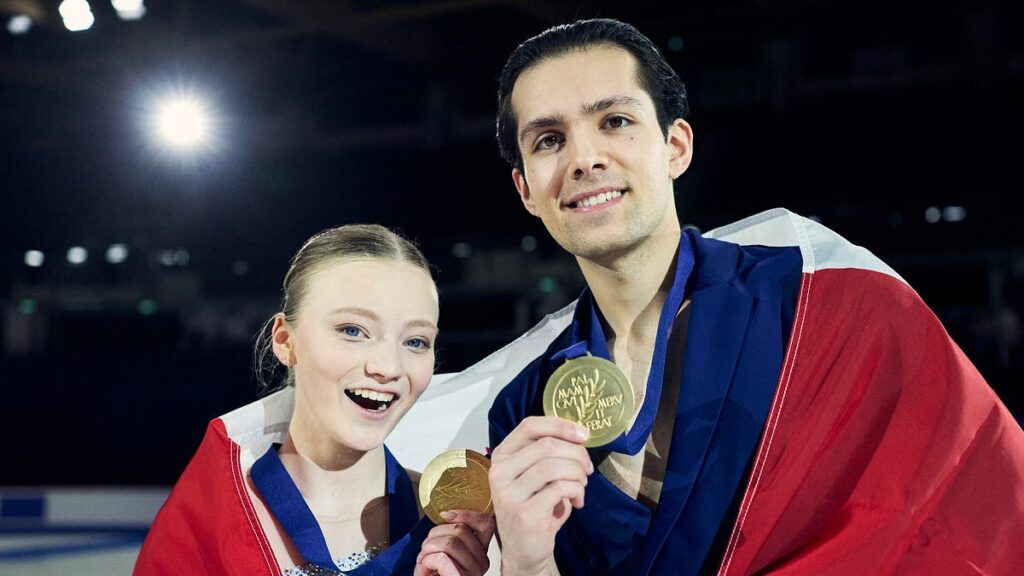
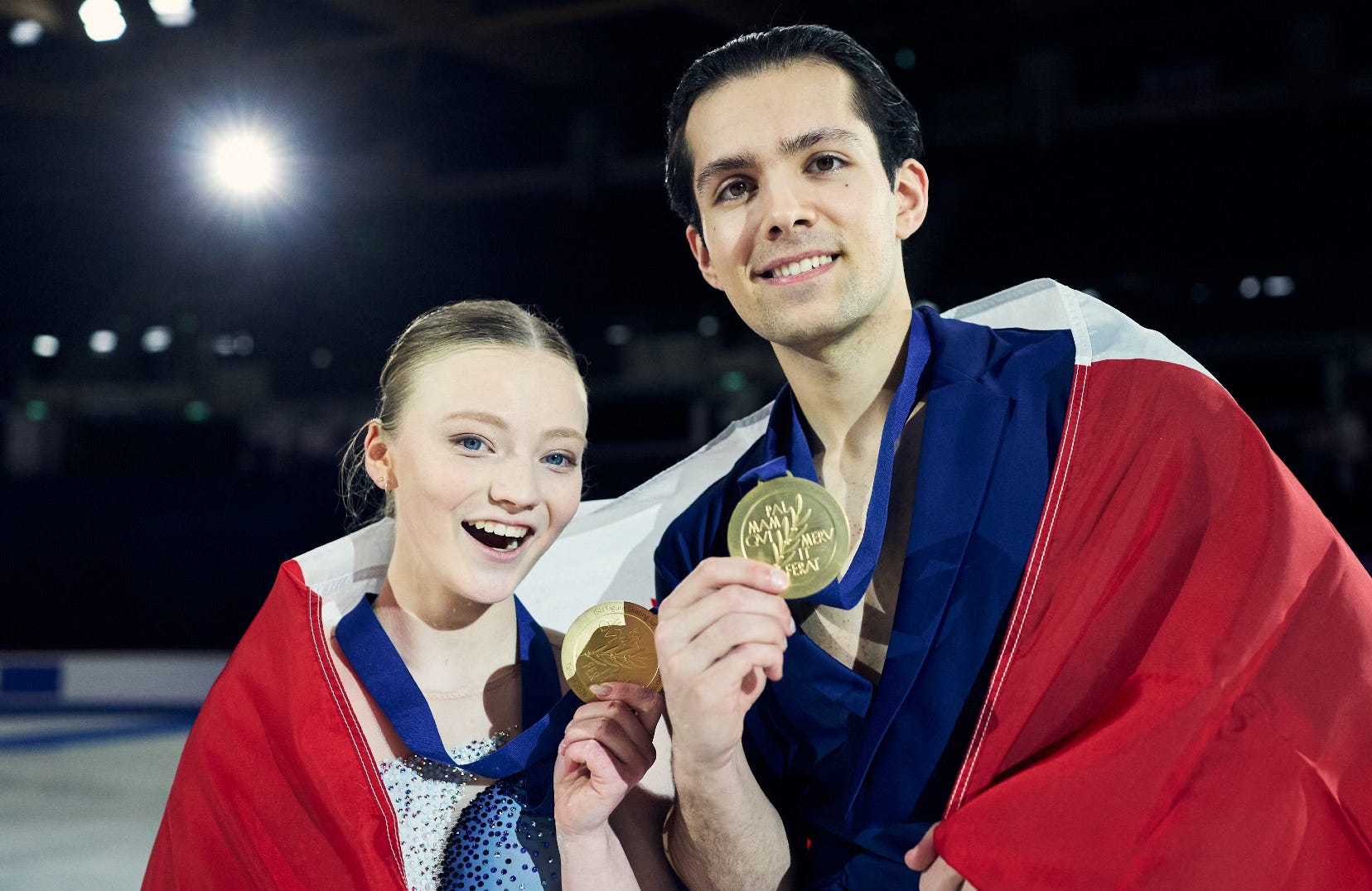
Ava Kemp and Yohnatan Elizarov never had to look far to see the impact a pair of Granite Club legends made on the illustrious history of pairs figure skating in Canada.
It is right there and highly noticeable on a banner that hangs in the venerable skating club in Toronto, where Kemp and Elizarov train under the direction of coaches Kevin Dawe and Lee Barkell. Some inspiration from above, if you will.
“Their (six) Canadian titles and (1984) World title … we see it every day,” the 17-year-old Kemp said of the banner that honours the accolades of Barb Underhill and Paul Martini, the legendary Canadian pairs team that preceded them many years earlier on Granite Club ice.
Now, after a momentous day way across the pond in Tallinn, Estonia, Kemp and Elizarov can say they belong in the same sentence as world junior champions. It is the first time Canadians have taken the pairs title at this global event since 1978, when the great Underhill and Martini skated to gold in this discipline.
Junior Worlds began in 1976 and Canadian pairs won the first three golds, with the competition held in Megeve, France, each year. Since then, there have been seven silver and three bronze medals for Canada in pairs, but a 47-year drought between golds. That all ended on Friday at Tondiraba Ice Hall in Tallinn.
(as a point of comparison, Canada has won pairs gold at the World Championships six times since 1978, four of them this century, the most recent coming in historic fashion from Deanna Stellato-Dudek and Maxime Deschamps two years ago in Montreal).
And yeah, there are some lines to draw between 1978 and now.
“At first, they just told us in the press conference, and that the last team to do it (from Canada) was Barb and Paul,” Kemp said on the line from Tallinn. “We met them earlier this year at an ice show for the Granite and we have a movement in our long program that’s from one of their programs. I have the same birthday as her. There’s a lot of weird connections, so it’s really cool.”
While Underhill and Martini’s greatest accomplishments all happened long before Kemp and Elizarov were born, they’re at least a little bit acquainted with the way their Granite Club predecessors skated.
“Lee has told us to watch their programs, so we watched a couple of their show programs, just as a perspective,” said the 22-year-old Elizarov. “And same with (Ekaterina) Gordeeva and (Sergei) Grinkov. So we know a bit about them, but not too, too much.”
There was even more history in this event in Tallinn. Jazmine Desrochers and Kieran Thrasher skated to the silver medal, marking the first time Canada has ever won two medals in the same event at Junior Worlds. It was another point of excitement for Kemp and Elizarov, who got to watch a pair of Canadian flags soar over the medal podium as ‘O Canada’ played for them.
“I was so happy. We’ve been competing with Jazzy and Kieran for three years, I think, so I was just so happy to be on a podium with them at the end of the year,” said Elizarov. “Both of our seasons have been so long; we’ve come through so much with our injuries.”
Added Kemp: “Even just the past few seasons, all of us have had our fair share of ups and downs. Us being able to be one and two … Canadian pairs has never had that at Junior Worlds. It’s amazing.”
It was apparent right from the start that Canada was going to be front and centre in this event. Desrochers and Thrasher won the short program with a big personal best score of 62.84, which put them 0.62 points in front of their Canadian teammates (who were less than two points away from setting a PB of their own).
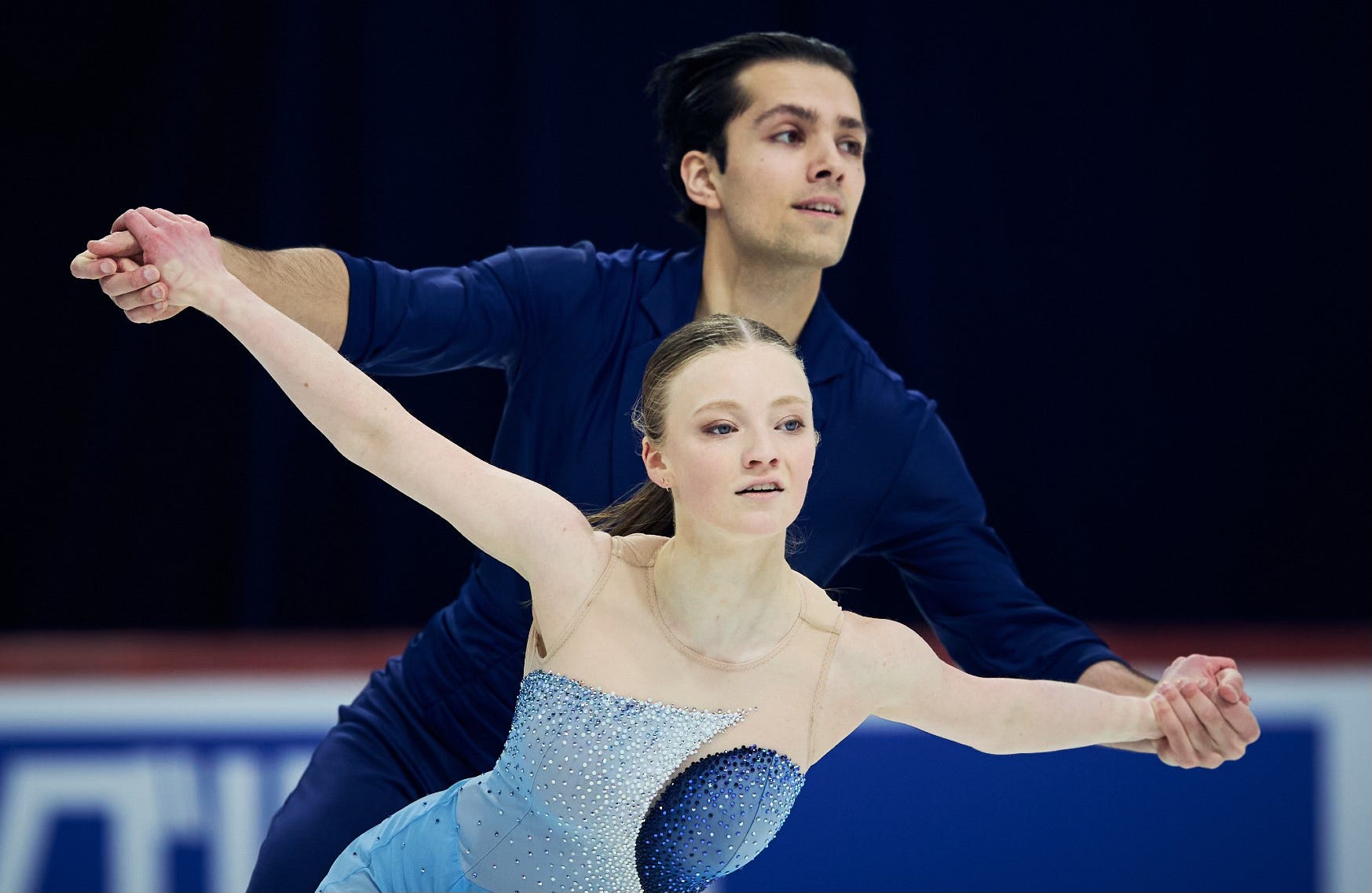
The tables turned in the free skate. Kemp and Elizarov were the first of the Canadians to skate in the final flight (and third of six pairs), seizing the lead with a solid performance to their enchanting “Clair De Lune” long program. But the few errors that were part of the performance led to some anxious moments of waiting for the duo.
“It was such a long three minutes and 40 seconds,” Elizarov said of the wait to see how Desrochers and Thrasher would fare (they were still leading after two other pair teams skated after them).
As Kemp detailed it, “from the time that we stepped on the ice to the time that the final results came out, it was just non-stop stress. Hearing the scores before us, it’s a bit tough because they’re low scores, and we know we’re capable of beating that, but it’s almost like, in a way, there’s another type of pressure where it’s like, okay, we can’t mess up because the door’s open. There’s kind of both sides to that. But yeah, after the skate was equally nerve-wracking.”
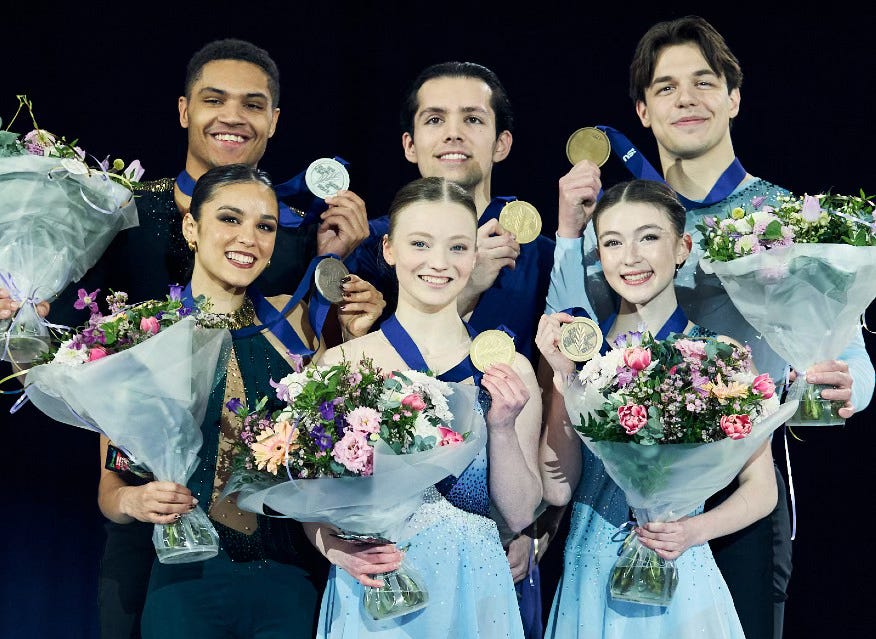
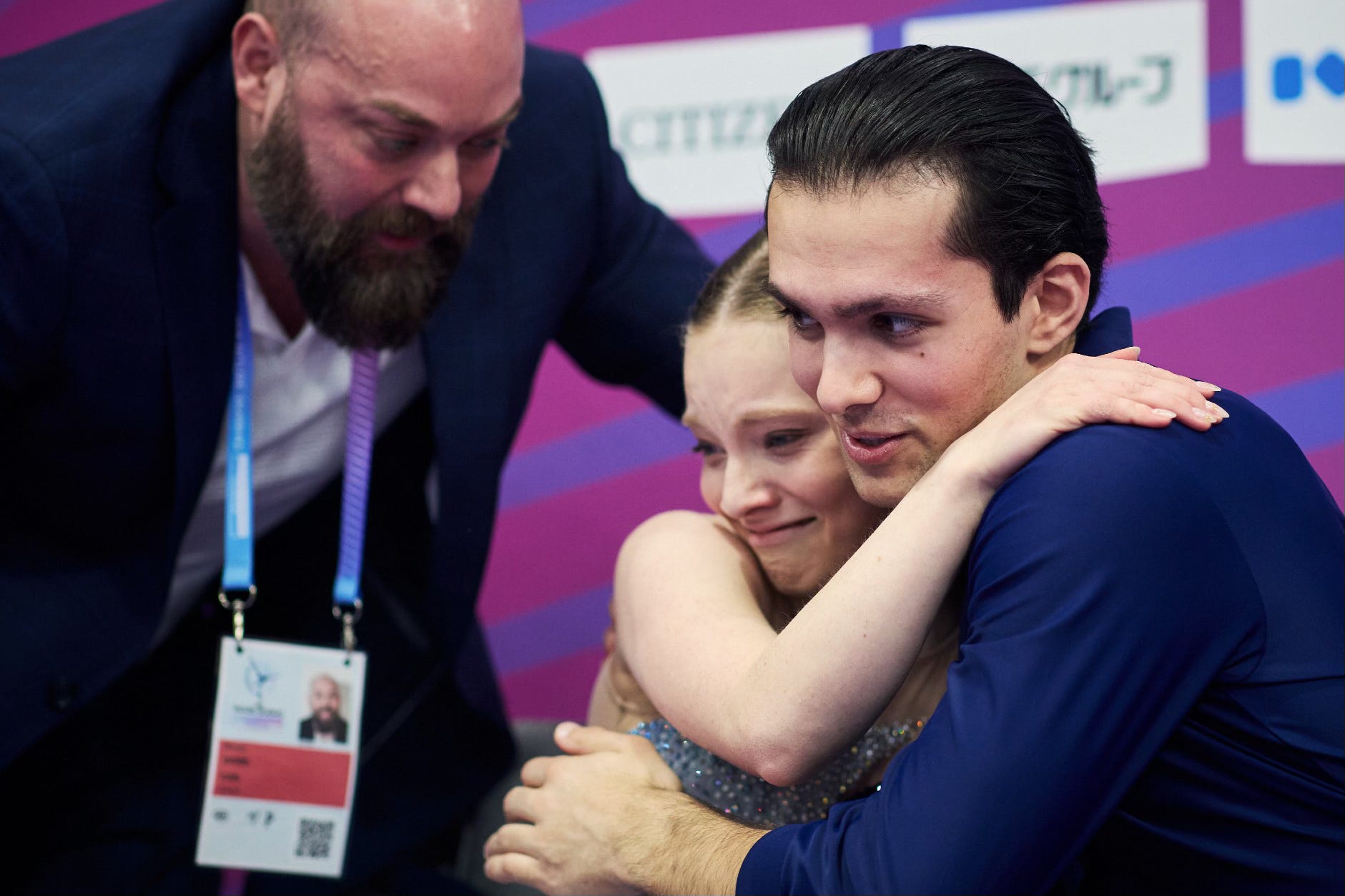
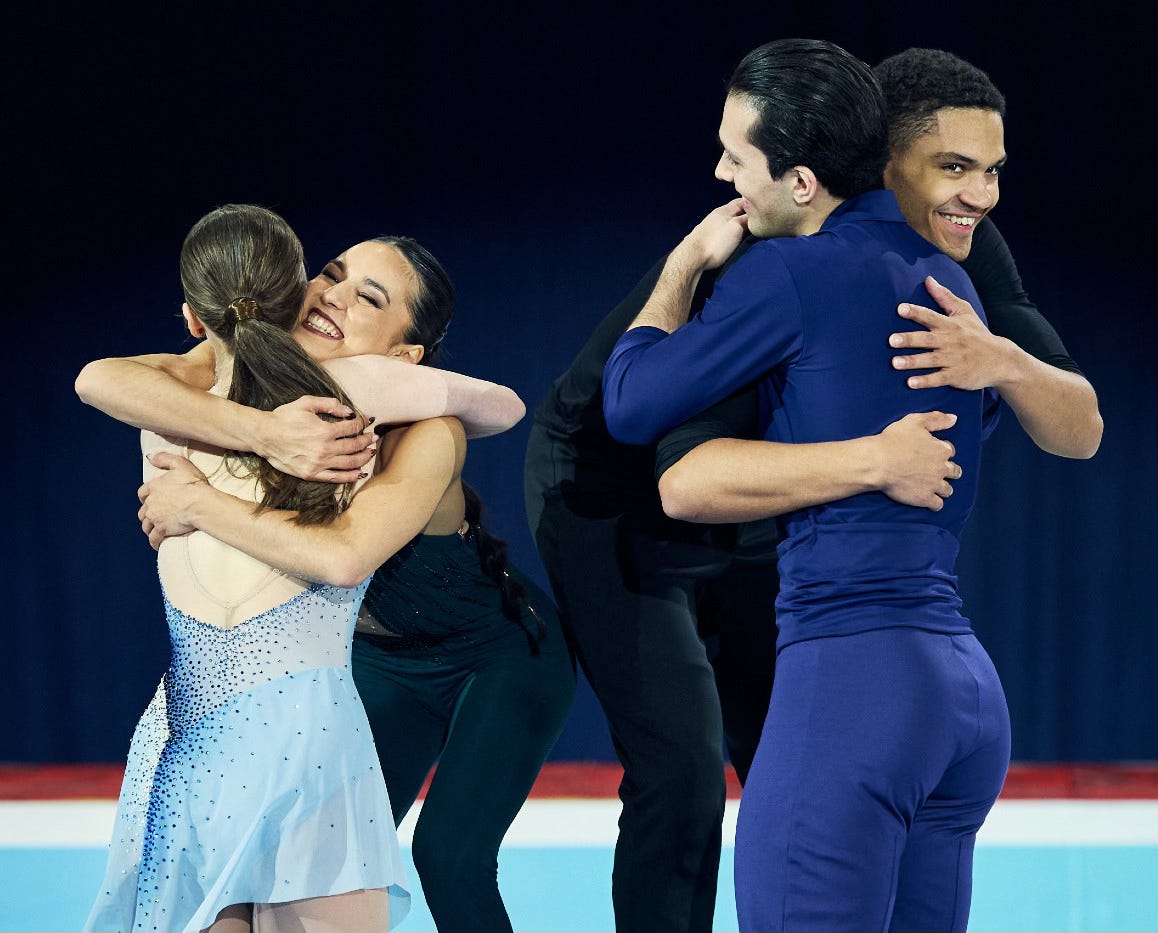
When Desrochers and Thrasher couldn’t top their effort, the celebration was on for Kemp and Elizarov, who shed tears when they knew the gold was officially theirs. Ukraine’s Hannah Herrera and Ivan Khobta moved up after the short to claim the bronze.
“I don’t even know. I was so tired and so stressed for those nine, 10 minutes, I don’t even think I processed it,” Elizarov said in describing his emotions. “I’m like, ‘okay, I guess we’re world champs.’ I started realizing it a couple hours later. It’s like, oh, we won the event. There was just so much going on, so many hugs, just so many people around us. So, yeah, it was hard to process everything at once.”
As they spoke on a WhatsApp call from Tallinn on the day after their triumph, the magnitude of it all still hadn’t fully hit home.
“The event (finished) quite late. It’s just a lot of emotions. We were thinking about our actual skate and not just the results. So, yeah … I don’t even know if it’s fully sinking in yet,” said Kemp. “I think we’re always striving for more, so we’re always striving for the next goal. It feels great and we’re trying to live in the moment and enjoy it, but also look ahead to what our goals are going forward.”
The Winnipeg natives’ winning total in Estonia (167.90) was nearly 12 points shy of their personal best (179.43, set earlier this season at a Junior Grand Prix triumph in Türkiye), but it was enough to outpoint Desrochers and Thrasher by 5.65 points. If there was any sour point about their history making night at Junior Worlds, it was that Kemp and Elizarov didn’t skate as well as they’d have liked.
“It was bittersweet, at least for me. Me and Ava are such perfectionists that we don’t want to win because other people mess up, but because we skated absolutely out of this world, and that’s kind of how we felt in our Grand Prixs (gold medals in Latvia and Türkiye),” said Elizarov. “Obviously we’re happy that we won, but we would have wanted to win with a perfect, clean skate. But you know, that doesn’t happen all the time.
“I think you could tell the last warm-up group, everybody was feeling the pressure. The Chinese team, they had a couple mistakes. The U.S. team had a couple mistakes. The other Canadian team had a couple mistakes. So I think it was kind of like, who can deal with the pressure the best? And that’s what we’ve been working on the last couple of months, especially since the (Grand Prix) Final, and that’s why I think we took the gold.”
Kemp and Elizarov earned a bronze medal at the Final back in December in Nagoya, Japan, and it’s been quite an interesting ride for them since then. Back in January, they placed fourth in their senior debut at Canadian nationals in Gatineau, Que., then it was off to Four Continents, where Kemp and Elizarov finished eighth.
While that competition didn’t carry near the intensity for them as Junior Worlds, it was useful as one last preparation skate.
“We learned a lot from that event, because our team leader was even telling us that we had a different energy to us. Practices, competition …we were just a little more settled and not so tense,” said Kemp. “At the Final, we just seemed so goal oriented, and that was all that mattered, and almost too focused. So he kind of suggested that we try to take a little bit more of that (mindset) from Four Continents into this event, which I do believe really helped.”
The gold medal at Junior Worlds would seem to be the perfect cap to their junior careers, but Kemp and Elizarov aren’t sure they’re quite done at that level just yet (they are age eligible for one more season). It all depends on how things play out in terms of them getting senior assignments next season.
“With senior Grand Prix, we don’t fully have control over that. So if we don’t get events, then we’ll go junior (internationally),” said Kemp. “We’re not going to not skate. It depends how many spots we have for senior stuff, too. There’s a lot of senior teams and we’re still eligible for junior, or we might do both.”
(it should be noted that Kemp and Elizarov have been to Junior Worlds each of the last four years, previously finishing sixth twice and then 10th last year).
There is surely some uncertainty heading into the senior pairs ranks as we begin a new quadrennial in the fall. It would appear the Stellato-Dudek and Deschamps era has come to an end (fellow Substacker Lori Ward pointed out that Deschamps has accepted a coaching job with a Montreal-area club, adding more fuel to that line of thinking).
At nationals in Gatineau, Kelly Ann Laurin and Loucas Ethier weren’t committed in any way toward their future beyond this season (although, to be fair, that’s a standard line for many at that point in the year. More discussions will be had between them, no doubt). A lot will be riding on what happens at 2026 Worlds later this month in Prague, where reigning Canadian champions Lia Pereira and Trennt Michaud, along with Laurin and Ethier, will try to preserve two Canadian pair berths for 2027 Worlds in Finland.
(and if Pereira and Michaud match the kind of skating they displayed at the Milan-Cortina Olympics, that should happen).
All that being said, it’s not difficult to suggest that Kemp and Elizarov should be in line for one of Canada’s three pair berths at Skate Canada International in October. There is always the possibility of a Challenger Series event or two. Add in a Senior B and perhaps skating at the Skate Canada Challenge for another competitive run-through, and that’s filling up the fall season with senior events quite nicely.
Let’s just say that for these two, the road to the 2030 Winter Games in France begins now. And they’re ready to take on that challenge.
“We’ve been junior for so long, and going from ‘let’s medal at Junior Worlds’ to ‘let’s get to the Olympics,’ I feel like it’s a bit of a jump,” said Elizarov (and yes, that’s a bit of an understatement). “We’re going to have to talk with our coaches and set a plan. These last couple of years, we’ve been going year by year (a set plan for growth each season). We might just even now say, let’s set a goal for the next four years instead of taking it year by year.”
Said Kemp: “A goal that we’ve always had is to just keep improving in any way that we can. Even if we’re injured or whatever, we can still improve in certain ways, certain aspects. I think that’s something that’s helped us. We haven’t really plateaued, I want to say, and you don’t want to (do that).”
And what just happened at Junior Worlds is one helluva springboard to whatever comes next. Seeing their names alongside legends for that achievement? Yeah, that’s more than a little bit motivating, too.
“It was, I don’t want to say a confidence boost, but (it shows) we’re going in the right direction and we’re definitely not going to stop here,” said Elizarov. “We’re looking at these next four years to really push, and hopefully by 2030, we’ll have a chance to get to the Olympic team. So I think this just gives us some momentum into next year.”
So, too, does the fact there’s room to grow from Tallinn.
“We’re walking away from this event feeling like there’s more left to give and work on, which is a good thing,” said Kemp. “Sometimes people leave this event feeling like, if they’ve won, that they’re the best and they’ve done it all. It can boost your confidence a little too much. But I don’t think we’re walking away with that feeling.”
The double medal in Estonia is just another exclamation point for the Canadian junior pairs program. This country has been sending multiple pair teams to the Junior Grand Prix Final for several years now — a third Canadian duo, Julia Quattrocchi and Étienne Lacasse, placed ninth in their Junior Worlds debut in Tallinn — and this can only inspire future generations to come.
It’s something that Kemp and Elizarov would like to see happen.
“We have promise, we have a future for sure. You can see the teams coming up. We have lots of novice teams, lots of pre-novice teams,” said Kemp. “When we were competing in novice, I think we competed against three other teams. It was coming right out of COVID, and there was kind of no one coming up, so (we’ve been) building from that.”
Added Elizarov: “We hope to make kind of a domino effect, like Trennt and Lia and Deanna and Max — they kind of inspired me — or Jazzy and Kieran. Then we hope to inspire the novices and juniors to kind of push their way to the top, so Canada will get (more) good pairs going.”
For Desrochers and Thrasher — whose coach, Bruno Marcotte, brought home a bronze medal (with Isabelle Coulombe) from Junior Worlds in 1993 — the medal in Estonia put an exclamation point on a season which saw them earn two silver medals on the Junior Grand Prix series and place fourth at the Final.
“We’re proud to be able to have gone home with a silver medal,” said the 19-year-old Desrochers, per a Skate Canada release. “I think (our free) skate definitely could have been better. We can do better and show better, but overall still proud of the short program we were able to put out and grateful for the experience overall.”
Canada came into the final day of Junior Worlds with a chance to add a third medal, something that would have been unprecedented for the country in this event’s history.
However, it was a case of just falling short for ice dancers Layla Veillon and Alexander Brandys, who wound up in fourth spot after the free dance with a 160.58 total. That left the Canadians a mere 3.74 points shy of the final podium spot held by Iryna Pidgaina and Artem Koval of Ukraine.
“It felt like exactly what we’ve been training for, which we’re really proud of,” Veillon said after their free dance. “We really wanted to push ourselves and I think we accomplished just that and really stayed present in the moment and together, and knew whatever happened we were just going to be proud of what we put out.”
Veillon, 19, and Brandys, 21, who are coached by team led by Scott Moir at the Ice Academy of Montreal’s satellite campus near London, Ont., had placed fifth earlier this year at the Grand Prix Final. They are also two-time Canadian junior champions.
The event in Estonia marked the Junior Worlds debut for Canada’s Summer Homick and Nicholas Buelow, who moved up a spot after the rhythm dance to finish 14th in the final standings.
Two other skaters from Canada, both of them late substitutes, also made their Junior Worlds debuts in Tallinn. With a strong free skate that produced a personal best score of 132.97, David Bondar placed 14th in the men’s event. He also established a new PB with 202.06 overall total.
Among the women, Canada’s Megan Woodley placed 28th in the short program and did not advance to the free skate.