


Vivien Khoo, founder of Web3Women (W3W), fifth from left, celebrates W3W’s official launch with the founding members in Hong Kong in 2023. Courtesy of Vivien Khoo

HONG KONG — Vivien Khoo left Goldman Sachs in 2019 after a 19-year career at the global investment bank. She felt she was too young to retire, yet too old to spend another two decades doing the same job.
So she stepped down from her managing director role and made an unexpected move. She became interim CEO and global chief operating officer of BitMEX, a cryptocurrency exchange that was grappling with a series of regulatory challenges at the time.
Recalling the decision in a recent interview with The Korea Times, Khoo said she wishes she could claim she had long been passionate about blockchain technology and instinctively believed in crypto’s future.
But that was not the case.
Instead, Khoo believed her long career in compliance and regulation made her a strong fit for the role. If she could successfully navigate the transition, she thought she might build a long-term career in the industry.
What struck her most, however, was the isolation. Unlike her years at Goldman Sachs, she found herself with few peers to turn to for advice. She was one of the few women in leadership in the crypto industry at the time. Even more unusually, she came from traditional finance.
At Goldman Sachs, she recalled, mentorship had been embedded in the firm’s culture. Diversity and inclusion were incorporated into key performance indicators, from recruiting and performance reviews to internal initiatives. Spending nearly two decades in that environment, Khoo said, naturally shaped her mindset.
It is perhaps no surprise, then, that after roughly two years at BitMEX, Khoo turned her attention to improving women’s representation in the crypto industry.
The crypto sector remains heavily male-dominated, with women underrepresented in both leadership positions and user participation. Only 13 percent of Web3 startups include a female founder, while just 3 percent of companies have a team made up exclusively of women, according to Web3Women (W3W).
“Women’s representation in financial institutions tends to taper off at senior levels,” Khoo said. “Still, the sector fares better than crypto, where the dominance of technology and trading backgrounds has traditionally limited female participation.”
In 2022, she co-founded W3W, a nonprofit organization that helps professional women transition into and thrive in Web3 by offering mentorship, education and sponsorship. Starting this year, the group is considering narrowing its focus to participants with a deeper long-term commitment, as many of its early members have effectively “graduated” from the program’s initial stage.
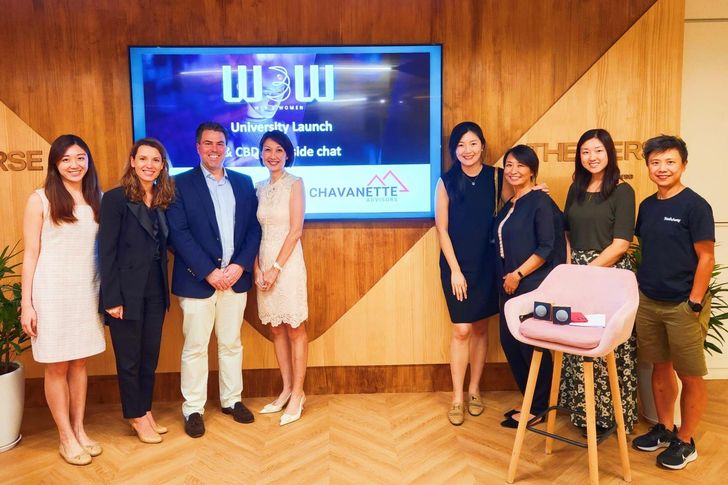
Vivien Khoo, fourth from left, poses at the launch ceremony of W3W University in Hong Kong in 2024. Courtesy of Vivien Khoo
Khoo said she is encouraged to see the industry evolving and becoming more legitimized. Aside from W3W, she holds several other roles, including being a member of the Hong Kong government’s Web3 task force regulatory subcommittee and stablecoin review tribunal.
“When I went in, I kept being told there were only two types of people who went into crypto: either you were on drugs or you were laundering something. If you were neither, then you didn’t belong in the industry,” she said. “At the time, the industry was simply too poorly understood.”
Going forward, Khoo said the industry is likely to see further consolidation as regulators globally move toward greater alignment and standardized rules.
“The industry is definitely moving from what I call an ‘island business’ to a more structured ecosystem,” Khoo said.
She noted that the shift has also changed the industry’s demographic profile. In its early days, the crypto sector was largely driven by younger participants. When she first entered the field, Khoo said she was among the oldest employees at her company, with most colleagues between 17 and 35 years old.
But that is no longer the case. As traditional finance players enter the space, the age range has broadened. Major asset managers such as Franklin Templeton are now involved in tokenization, and crypto companies are bringing in professionals from conventional financial backgrounds — many of whom are closer to her generation.
Khoo offered broader advice for women considering a move into the industry.
First, forget about whether you are female and focus instead on whether you are good at what you do, she said, and try to differentiate yourself in your field. Understand the trends and the technology, and how you can use these tools to advance your career. Do not assume that coding or artificial intelligence are not fields for women, she said.
“I left Goldman in my 40s after almost two decades in a senior role and entered crypto with no prior experience,” Khoo said. “If I could make that shift, anyone can do it.”