
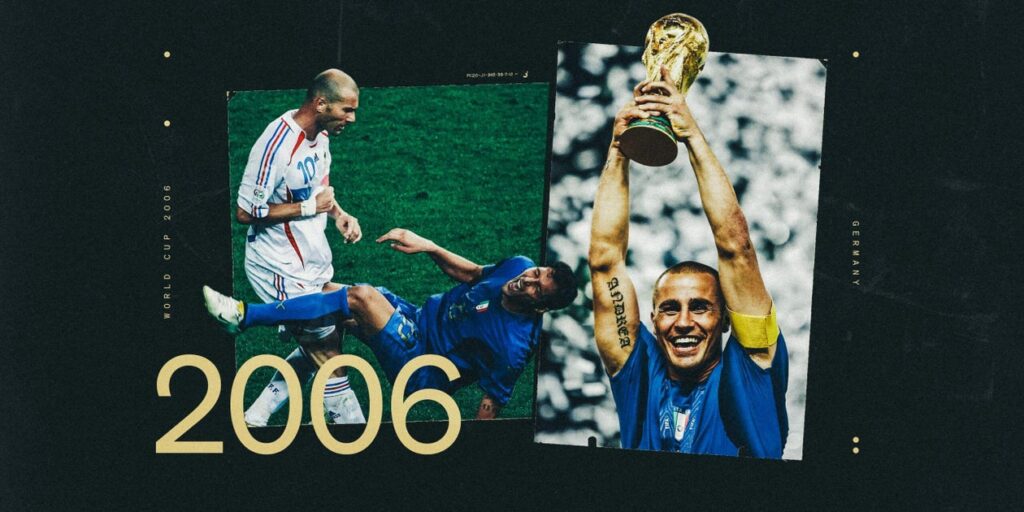
This is the 18th article in a series by The Athletic looking back at the winners of each men’s World Cup.
Previously, we’ve looked at Uruguay in 1930, Italy in 1934 and again in 1938, Uruguay in 1950, West Germany in 1954, before a Brazilian double in 1958 and 1962.
Next came an England success in 1966, another Brazil win in 1970, a second West Germany triumph in 1974, Argentina’s first win in 1978, Italy’s third in 1982, Argentina’s second in 1986, West Germany’s third in 1990 and Brazil’s fourth World Cup in 1994. France joined the party on home soil in 1998 and Brazil celebrated an unprecedented fifth title in 2002.
Now, it’s time for Italy to put a fourth star on their shirts…
Introduction
Italy’s fourth World Cup was won in typical Italian fashion — they rarely win international trophies in great style, but there’s always great drama involved.
This success played out with Serie A, their domestic top flight, in a crisis. The Calciopoli scandal revealed that various club executives had been effectively choosing favourable referees for their teams’ matches.
A complex storyline that was unfolding throughout the tournament, the main sporting consequence was that Juventus were stripped of the previous two years’ Serie A titles and relegated to the second division. Gianluca Pessotto, who had recently retired as a player and was then working in the club’s coaching system, survived a fall from a fourth-floor window at their headquarters. Two of his longtime defensive colleagues, Fabio Cannavaro and Gianluca Zambrotta, flew home from the World Cup to visit him in hospital.
There were some echoes of the Totonero scandal in the early 1980s, which meant striker Paolo Rossi was banned from football for two years, but returned in time to star as the Italians won the 1982 World Cup. In more ways than one, Italy always seem to triumph when on the back foot.
The manager
Marcello Lippi was possibly European football’s most respected tactician at this point. He won five titles with Juventus across two spells, either side of a disappointing spell with Inter, and also won them the Champions League in 1995-96, although he would later lose three times in that competition’s final with the Turin side.
He was a classic Italian coach: a disciplinarian who was highly flexible in terms of formation and marking system. He adapted his systems to suit the players at his disposal, although while a coach such as countryman Carlo Ancelotti tended to focus upon getting the best from his technical players, Lippi was fonder of hard-working, versatile, disciplined foot-soldiers who had stamina and who could nullify opponents.
Lippi played a crucial but relatively low-key role — there were no controversial omissions from the final Italy squad, and he wasn’t particularly known for making big statements in press conferences. He slightly tarnished his legacy by taking charge for a second time, for an ill-fated 2010 World Cup campaign when holders Italy exited at the group stage.
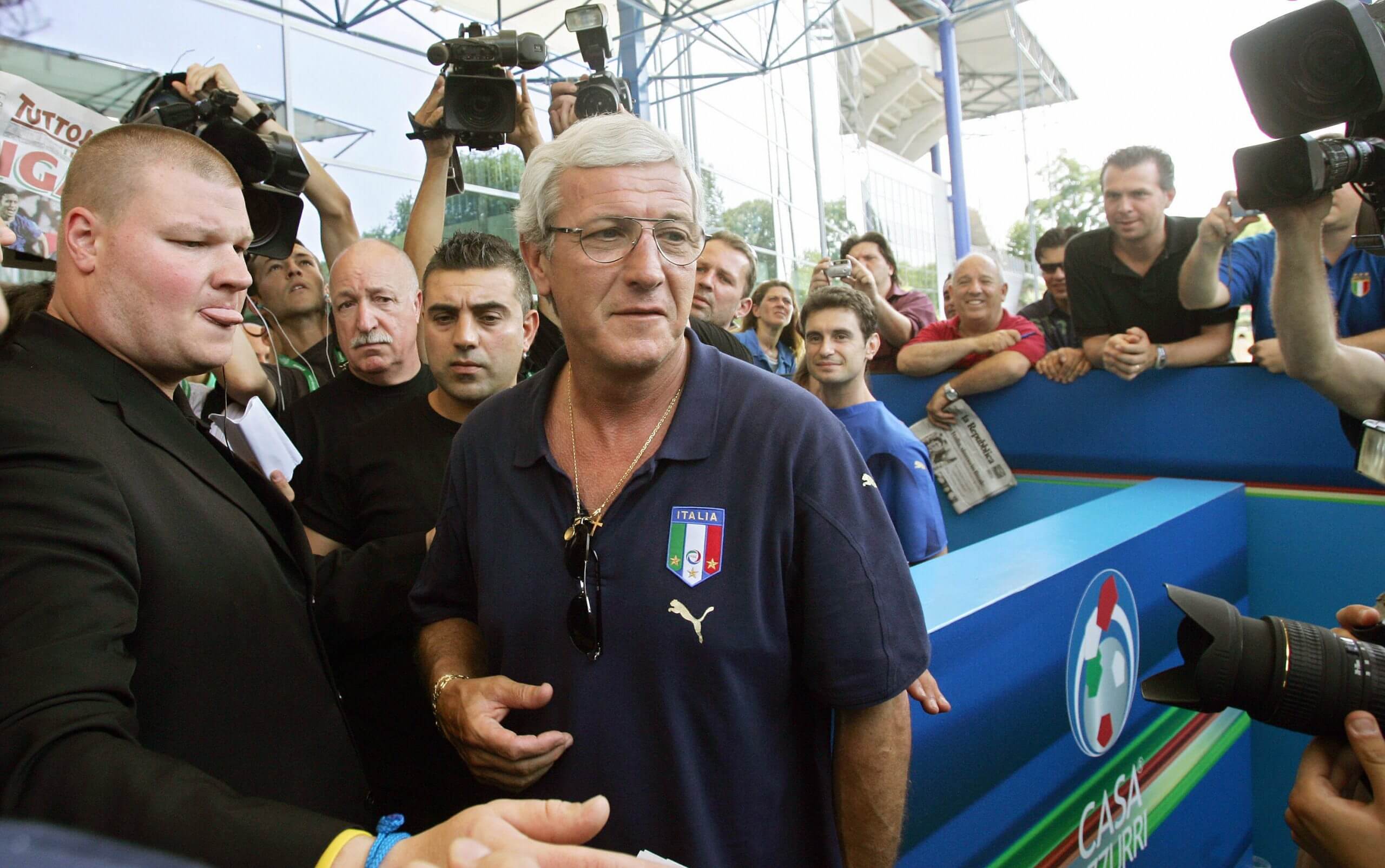
Marcello Lippi was possibly European football’s most respected tactician at the time of the 2006 World Cup (Patrick Hertzog/AFP via Getty Images)
Tactics
Lippi used two systems at the 2006 World Cup. In the early part of the tournament, he switched between 4-2-3-1 and more of an old-school 4-3-1-2, often using Francesco Totti behind two centre-forwards. In the latter stages, though, he exclusively used the 4-2-3-1.
It was a strange 4-2-3-1, because the front four players acted almost as decoys rather than the main attacking threats. Fiorentina’s Luca Toni had just won the European Golden Shoe, and his 31 goals were the most in Serie A for nearly half a century. But he only scored in one match at that World Cup, a double in the 3-0 quarter-final win against Ukraine. The legendary Totti played as the No 10, but was praised more for his work rate than his flair. Mauro Camoranesi was an Argentina-born, hard-working wide midfielder more than a ‘proper’ winger, while England-born Simone Perrotta was usually a central midfielder, but did a job out wide.
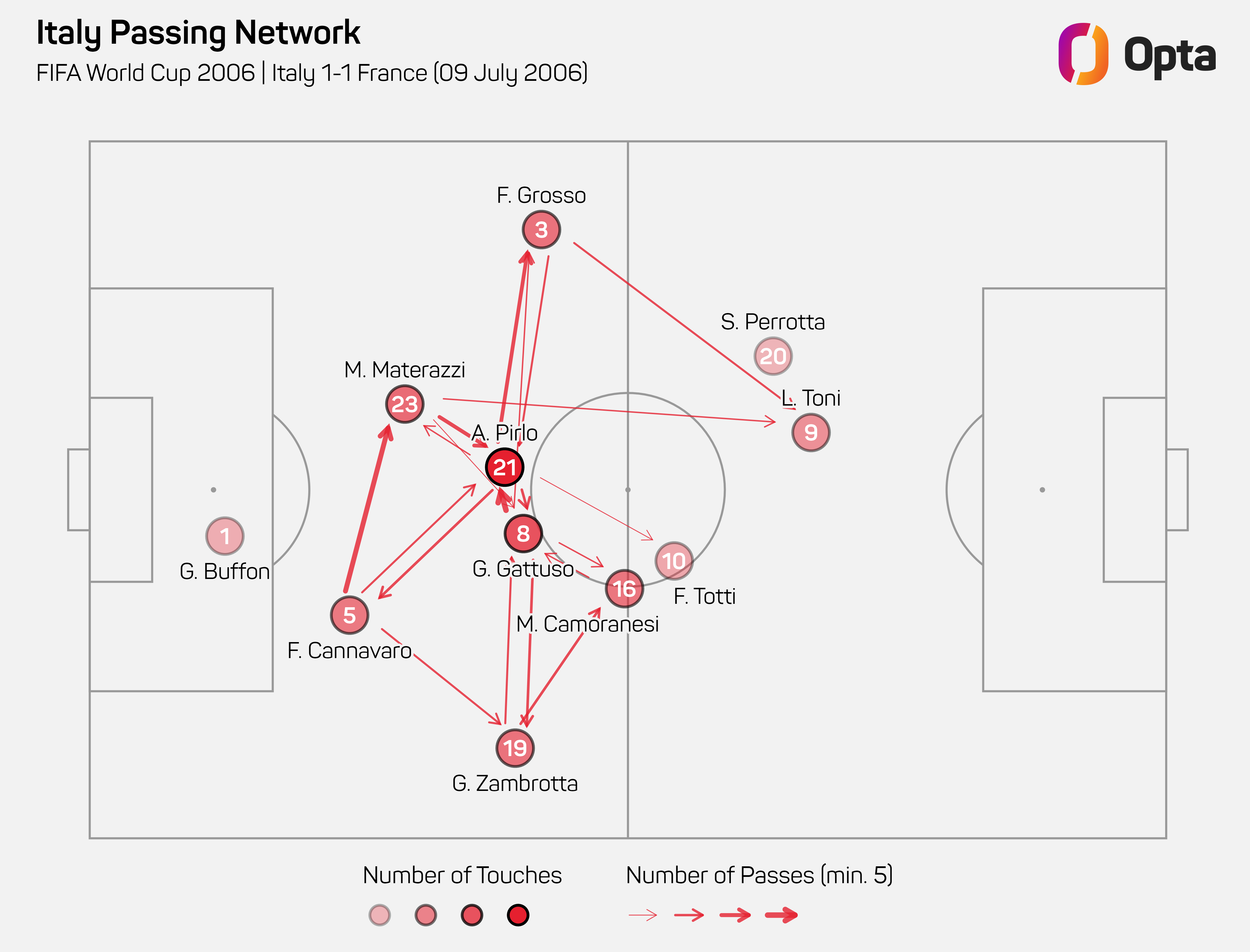
The flair came from deeper. Andrea Pirlo was like no other midfielder in the tournament, a deep-lying passer with incredible vision and technique. Zambrotta was probably the most complete right-back — and left-back, too — in the world at the time, eternally galloping forward on the overlap.
🇮🇹🏆🌍
One of Italy’s 2006 #WorldCup heroes turns 4⃣3⃣ today 🎂
Happy birthday, Gianluca Zambrotta! 🥳#HBD | @azzurri | @Vivo_Azzurro pic.twitter.com/RCHNsOxp8F
— FIFA World Cup (@FIFAWorldCup) February 19, 2020
And while Fabio Grosso had a relatively modest club career, for a month that summer he was world-class. He — to put it charitably — exaggerated contact to win a stoppage-time penalty in a 1-0 victory over Australia in the round of 16. He also scored the crucial late opener against hosts Germany in extra time of the semi-final. And then he smashed home the final’s winning shootout penalty. Few other players’ careers are so dominated by one single tournament.
Italy weren’t spectacular, but they offered control and a fine defensive record. Gennaro Gattuso, the tigerish central partner to Pirlo, epitomised their fight. In seven matches, two of which went to extra time, they only conceded twice: a freak Cristian Zaccardo own goal in the drawn middle group game with the United States, and a penalty in the final against France.
You might be surprised to learn…
Lippi took no fewer than six forwards in his 23-man squad, and all of them scored in the tournament.
In the group stage, Udinese’s Vincenzo Iaquinta got the clinching goal in the 2-0 opening win over Ghana. Milan’s Alberto Gilardino opened the scoring in a 1-1 draw with the United States and his club team-mate Filippo Inzaghi hit the second in a 2-0 defeat of Czech Republic. Then, in the knockout stage, Totti scored a last-gasp penalty to see off Australia 1-0. Toni’s second-half double put the quarter-final beyond Ukraine. Then Alessandro Del Piero completed the set in the semi-final with Germany — more on that later.
Only one Italy player scored in multiple games: centre-back Marco Materazzi, who was a backup coming into the tournament.
Lippi used the right attackers at the right moments. And in that semi-final he ended up with four of them — Gilardino, Iaquinta, Totti and Del Piero — on the field together, having substituted Toni and his two wide players.
Star man
Italy’s best player was surely Pirlo, capable of commanding games and playing penetrative passes into attack. But the symbol of the side became centre-back Cannavaro, largely on the strength of a brilliant performance in the semi-final against Germany, although he also came out on top in an epic duel with Thierry Henry at the start of the second half in the final, when France were on top and Henry constantly threatened to win the game, only to be thwarted by Cannavaro.
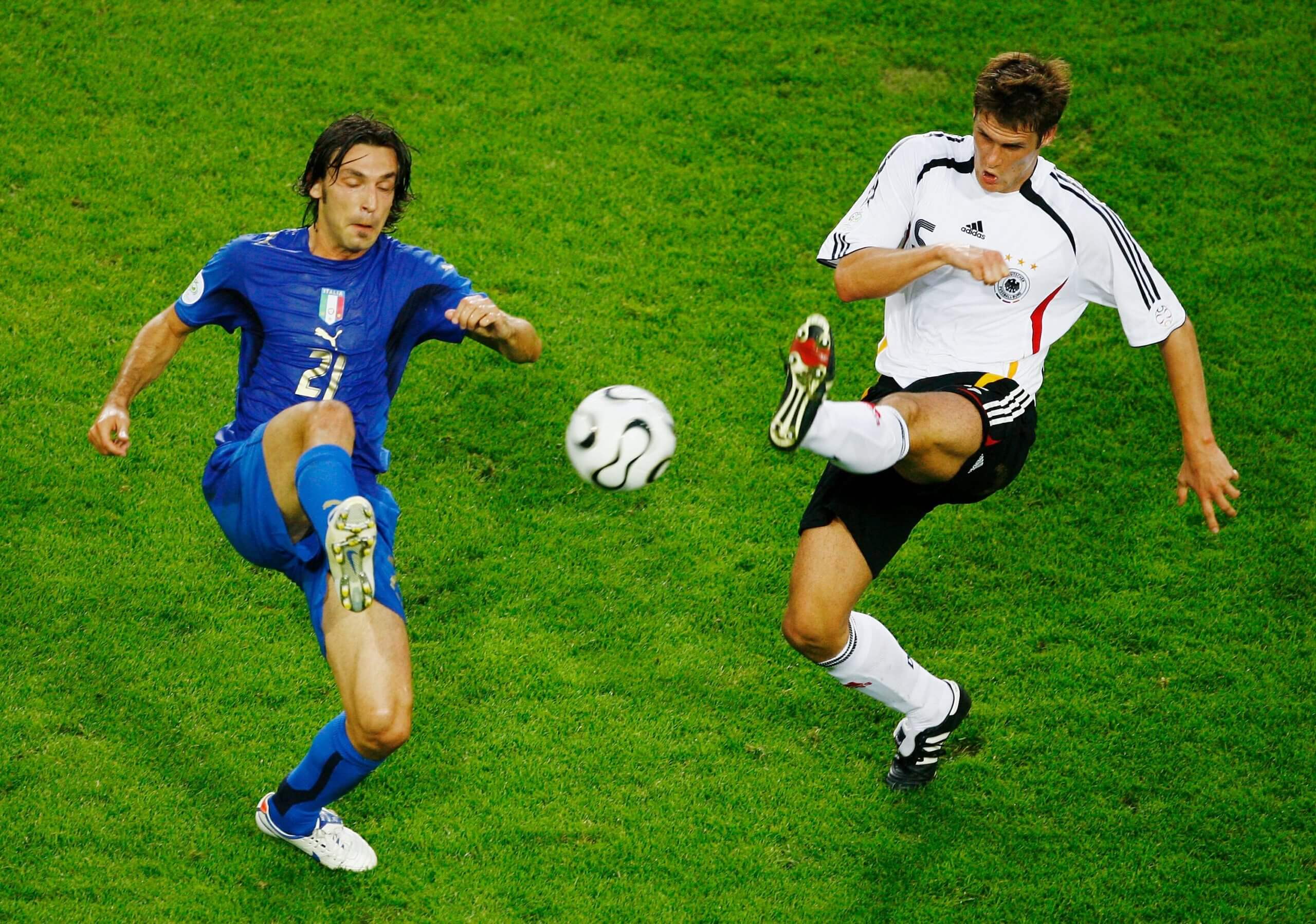
Andrea Pirlo was the creative heart of this Italy side (Clive Mason/Getty Images)
Cannavaro was an unusual centre-back. He was only 5ft 9in (175cm) and wasn’t particularly gifted on the ball compared to later Italian defenders like, say, Leonardo Bonucci. He wasn’t as elegant in his defending as his contemporary Alessandro Nesta, whose 2006 tournament was sadly compromised by injury. But in terms of positioning, reading the game, putting his body on the line and simply being a proper Italian defender, Cannavaro had no equal.
Later that year, he won the Ballon d’Or ahead of Italy’s goalkeeper Gianluigi Buffon, becoming the first defender to win the award in a decade, since Matthias Sammer — who also got the nod on the strength of a tournament, Euro 96, but was a more forward-thinking defender praised for his forays into attack. It’s notable that no defender has topped the Ballon d’Or voting since.
The defining moment
Two truly wonderful World Cup minutes. Italy’s semi-final against the host nation was one of two outstanding knockout games at this tournament, alongside Argentina’s 2-1 last-16 victory over Mexico after extra time. Germany, unfancied going into the tournament, had suddenly put together a decent side and battled their way through to that semi in Dortmund.
And then Italy broke their hearts.
Two minutes from the end of extra time, with the game goalless but nevertheless thrilling, an Italian corner was half-cleared, and Pirlo threaded a clever reverse pass through to Grosso, who responded with an outstanding curled effort, beyond the grasp of Jens Lehmann and into the bottom corner.
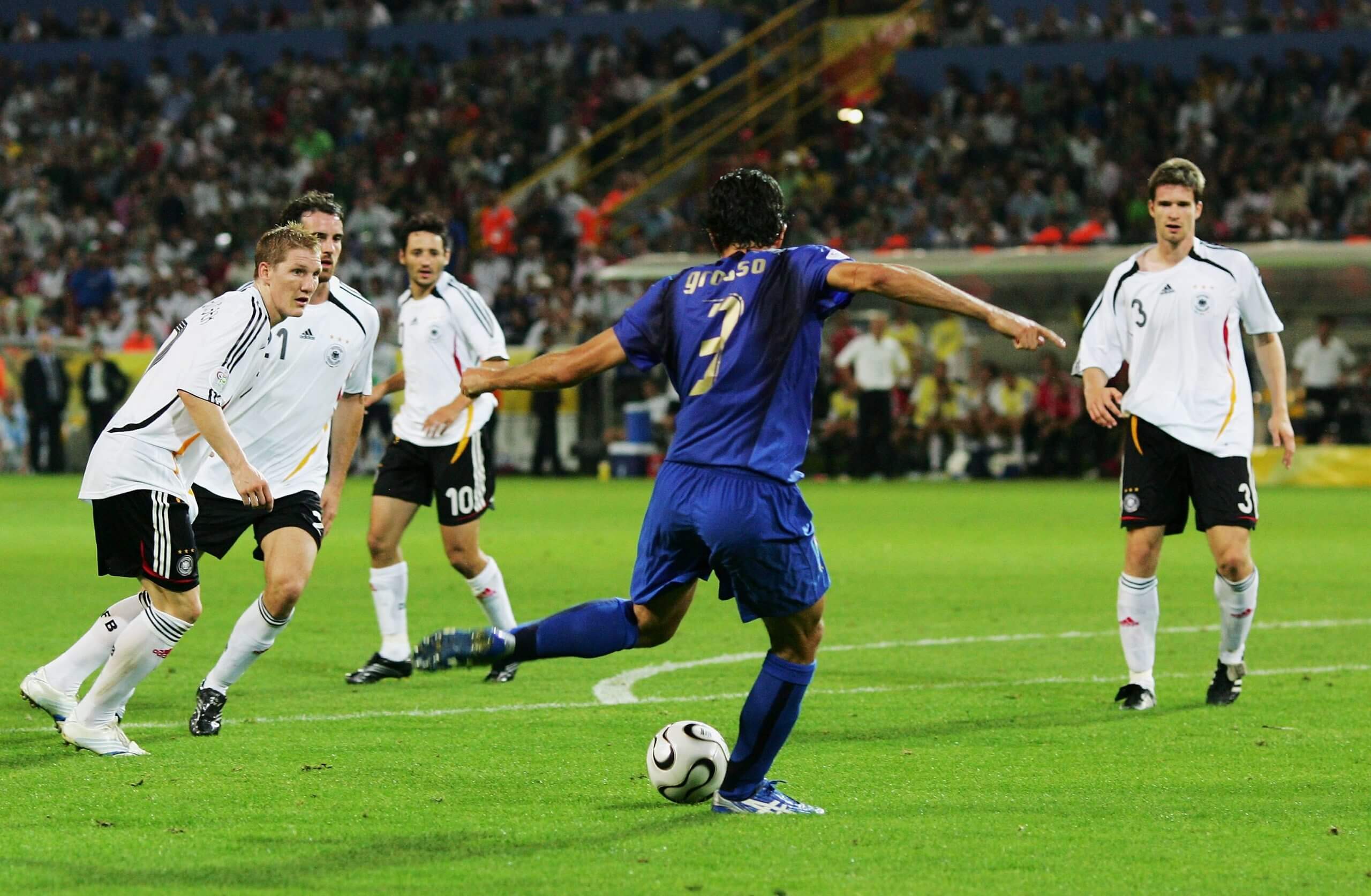
Fabio Grosso gives Italy the lead in extra-time off an enthralling semi-final against Germany (Alex Livesey/Getty Images)
With Germany compelled to throw everyone forward in the final few seconds, Italy hit them with a second.
Cannavaro, high on adrenaline, raced 20 yards out of defence to win a header in midfield. Totti pushed him off the ball, almost telling him to leave the attacking to the four forwards on the pitch. He slipped in Gilardino, who looked like he was about to break past the last defender, Christoph Metzelder, but instead waited, shifted Metzelder inside, opened up space on the outside, and then reversed the ball to Del Piero, who responded with a delicious side foot into the top corner, the final kick of a brilliant match.
#OTD in 2006, @gianluigibuffon made a vital stop vs Germany during Italy’s semi-final triumph! 💫 🇮🇹
Who can remember the scoreline from that day? 👀 @Azzurri | @Azzurri_En pic.twitter.com/uOOliJquLI
— FIFA World Cup (@FIFAWorldCup) July 4, 2022
The final
A hugely memorable contest where the main protagonist wasn’t on the winning side.
Eight years after he was the hero of the World Cup final on home soil, Zinedine Zidane scored a Panenka penalty (just about), brought a superb save out of Buffon with a header, and then memorably headbutted Materazzi in the chest, was sent off, and never played another minute of professional football.
Alternatively, maybe the main protagonist was Materazzi. He was involved in the game’s three main incidents: it had been his foul on Florent Malouda for the penalty. He then equalised shortly afterwards with a header from Pirlo’s corner. And then he provoked Zidane’s final act by muttering some personal abuse to him.
We tend to remember France coming closer to winning the game, because the story was all about Zidane. But Toni headed a corner against the crossbar in the first half of normal time, and then in the second half had a goal disallowed for a very marginal offside.
The moment Italy won the #FIFAWorldCup on this day in 2006… 🇮🇹🏆 pic.twitter.com/Yco1o262o8
— FIFA World Cup (@FIFAWorldCup) July 9, 2025
The idea of Italy winning on a penalty shootout seemed fanciful — they’d been eliminated from the 1990, 1994 and 1998 World Cups on penalties. The only taker who missed was a Juventus player: but a French one. David Trezeguet had settled the Euro 2000 final between these nations with a golden goal. Here, his penalty struck the bar and — unlike Zidane’s in normal time — didn’t cross the line.
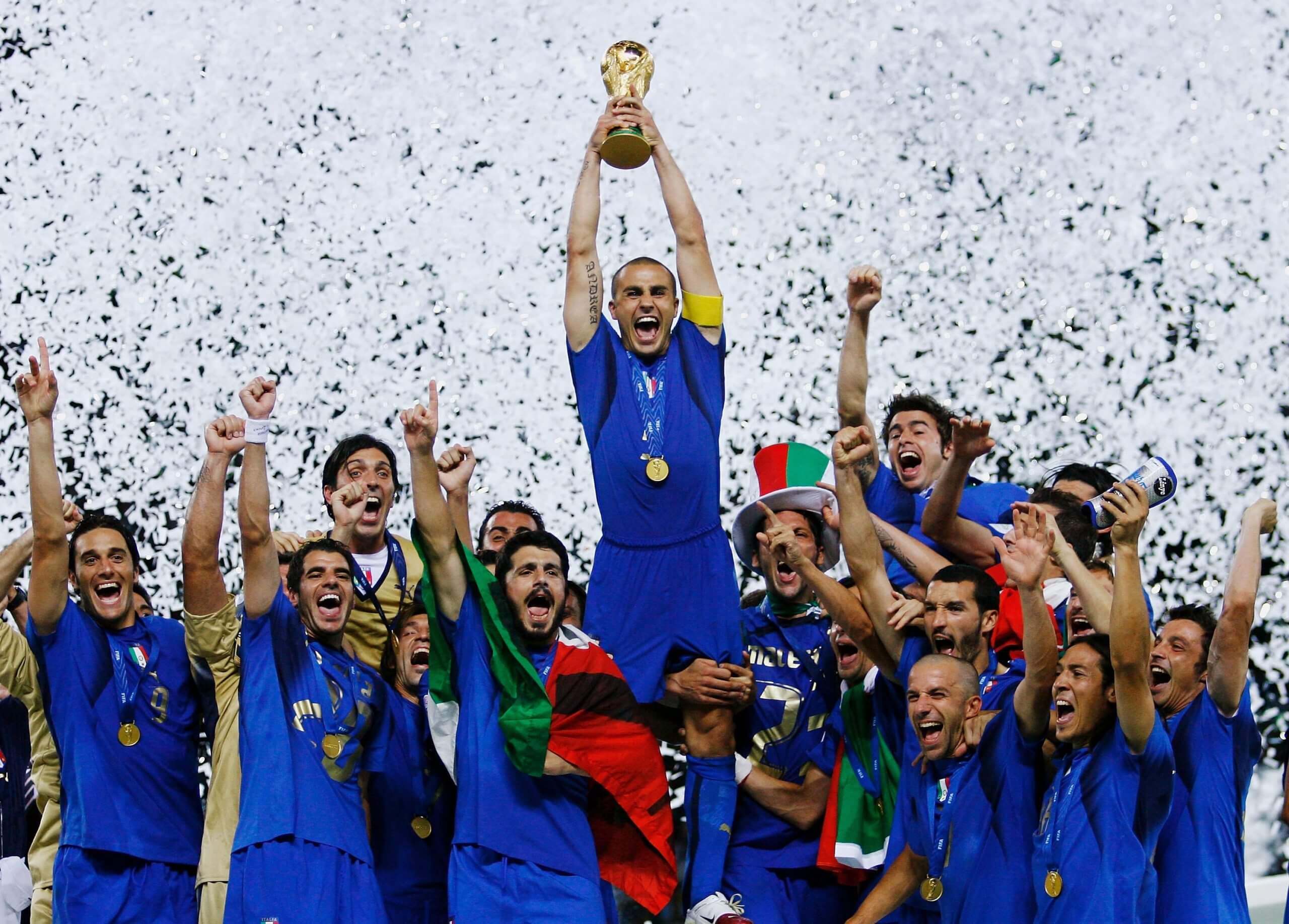
Fabio Cannavaro hoists the World Cup after Italy’s victory. They have not appeared in a knockout game at a World Cup since (Shaun Botterill/Getty Images)
Were they definitely the best team?
This was a memorable success and an excellent side, but it’s difficult to view Italy as all-conquering 2006 World Cup champions. Three of their four knockout-phase victories were that controversial 95th-minute penalty against Australia, a last-gasp extra-time squeeze past Germany, and then a shootout win versus France.
Argentina and Brazil were the most impressive sides going into the quarter-finals before collapsing, leaving an all-European final four. Neither Germany nor Portugal, the other semi-finalists, were particularly impressive.
Ultimately, there was little to choose between France and Italy. It was all about the crossbar: Zidane’s Panenka bounced down over the line, Toni’s header bounced back into play, and then Trezeguet’s shootout penalty bounced onto the line and out.