
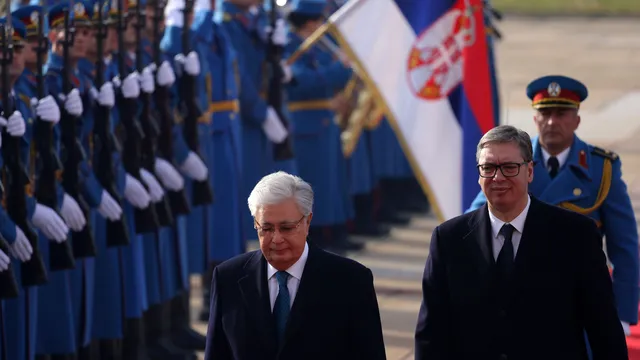
The route that begins in Kazakhstan can end only in Serbia because it is the only country outside NATO connected by railway to the port of Piraeus, the only European port owned by a Chinese corporation.
“I am not ashamed to speak about how I try to learn from you personally and from the people of Kazakhstan.”
This admission was made by Serbian President Aleksandar Vučić on the final day of his visit to Kazakhstan on February 27, addressing his host, President Kassym-Jomart Tokayev.
As far as domestic politics are concerned, it must be acknowledged that Vučić is learning quickly, even though the Kazakh regime remains more authoritarian than the Serbian one. In foreign relations, however, Vučić behaves differently. Instead of making a strategic bet on one of the global players, as Tokayev has done with China, Vučić attempts to be regarded as a potential partner by all the most influential actors — the United States, China, Russia, and the European Union. Serbia is the most pro-Russian and pro-Chinese country in Europe. At the same time, it successfully develops its relations with the United States and the EU. Such tactics have proven effective. Vučić managed to survive mass protests without making any concessions because all the major actors were interested in keeping him in power (or at least had no objection).
Now the situation is changing. The American and Israeli attacks on Iran, and Donald Trump’s threats to escalate military actions, clearly demonstrated that the interests of the United States and the leading countries of the EU can no longer be compatible, at least while the Trump administration remains in power. This means that the United States will intensify pressure on China regardless of European interests. China needs Serbia and will certainly do everything possible to gain economic control over it. The opportunities offered to Vučić in Kazakhstan are the clearest confirmation of such plans.
Serbia and Kazakhstan have always maintained good relations. However, economic ties between them are weak, mainly due to the great distance separating the two countries. Trade turnover between them reached €92 million in 2025. By comparison, the volume of trade between Serbia and China exceeded €6.4 billion in 2024, while trade between Kazakhstan and China surpassed €26.3 billion in the first eight months of 2025.
Despite these modest economic relations, Vučić brought a large delegation to Astana and even opened the Serbian-Kazakh Business Forum. Nenad Popović, minister without portfolio in the Serbian government, stated that Serbia and Kazakhstan currently have an excellent opportunity to diversify trade, expand business ties, and build sustainable economic cooperation. Kazakhstan will invest heavily in Serbian industry and is offering the Serbian government profitable joint projects. China urgently needs a reliable land route to Europe, and Kazakhstan and Serbia are expected to serve as its starting and end points.
The capture of Venezuelan President Nicolás Maduro by the United States, the attack on Iran, and the recent drastic measures against Russia’s “shadow fleet” demonstrate Trump’s strong intention to establish control over maritime routes vital to China’s foreign trade. The main focus of U.S. actions now is the import of Chinese hydrocarbons. Trump has already achieved significant results in this regard. On March 3, Iranian General Ebrahim Jabbari, an adviser to the Islamic Revolutionary Guard Corps, declared the Strait of Hormuz “closed” and warned that all ships passing through it would be burned. This should be considered a major achievement for Trump, who immediately announced that the U.S. Navy would escort commercial oil tankers through the Strait of Hormuz. President Trump promised that “the United States will ensure the free flow of energy to the world.” This means that 20 percent of the world’s daily oil supplies passing through the Strait of Hormuz will either be blocked or delivered under U.S. supervision.
China has invested significant efforts in establishing strong ties with the countries of the Persian Gulf and in organizing their reconciliation with Iran. This has also influenced Kazakhstan’s foreign policy to some extent. If we examine the list of national leaders awarded the Order of the Golden Eagle by Tokayev, we will find only two rulers (before Vučić) who were not leaders of post-Soviet states — Tamim bin Hamad Al Thani, the Emir of Qatar, and Abdullah II, King of Jordan. Qatar is Iran’s main partner in the region, while Jordan is an important ally of Saudi Arabia. The rapprochement between Iran and Saudi Arabia is considered a major achievement of Chinese diplomacy. It began in March 2023, when Iranian and Saudi diplomats met in China and announced the restoration of diplomatic relations between their countries. Jordan, which considers Iran a threat to its national security, has been persuaded through massive Chinese investments not to interfere in the relations between Iran and Saudi Arabia. In April 2025, when Saudi Defense Minister Prince Khalid bin Salman — the brother of the kingdom’s de facto ruler — visited Iran, it appeared that the results of China’s strategy had exceeded even the most optimistic expectations.
King Abdullah II received his “Golden Eagle” from Tokayev two months earlier. It can be assumed that the president of Kazakhstan wanted to demonstrate that his country is helping China in a highly important diplomatic project.
The United States destroyed all Chinese efforts in just two days. In response to the American-Israeli attacks, Iran struck energy facilities in neighboring Persian Gulf countries, including Qatar, Saudi Arabia, the United Arab Emirates (UAE), and Jordan, causing disruptions in oil production. On March 3, Turkish Foreign Minister Hakan Fidan called Iran’s bombardment of the entire Persian Gulf region “an incredibly wrong strategy.” But nothing can be done about it. China has lost the ability to import Iranian oil, and its access to oil from the Persian Gulf countries will depend on Trump for the foreseeable future. The Chinese shipping giant Cosco, which operates one of the world’s largest fleets of oil tankers, announced on March 4 that it had suspended its operations in the Persian Gulf.
Venezuela has halted its exports to China, although the loss has not been compensated by the continuing deliveries to the United States and Europe. After U.S. forces captured President Nicolás Maduro, most Venezuelan oil has been exported by the Singapore-based trading house Trafigura, the Swiss-Dutch multinational company Vitol, and the American producer Chevron, all of which operate with U.S. authorization.
Russia’s Ministry of Transport reported on March 4 that the Russian gas supertanker Arctic Metagaz had been attacked by drones off the coast of Libya and had caught fire in the Mediterranean Sea. The tanker had been used to transport sanctioned gas from the largest terminal in Siberia, Arctic LNG-2, to China. For China, this means that supplies from Russia are becoming unreliable.
At the beginning of April, Trump will visit China. He will attempt to reach an agreement with the Chinese government on his own terms, using every lever of influence he hopes to gain by then. If this does not happen, they will certainly continue pushing to achieve their goals by obstructing China’s foreign trade. If no agreement is reached, this could lead to attempts to disrupt Chinese exports to Europe and Africa.
China has established a land route from its border with Kazakhstan to Turkish ports. Since 2022, the transport capacity of the Trans-Caspian International Transport Route (TITR) has been significantly increased thanks to Chinese efforts.
The route that begins in Kazakhstan can end only in Serbia because it is the only country outside NATO connected by railway to the port of Piraeus, the only European port owned by a Chinese corporation. Thus, the success of the Chinese project now depends on Vučić. Vučić became the first leader of a European country to receive the “Golden Eagle” from Tokayev. This proves the importance of the Serbian president. And this means he will lose his freedom of action, especially in relations with the United States and Russia.
Russia has lost its transit significance due to the conflict with the EU caused by its aggression against Ukraine. However, it will not be interested in the successful functioning of a route that bypasses Russian territory. Trump will not tolerate Vučić’s participation in an important Chinese project, even if his ally Milorad Dodik, the former president of Republika Srpska, continues to support all Israeli military operations. Vučić will have to stop his current tactic of balancing between global players without making a final decision. It will be interesting to see whether he understands this. | BGNES
Analysis by the well-known publicist Dmitry Galkin.