

Bindi Metals is accelerating exploration works at its Ravni gold project in Serbia. Pic: Getty Images
- Bindi Metals is accelerating exploration work at its Ravni gold project in Serbia ahead of planned upcoming drilling
- Early-stage exploration hints at the potential for a large-scale epithermal gold system
- The project lies in a richly endowed mineral belt and just 30km from the 8.6Moz gold-equivalent Rogozna deposit
Bindi Metals (ASX:BIM) has positioned itself at the forefront of Europe’s emerging gold story after securing an earn-in agreement to acquire up to 80% of the Ravni gold project in Serbia.
The project is located within one of Europe’s most richly endowed mineral belts and sits just 30km from the 8.6Moz gold equivalent Rogozna deposit.
Early-stage historical exploration results point to the potential for a large epithermal gold system to be lurking beneath the surface.
Bindi has wasted little time getting boots on the ground since acquiring the project at the tail end of last year.
A wide range of exploration activities has now set the stage for a planned maiden drilling campaign as the company’s gold hunt in Serbia gathers momentum.
Regional perspective
Serbia has emerged as one of Europe’s leading gold and copper jurisdictions, combining strong geological endowment with established infrastructure, a skilled workforce and a supportive regulatory framework.
Ravni itself is strategically located in the Raska mining district.
This fertile geological domain lies within the Kopaonik Metallogenic Zone which forms part of the Western Tethyan Belt – a structure known to host a series of epithermal gold systems, porphyry copper-gold project, and polymetallic deposits.
Among the most prominent is Rogozna, operated by Strickland Metals (ASX:STK) which has seen its market cap surpass $500 million since acquiring the asset in 2024.
Elsewhere along the belt, the Ilovica project in North Macedonia hosts nearly 5Moz of gold and about 1Mt of contained copper.
In northern Greece, Canadian outfit Eldorado Gold is developing the Skouries project, which is expected to churn out 140,000 ounces of gold and 67 million pounds of copper annually once in production.
More broadly, Serbia features a string of standout deposits including the Chinese-owned Cukaru Peki copper-gold project in the Timok belt, which hosts multi-million-ounce gold and significant copper resources.
“It’s the best place to explore in Europe,” Bindi Metals director Henry Renou told Stockhead.
“It’s at surface, it’s easy to drill, there’s a lot of local support, and the technical proficiency of local geologists and survey teams is very good.”
“We think we’re in a good neck of the woods for multi-million ounce potential,” he said.
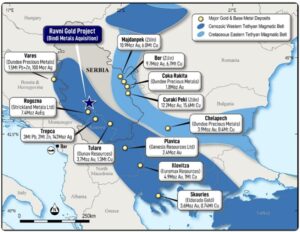
Map showing Western Tethyan Belt and location of major gold and copper projects in Serbia. Pic: Bindi Metals
The Ravni opportunity
Bindi’s tenure at Ravni covers 30km2.
It is interpreted as a large-scale epithermal gold system, featuring strong geological continuity along a 2.5km trend linking the Drenjak and Rujak prospects.
Multiple zones of intense alteration, epithermal textures and historical workings have been mapped across the tenure, defining a string of prospects and highlighting the potential for a significant mineralised system.
For example, surface mineralisation at Drenjak has been mapped over 1.1km. To the south, soil anomalies measuring 1.3km by 1.2km reinforce the exploration credentials.
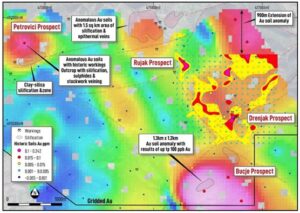
Map showing gold-in-soil anomalies at Ravni. Pic: Bindi Metals
The standout prospect within the licence area is Drenjak, where historical adit and trench sampling defined high-grade gold and broader zones of lower-grade mineralisation.
Here, adit sampling returned an eye-catching 4m interval grading 19.0g/t gold and 39g/t silver. And nearby trenching delivered 5m at 14.9 g/t gold and 12.2g/t silver, including 1m at 35.2g/t gold and 4g/t silver.
These results occur within a broad alteration system that remains largely untested at depth.
Bindi’s recent mapping program reinforced the high-grade potential at Drenjak, with rush assays serving up 48.7g/t gold, 22.8g/t gold, and 5.3g/t gold.
At Rujak, historical channel sampling returned 12m at 0.5g/t gold and 4g/t silver, including 2m at 1.9g/t gold and 5.8g/t gold. Rock sampling also delivered 3.1g/t gold and 11.8g/t silver.
More recently, Bindi’s own rock sampling confirmed high-grade mineralisation at Rujak, returning assays of up to 12.1g/t gold and 181g/t silver.
“At the moment there’s two major outcropping epithermal gold systems, and then we’ve got another three or four prospects which look really promising,” Renou explained.
“Soil anomalies, rock chip mineralisation as well, outcropping alteration over wide zones, and the right host rocks. So it’s all kind of coming together and we’re at the early stages of exploration,” he said.
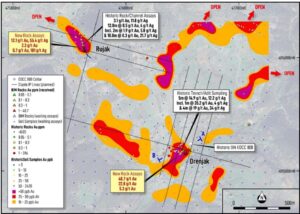
Drenjak and Rujak prospects with historical and recent results. Pic: Bindi Metals
Beyond epithermal gold, the Ravni tenure presents compelling porphyry copper-gold upside.
Past rock and soil sampling at the project identified the potential for porphyry and skarn-style systems, with grades reaching up to 2.5% copper and 0.16g/t gold.
Multi-vein potential
Relogging of historical diamond hole EOCC 808 has also confirmed sulphide-bearing epithermal veining at Drenjak, consistent with mapped surface mineralisation.
Curiously, this solitary hole at Ravni pierced a single vein within what may be a broader stacked vein system at depth, leaving down-dip and lateral extensions untested. However, it was abandoned prematurely for technical reasons.
“It only got drilled to 50 metres and it has intersected one vein,” Bindi Metals managing director Mark Freeman told Stockhead.
“But they never actually assayed it,” he said.
Management added that relogging of the hole identified a 10-12 metre zone of epithermal mineralisation which has now been submitted for laboratory analysis.
In addition, the vein isn’t believed to be the highest-grade vein within the deposit.
“Because the drilling was so shallow, they’ve only intersected the one closest to the drill hole,” Renou explained.
“There’s potentially bigger and better things to be intersected with drilling at the Drenjak prospect.”
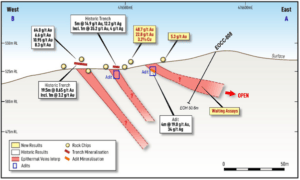
Cross-section showing historical hole EOCC 808 and past exploration results at Drenjak Pic: Bindi Metals
Exploration momentum builds
Bindi’s gold hunt at Ravni is heating up as it implements a comprehensive exploration program in preparation for its maiden drilling.
Field programs have so far included systematic surface mapping, rock chip sampling, regional soil geochemistry, historical data compilation and early-stage drill targeting work.
An initial surface soil sampling program comprising 267 samples was recently concluded across the project area.
It was designed to validate and extend historical high-grade surface results, improve geological understanding of mineralised structures and alteration systems, and support prioritisation of drill targets.
In addition, a regional soil sampling program was completed in early January.
Here, the company collected 746 soil samples with the aim of better defining geochemical anomalies, extending historical soil datasets and testing prospective volcanic and intrusive units across the licence area.
Results from both campaigns are expected in the coming weeks.
Assays from relogging of the historical diamond hole EOCC 808 are also due in the near term.
Separately, the group has mobilised a 10-line kilometre dipole IP survey as it looks to define further drill targets at depth.
The road to drilling
Bindi recently secured regulatory consent from the Serbian Ministry of Mining and Energy for its maiden drill program at Ravni, totalling up to 2500m.
It is now working to conclude land access agreements in anticipation of the program. And the drill bit could be spinning in the not-too-distant future.
“I suspect we should be drilling in second quarter of 2026, all going well,” Freeman said.
In the meantime, upcoming assays from rock chip sampling, soil geochemistry and the relogged historical core are expected to further guide drill planning.
This article was developed in collaboration with Bindi Metals, a Stockhead advertiser at the time of publishing.
This article does not constitute financial product advice. You should consider obtaining independent advice before making any financial decisions.