
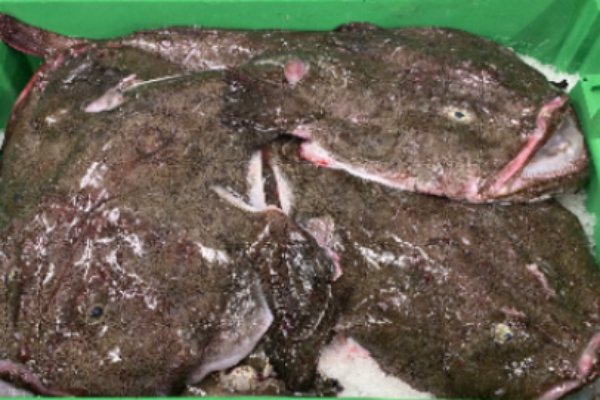
Norwegian fisheries body, Fiskebåt urges government to set a separate monkfish quota south of 62°N as talks begin on joint North Sea management of monkfish and hake.
Norway should establish a separate national quota for monkfish (monkfish) south of 62°N in 2026, according to the Norwegian fishing vessel owners’ organisation Fiskebåt.
The call comes as the European Union, the United Kingdom and Norway begin work on bringing both hake and monkfish under a joint management framework for the North Sea.
In a letter to Norway’s Ministry of Trade, Industry and Fisheries, Fiskebåt argues that Norway must safeguard its interests as discussions begin on how the stocks will be managed and shared between the three parties.
The International Council for the Exploration of the Sea (ICES) provides annual catch advice for monkfish covering the North Sea, Rockall, waters west of Scotland, and the Skagerrak and Kattegat areas. ICES recommended total catches of 30,726 tonnes for 2025 and 30,358 tonnes for 2026.
According to Fiskebåt, the EU and the UK have developed a practice of dividing the entire ICES quota recommendation between themselves. This allocation excludes catches taken in area 3a (Skagerrak and Kattegat) and in the Norwegian zone of area 4 in the North Sea. In return, catches taken by the EU and the UK in Norwegian waters of area 2a and in international waters in areas 5b, 12 and 14 are included, though these catches are believed to be relatively limited.
For 2026, the EU and the UK have already distributed the full ICES-recommended quota of 30,358 tonnes. Of this, 19,387 tonnes were allocated to waters in area 4 and the UK zone of area 2a, while 10,971 tonnes were allocated to area 6 and international waters in areas 5b, 12 and 14.
Recent ICES data indicate that monkfish catches in the Skagerrak and Kattegat have remained around 1,000 tonnes annually between 2020 and 2023, with Denmark accounting for roughly 80% of the total catch.
Fiskebåt believes negotiations on quota sharing between the EU, the UK and Norway are likely to prove difficult, as is the case with many quota allocation issues in the North Sea. The organisation argues that zonal attachment — the share of a stock found in each party’s waters — should be the guiding principle in any future distribution. However, it warns that historical fishing patterns are also likely to play a role in the discussions.
Research conducted by an international working group on monkfish distribution shows that, on average, 21.8% of the stock across areas 3a, 4 and 6 has been located in Norwegian waters between 1983 and 2025. The share in Norwegian waters increases with the size of the fish, according to the findings.
Fiskebåt argues that the current situation effectively allows the EU and the UK to allocate the entire ICES quota recommendation to their own fleets, which it considers unjustified.
The organisation also believes there is scope to ease domestic regulations for Norwegian fishers targeting monkfish. It proposes increasing the permitted bycatch of monkfish when fishing for other species with large-mesh trawls and Danish seines from the current 40% to 49%.
Fiskebåt says establishing a dedicated Norwegian quota south of 62°N would better reflect Norway’s share of the stock and ensure fairer management as trilateral negotiations on joint governance move forward.