
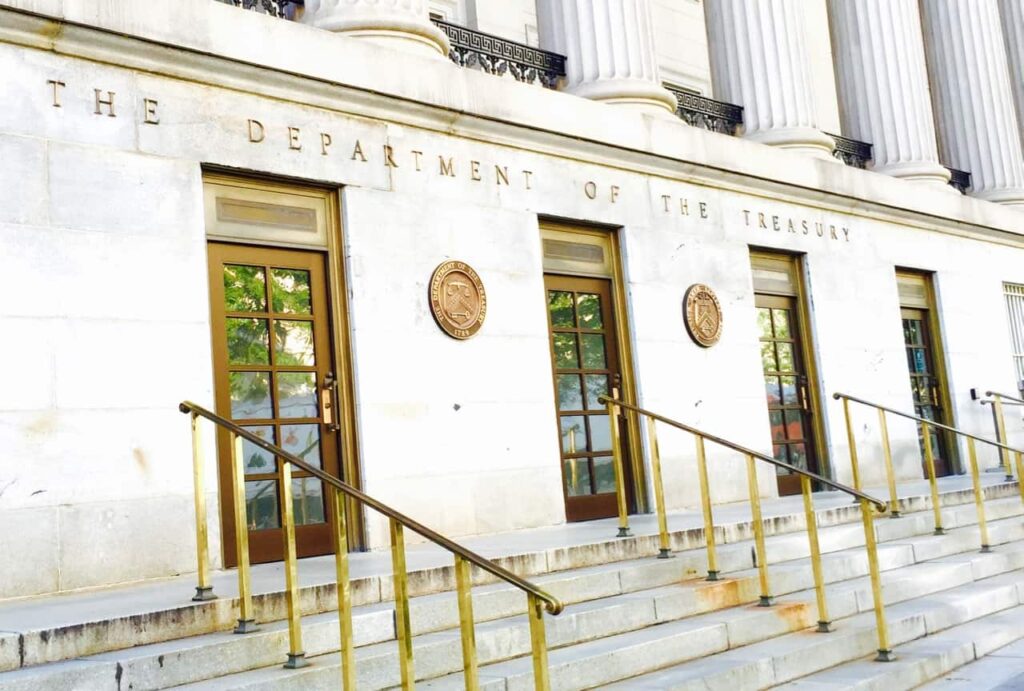
In a policy shift, the US Department of the Treasury has informed lawmakers that certain cryptocurrency mixing tools offer genuine value for safeguarding user confidentiality in everyday transactions.
Submitted under the GENIUS Act framework, the department’s latest assessment to Congress recognizes that individuals and businesses engaging with public blockchains may turn to these services to shield sensitive details—such as personal net worth, corporate transfers, or charitable contributions—from public scrutiny.
As digital currencies gain traction for routine payments, the report notes, users increasingly seek ways to preserve spending discretion in an otherwise fully transparent ledger environment.
Mixing services function by pooling and redistributing assets in ways that break direct links between sender and receiver addresses.
The Treasury draws a clear line between centralized platforms, which already operate under money-services business rules and can share customer data when required, and decentralized alternatives that function without intermediaries.
Notably, the department stops short of endorsing fresh restrictions on the latter category or reviving earlier proposals for mandatory reporting on mixing activity.
This stance contrasts sharply with actions taken just a few years ago, when authorities sanctioned high-profile tools like Tornado Cash amid concerns over criminal exploitation.
Recent court rulings and enforcement adjustments have since softened that approach, reflecting a growing appreciation for the technology’s legitimate applications.
At the same time, the report does not downplay persistent dangers.
State-sponsored actors, particularly those linked to North Korea, continue to route billions in stolen cryptocurrency through layered laundering sequences that frequently incorporate mixing steps.
Treasury data reveals that between early 2024 and late 2025 alone, such groups pilfered at least $2.8 billion in digital assets, often swapping tokens across exchanges, obscuring trails via mixers, and funneling proceeds into stablecoins for easier conversion to cash.
Since 2020, more than $1.6 billion in deposits originating from mixing services have flowed into major cross-chain bridges, with a substantial share tied to sanctioned networks.
These patterns underscore how obfuscation tools, while privacy-positive for law-abiding participants, can complicate detection efforts by regulators and law enforcement.
To address this tension without stifling innovation, the Treasury urges Congress to establish a specialized “digital asset hold” statute.
The proposed legislation would create a legal safe harbor, allowing regulated institutions to temporarily pause or secure assets suspected of illicit involvement during brief investigative windows.
Designed especially for stablecoin transactions that settle almost instantly on-chain, the measure would protect compliant firms from liability while giving authorities time to obtain warrants or complete reviews.
Proponents argue this narrowly tailored authority mirrors traditional banking freeze powers but adapts them to the borderless, intermediary-light nature of blockchain finance.
Beyond the hold mechanism, the report calls for clearer definitions of anti-money laundering responsibilities within decentralized finance protocols, based on each participant’s role and risk exposure.
It also suggests exploring an additional special measure under the USA PATRIOT Act to impose conditions on certain digital asset transfers that evade standard oversight channels.
Analysts see the recommendations as a pragmatic middle path. By formally validating privacy use cases while equipping institutions with targeted tools to interrupt suspicious flows, the Treasury aims to build a regulatory environment that encourages responsible adoption of digital assets.
Lawmakers now face the task of translating these ideas into statute, potentially reshaping how the United States balances individual financial confidentiality against collective security needs in the crypto sector.