
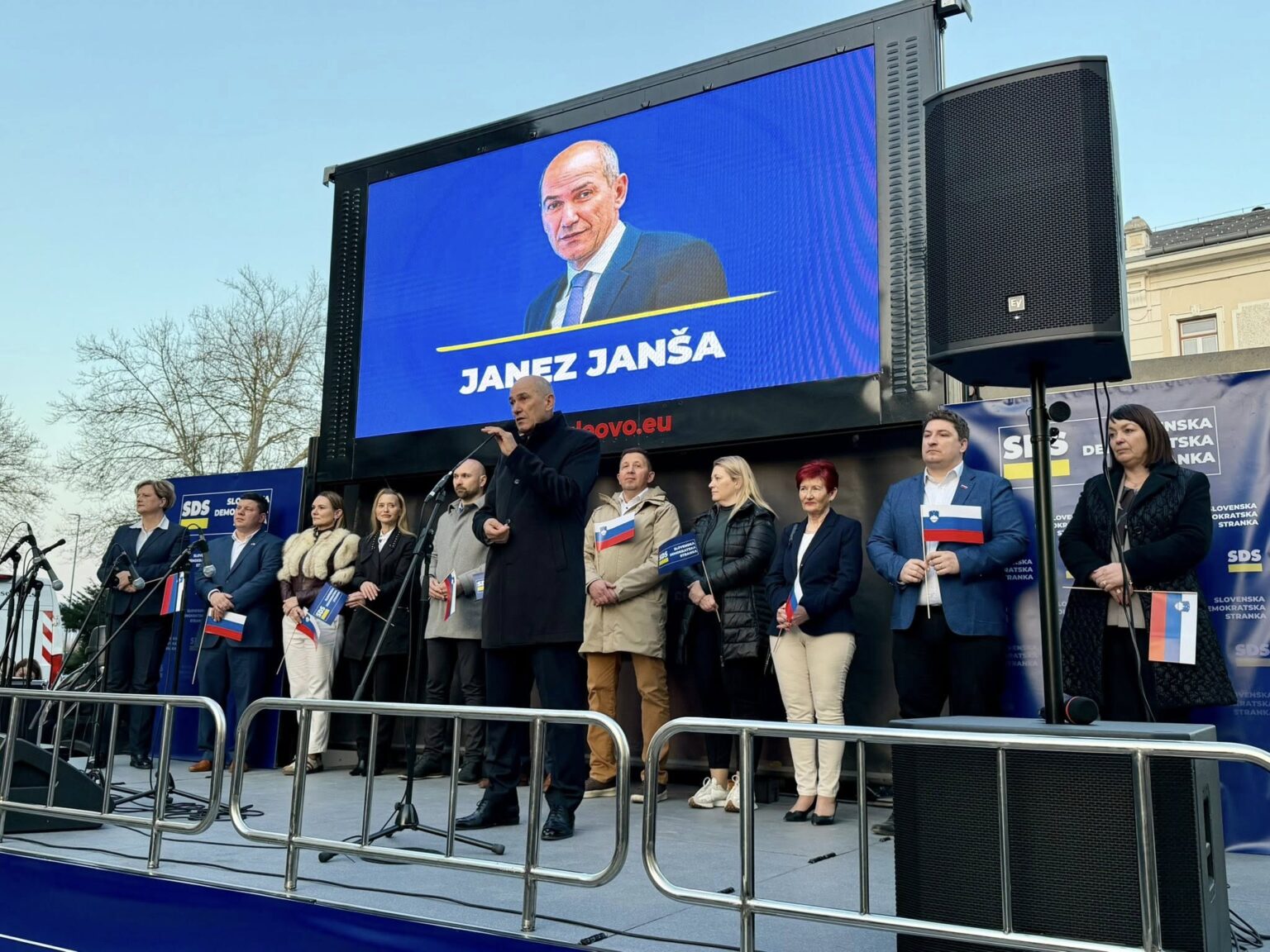
The populist leader Janez Janša, head of the Slovenian Democratic Party (SDS),, a supporter of Donald Trump, often compared to Hungary’s Viktor Orbán, is currently the frontrunner in polls ahead of Slovenia’s parliamentary elections on 22 March.
Recent surveys show his SDS leading with support in the mid-to-high 20s (and occasionally higher), placing it ahead of Prime Minister Robert Golob’s Freedom Movement and other parties in a fragmented field. While coalition negotiations could ultimately decide the government, Janša’s party appears best positioned to claim victory and potentially return to power.
The upcoming Slovenian parliamentary elections represent a pivotal moment for this small but strategically positioned European Union member state of roughly 2.1 million people.
As voters prepare to elect the 90-seat National Assembly, where a majority requires 46 seats, the contest pits the incumbent liberal-left coalition led by Prime Minister Robert Golob against a resurgent right-wing opposition spearheaded by Janez Janša and his Slovenian Democratic Party (SDS). Recent opinion polls consistently show the SDS holding a lead, often in the high 20s to low 30s percent range, while Golob’s Freedom Movement (Gibanje Svoboda) trails in the low to mid-20s.
This shift suggests a potential return to power for Janša, a veteran politician whose style echoes elements of Orbán’s governance in Hungary and aligns with broader populist currents, including strong support for Trump’s approach in the United States.
The race remains tight, with no party poised to secure an outright majority. Coalition negotiations will likely determine the next government, as smaller parties and alliances hold the balance. Golob’s administration, formed after a surprising 2022 triumph that ousted Janša, has governed in partnership with the Social Democrats (SD) and the Left (Levica). Yet support for the ruling bloc has eroded significantly since then, amid perceptions of stalled progress on key domestic issues despite macroeconomic stability.
Janša, who has led the EPP-affiliated SDS for decades and served three terms as prime minister, positions his party as the defender of national interests, economic competitiveness, and traditional values. His close ties to Orbán – highlighted by shared skepticism toward certain EU policies and mutual support in European forums, add a geopolitical layer to the campaign. Speaking to Politico, Golob has warned that a Janša victory would bolster Orbán’s efforts to fragment the European Council, potentially undermining unified EU decision-making on issues like rule-of-law procedures under Article 7.
Domestic challenges fueling the rightward shift
Slovenia’s economy under Golob has avoided major crises but failed to ignite dynamic growth. Inheriting a post-pandemic recovery complicated by energy shocks from the Ukraine war and devastating 2023 floods that affected much of the country, the government maintained steady performance. GDP growth has hovered between 1.5 and 2.4 percent in recent years, above the EU average at times but lacking the vigor of earlier periods. Inflation has eased dramatically from peaks around 8.8 percent in 2022 to 2-3 percent recently, while the labor market shines with unemployment rates near 4 percent – one of the EU’s lowest. Public debt has declined toward 65 percent of GDP, and fiscal deficits have narrowed, signaling prudent management.
Nevertheless, this stability masks underlying frustrations. Productivity gains remain elusive, and the government has struggled to boost competitiveness or attract substantial foreign investment. Opposition voices, particularly from the SDS, criticize high taxes and regulatory burdens, advocating reductions in wage taxation and caps on social contributions to stimulate business and living standards. Healthcare emerges as a particularly potent issue: shortages of medical professionals plague the system, exacerbated by doctors migrating to higher-paying opportunities in neighboring Austria. Controversial policies restricting public hospital doctors from private practice have sparked backlash, contributing to long waiting times and a sense of declining state capacity in essential services.
Social and security debates further tilt the discourse rightward. Tensions involving the Roma minority, highlighted by high-profile incidents and protests, have fueled calls for stricter policing and public order measures. Welfare policies face scrutiny, with proposals to tighten eligibility – such as limiting benefits for those with criminal records, to curb perceived abuse.
Roma community in Slovenia plans protest against seizures of cash social assistance
Migration discussions center less on mass refugee inflows and more on workers from the Western Balkans in construction and services; right-leaning parties emphasize cultural integration, Slovenian language requirements, and national identity. These themes resonate strongly outside urban centers, among older voters, and in rural areas, where conservative support concentrates.
The left’s fragmentation compounds these challenges. While Golob’s Freedom Movement anchors the liberal-progressive side, competing parties like the SD, Left-Vesna alliance, and various greens dilute the vote, often polling in single digits. In contrast, the right has coalesced around the SDS and aligned conservatives like New Slovenia (NSi). This asymmetry makes coalition-building harder for the center-left and enhances the opposition’s efficiency.
Communication strategies and broader European implications
Digital campaigning has amplified the right’s momentum. Right-leaning influencers, podcasts, and TikTok channels dominate online spaces, relentlessly critiquing government shortcomings on the economy, healthcare, and services. This approach effectively reaches younger voters who increasingly source information from social media, contrasting with the more traditional, fragmented efforts of center-left parties. Voter turnout could prove decisive, as older demographics—more reliable participants – lean conservative.
The election’s outcome holds significance beyond Slovenia’s borders. A Janša-led government would likely prioritize sovereignty, economic incentives, and alliances with like-minded leaders, potentially moving closer to American conservatives and figures like Orbán. This could include symbolic gestures, such as relocating the embassy to Jerusalem, while pushing for multi-speed EU integration to bypass perceived gridlock. Golob, drawing from his business background in energy, laments the EU’s slow pace and supports voluntary coalitions of willing states to advance faster on key issues.
Ultimately, Slovenia’s voters face a choice between continuity under a progressive-liberal vision, emphasizing stability, European integration, and social dialogue, and a shift toward a more assertive, populist-right direction. While the elections will not upend Slovenia’s core commitments to the EU and NATO, they could accelerate a broader European realignment, favoring parties that prioritize national priorities amid global uncertainties.
Sources: Siol.net, Politico, EUobserver
Caption: Janez Janša speaks at an election rally in Ljubljana, March 8. (Janša’s Facebook page)
Updated: March 9, 2026 – 12:50