
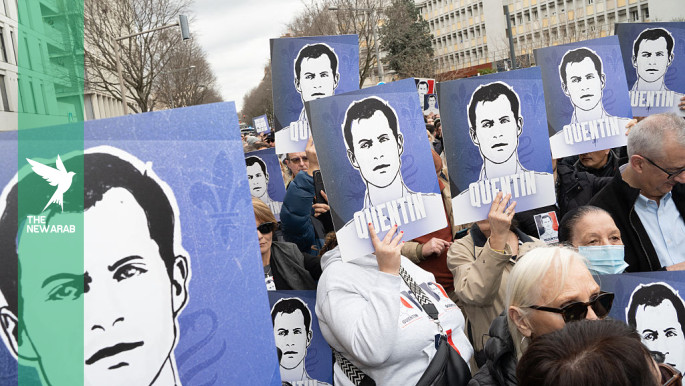
The Deranque case has become especially important in the run up to local elections in March, and indeed the 2027 presidential race, writes Nabila Ramdani. [GETTY]
There is every reason for the French to be remembering Quentin Deranque following his killing in a street attack this month. Video footage shows the 23-year-old ultra-nationalist student being repeatedly punched and kicked by hooded thugs, before he died from a head wound.
The alleged murder in Lyon in mid-February was reminiscent of multiple acts of violence that have always blighted protest movements in France. Opposing groups confront one another, fighting ensues and, inevitably, there are serious casualties, including deaths. This has been going on for centuries – at least as far back as the 1789 French Revolution – and people rightly want it to stop.
Never mind that Deranque was part of an extremist group that wanted to disrupt the visit of a democratically elected MEP to Sciences Po Lyon university. His days should not have ended at the hands of a mob, and that is why people of every background have united in calling for those responsible to be brought to justice.
However, this is where consensus around Deranque’s death stops. While the majority have recognised an unspeakable tragedy, there are plenty of far-right voices who hope it will trigger a mass reaction against their hated enemies, namely the hard left.
What such a view ignores is the racism, Nazi nostalgia and excessively violent nature of the right-wing fanatics now rallying, as they attempt to turn Deranque into a nationalist martyr.
They have capitalised on the fact that some of the seven men currently being held in custody over the Deranque killing are close to the left-wing France Unbowed party (La France Insoumise (LFI)). The party’s current leader, Jean-Luc Mélenchon, wins millions of votes at election time, and is still tipped by some as a future president. Crucially, he is also a key figure in the electoral machinations that, until now, have kept the far-right National Rally party (Rassemblement National (RN)) out of power.
Hence the argument that LFI are now a pariah party, just as the RN was when it was called the Front National (FN). It was founded by the late racist, Holocaust denying army veteran Jean-Marie Le Pen, along with men who had served with Third Reich units during the Second World War.
No moral high ground here
Le Pen Senior himself was a paratrooper and intelligence officer during the Algerian War and was involved in acts of torture in France’s former colony. Referring to the most murderous Nazi units, he once described his role in Algeria as being “a mixture between being an SS officer and a Gestapo agent.”
The FN was regularly linked with lethal street attacks. Beyond Le Pen losing an eye in a fight, one of the party’s biggest scandals came in 1995, when Brahim Bouarram, a French-Moroccan and father-of-two, drowned after being thrown into the River Seine by FN skinheads. This was during a Paris rally attended by Le Pen and his daughter, Marine Le Pen, who remains the RN’s de facto leader.
Madame Le Pen claims to have reformed the RN and, the argument goes, it is now the left who represents the worst kind of disorder, and should thus be demonised.
Those pushing this agenda have ranged from far-right politicians and their media allies to increasingly clownish and malevolent officials at the American Embassy in Paris, where the Trumpian Ambassador is the ex-convict septuagenarian, Charles Kushner.
Kushner has just been boycotted by the French government after failing to answer a summons to the Foreign Ministry in Paris. He would have been asked to explain why his Embassy’s social media accounts had posted: ‘Violent radical Leftism is on the rise and its role in Quentin Deranque’s death demonstrates the threat it poses to public safety’. The Americans even used the word “terrorism” to describe what happened.
Beyond breaking all diplomatic conventions, the posts aimed to discredit anti-fascists whom the Trump administration view as the foot soldiers of the left.
What the posts did not mention, however, is the reality of those organising remembrance marches and other events in honour of Deranque, a founding member of the neofascist Allobroges Bourgoin. Named after an ancient Gallic tribe, the self-styled “national revolutionary” group from Burgundy is made up of white supremacists who fiercely oppose the arrival of dark-skinned immigrants in France.
Allobroges Bourgoin and its supporters have been filmed performing Nazi salutes at marches in honour of Deranque, while racial slurs were shouted out against black people and anyone of Arab descent.
A march in Lyon on 21 February was also marked by xenophobic chants, including “We will take back our country”. Signs with the slogan, ‘Quentin, killed by Mélenchon’s militia’ were stuck on walls, and LGBT people were targeted and abused.
Members of Allobroges Bourgoin have strong links to the RN, not least of all because they see it as the only party with a genuine chance of introducing hard-line measures to clamp down on mass immigration.
Elections
The Deranque case has become especially important in the run up to local elections in March, and indeed the 2027 presidential race, when President Emmanuel Macron will be forced to stand down after serving the two terms allowed by the Constitution. Marine Le Pen is among those who thinks she has a good chance of replacing him as head of state, if she can overturn her corruption conviction and four-year prison sentence. If not, her “lion cub” – as she has referred to her young lieutenant, Jordan Bardella – is likely to be the RN presidential candidate next year.
The RN felt they were on the verge of power before the last legislative election in 2024 but, in the second round, candidates stood aside in order to bolster the “Anyone but the RN” vote. The result was a resurgence of the left and centre in the National Assembly, with the RN winning less than 150 seats in the 577-seat Assembly.

The Popular Front against the far-right was only possible because all parties were willing to work with Mélenchon’s LFI, however. If, as the far-right now hopes, LFI is excluded from the so-called Republican Arc, then the RN could do considerably better.
More than that, the RN claims that the Deranque killing portrays them as civilised and reasonable, in contrast to LFI, which currently has 64 seats in parliament. Les Républicains – the conservative party with around 50 seats – could start openly dealing with the RN, so bringing them further into the mainstream.
This is certainly what the far-right wants but, as more details of the Deranque affair are released, it looks highly unlikely. In such circumstances, the killing of Deranque is by no means the horror that the far-right has been looking for to wipe out opponents. Instead, it has reminded French people of the RN’s grotesque history, and the kind of violent bigots who still support it.
Nabila Ramdani is a French-Algerian Journalist, Broadcaster, Academic, and Author of Fixing France: How to Repair a Broken Republic (PublicAffairs/Hurst).
Follow Nabila on X: @NabilaRamdani
Have questions or comments? Email us at: editorial-english@newarab.com
Opinions expressed in this article remain those of the author and do not necessarily represent those of The New Arab, its editorial board or staff.