
European countries are struggling to coordinate an effective response to the outbreak of violence in the Middle East, with many leaders stuck in meetings as the Strait of Hormuz closure threatens to exacerbate the continent’s energy shortage.
The United Kingdom, Italy, and Germany held a joint conference late Monday to discuss the narrow water passage through which a quarter of all maritime oil trade passes. Transit through the strait has slowed to a crawl since “Operation Epic Fury” sparked a regional conflict that has spilled over from Iran into neighboring countries.
“We’re working with our allies on a range of options to support commercial shipping through the strait as the threat picture develops,” a spokesman for 10 Downing Street told reporters on Tuesday.
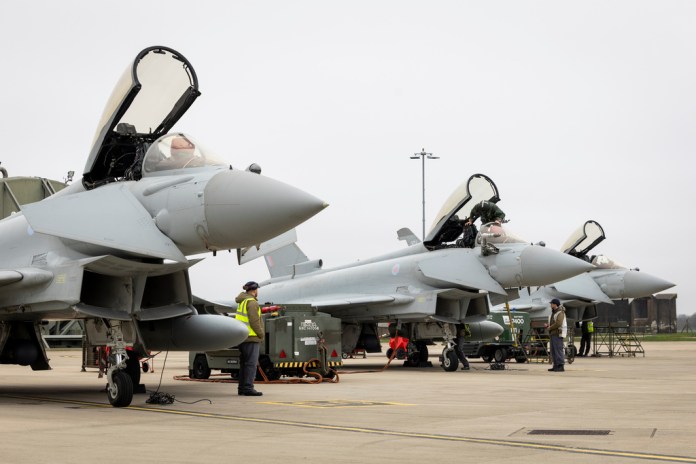 In this photo provided by the U.K. Ministry of Defence, RAF Typhoon aircraft are prepared to depart RAF Coningsby, England, on Friday, March 6, 2026, bound for Qatar to support the defense of British interests and regional allies in the Mideast. (AS1 Shauna Martin RAF/MOD/PA via AP)
U.K. Prime Minister Keir Starmer’s government has simultaneously opposed the attacks on Iran and pledged to defend regional allies — though the deployment of a promised aircraft carrier has yet to materialize.
A read-out of Starmer’s discussion with German Chancellor Friedrich Merz and Italian Prime Minister Giorgia Meloni provided no concrete details either, only stating that the leaders “agreed on the vital importance of freedom of navigation for vessels through these waters” and “agreed to work closely together in the coming days in the face of Iranian threats.”
Europe as a whole enjoys a diversified line-up of oil suppliers, with Norway, the United States, and Kazakhstan making up close to half of its imports.
With 6.2% of imported crude oil and 8.7% of imported liquefied natural gas in Europe passing through the Strait of Hormuz, a long-term closure would not necessarily implode the European energy market. But the continent has already been suffering an energy crunch since well before the Iranian conflict began, inflamed by governments’ pivot away from Russian oil following the invasion of Ukraine. A lengthy halt to ship traffic through the passage could further destabilize global markets and push the continent into an energy crisis.
Damage to regional oil refineries — such as the Abu Dhabi National Oil Company’s Ruwais refinery that was struck on Tuesday — could further contribute to energy shortages.
“Gas prices in Europe have already climbed to their highest level since 2023, though they are still well below 2022 peaks,” the European Council on Foreign Relations said in a report on the conflict. “The intensifying crisis could revive calls in some European capitals to pause the [European Union’s] push to end fossil-fuel imports from Russia.”
Russian President Vladimir Putin has noted the difficult position Europeans find themselves in and reminded them of his country’s capacity to export.
“If European companies and European buyers suddenly decide to reorient themselves and provide us with long-term, sustainable cooperation, free from political pressures, free from political pressures, then yes, we’ve never refused it,” Putin said. “We’re ready to work with Europeans too.”
EU Council President Antonio Costa told EU ambassadors in a speech on Tuesday that Russia is the “one winner in this war.”
“It gains new resources to finance its war against Ukraine as energy prices rise,” he explained. “It profits from the diversion of military capabilities that could otherwise have been sent to support Ukraine. And it benefits from reduced attention to the Ukrainian front as the conflict in the Middle East takes centre stage.”
French President Emmanuel Macron appears to be the only European leader attempting to seize the moment and cement his nation’s place as the tip of the spear for the continent’s response — despite his outspoken agreement with President Donald Trump’s critics that “Operation Epic Fury” amounted to a violation of “international law.”
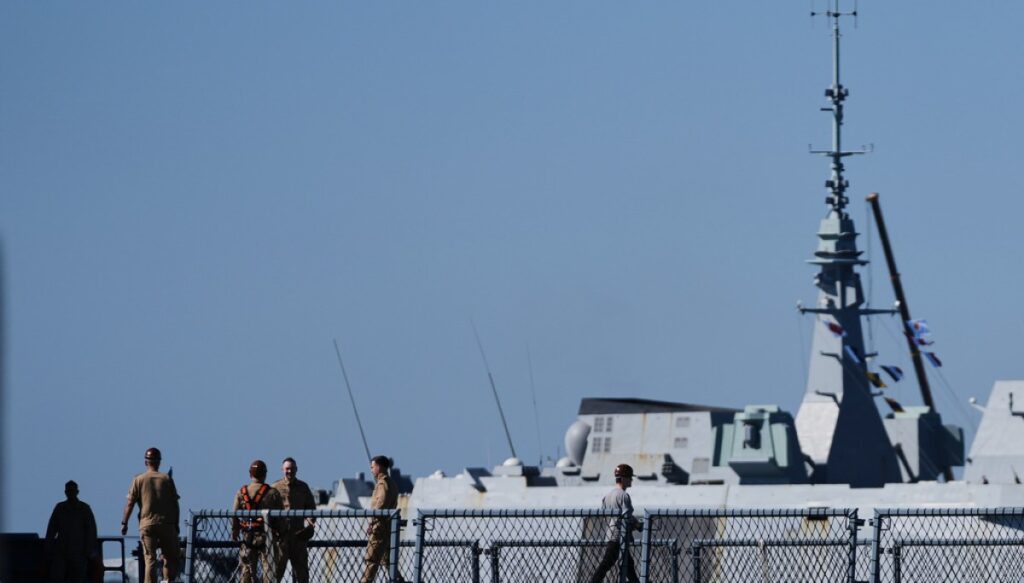
French aircraft carrier Charles de Gaulle was deployed to the region last week, flanked by approximately a dozen smaller naval vessels. That group of ships was in Crete, Greece, on Tuesday, on its way to Cyprus, where Iranian missiles struck a British base on March 2. Another French frigate is currently docked in Crete, with the intention of sailing on to the Middle East.
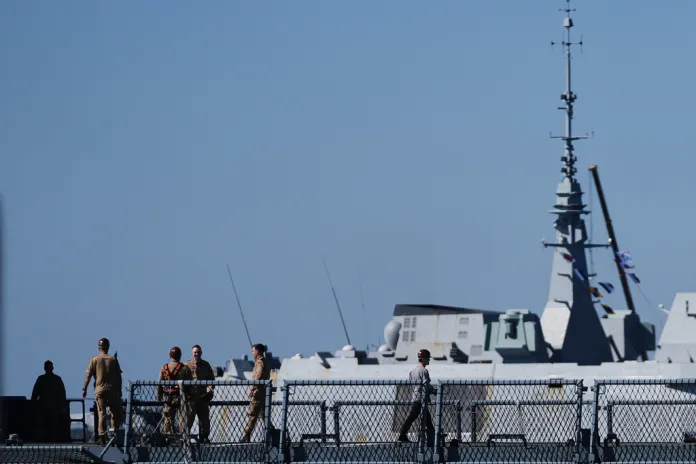 A French frigate enters the port behind sailors walking on the German UNIFIL ship FGS Nordrhein-Westfalen docked at the port of Limassol, Cyprus, Tuesday, March 10, 2026. (AP Photo/Petros Karadjias)
But even Macron is wary about becoming entangled in the hot war, asserting that the operations are entirely “defensive” and promising only that French vessels will be prepared to escort oil tankers through the strait once the “intense phase” of the conflict is over.
“We are establishing a mission that is entirely defensive and supportive in nature,” Macron said Monday from a base on Cyprus. “Once the most intense phase of the conflict subsides, this mission will provide escort to container ships and tankers and progressively reopen the Strait of Hormuz. This is vital for international trade and for the transit of gas and oil from the region.”
The U.S.’s role in the initial assaults that provoked the Islamic Regime remains deeply unpopular with the European ruling class and the Gulf monarchies caught in the spill-over of Iran’s spray-and-pray response.
Belgium has committed itself to sitting out of the conflict with Iran, promising to deploy military assets only if called upon to aid allies. Spain similarly firmly opposes the conflict, having previously refused to let the U.S. military use its bases to stage the initial attacks.
IRANIAN NATIONAL SECURITY CHIEF THREATENS TRUMP: ‘BE CAREFUL NOT TO GET ELIMINATED YOURSELF’
The Islamic Revolutionary Guard Corps has sought to use this resentment as a wedge, offering to reward those Western-aligned nations that rebuke the U.S. and Israel.
The Guard announced that, beginning Tuesday, any European or Arab country that expels its U.S. and Israeli ambassadors will be provided with “full right and freedom” to use the Strait of Hormuz.